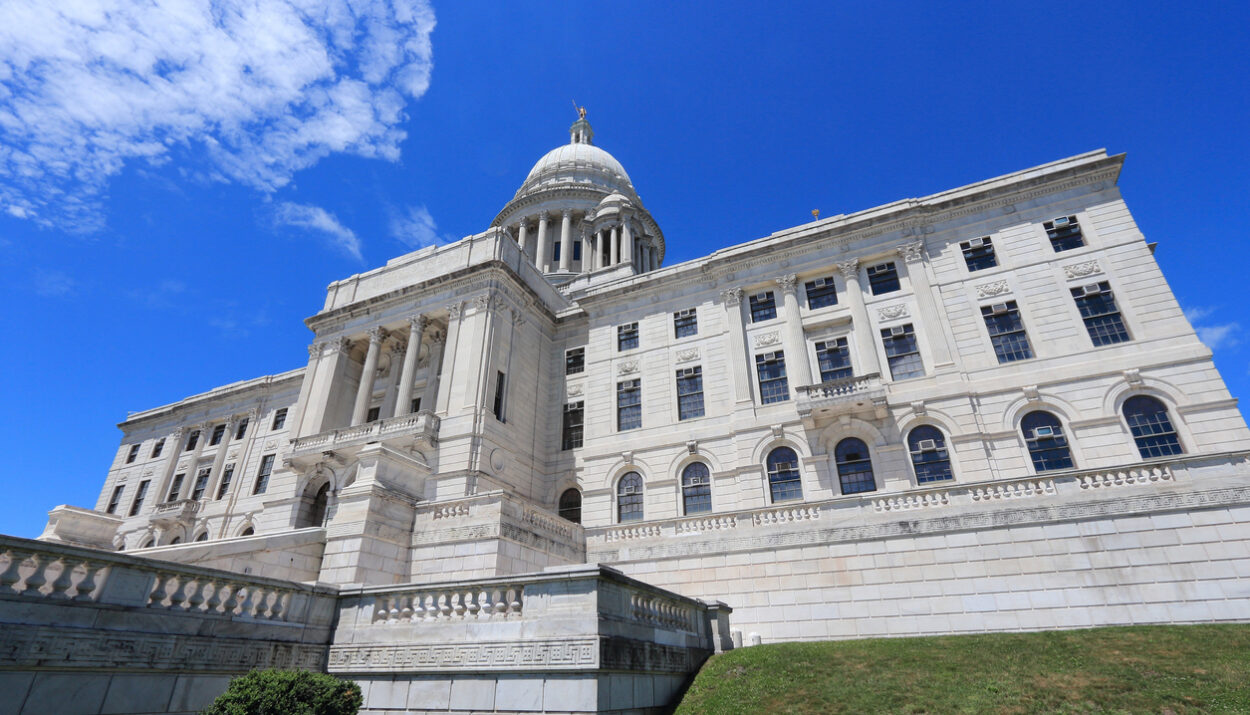

The General Assembly has failed to pass legislation creating decarbonization programs, expanding public transit, or creating a clean heat standard, among other climate-friendly bills backed by local environmental groups, report finds.
This story was originally published in EcoRI News, a publication partner of Ocean State Stories.
PROVIDENCE — It’s not a secret that climate legislation has been sparse over the past five years.
Despite starting off the decade strong with the Act on Climate law in 2021, and the 100% Renewable Energy Standard in 2022, no additional legislation responding to or tackling the climate crisis has emerged from the General Assembly in the years since.
The General Assembly has failed to pass legislation creating decarbonization programs, expanding public transit, or creating a clean heat standard, among other climate-friendly bills backed by local environmental groups. Some of those groups even held a mock funeral last year to lodge their protest against climate inaction.
The reason for the slowdown? Aggressive opposition to climate legislation from Rhode Island’s main utility company and business interests, according to a new report from Brown University’s Climate and Development Lab (CDL).
The report is part of a larger project by CDL to understand state-level lobbying and political influence across different state legislatures in the United States.
Rhode Island Energy, now owned by the Pennsylvania-based PPL Corporation, is identified as a major opponent to climate legislation introduced in the General Assembly. Between 2018 and 2024, according to the report, the company opposed 42 different pieces of legislation backed by the Environmental Council of Rhode Island and Climate Action Rhode Island.
It’s also one of the biggest spenders on lobbyists in the Statehouse. In 2024 Rhode Island Energy spent $139,000 on lobbyist compensation, for a total of $466,500 since 2018, according to the report.
National Grid, when it owned the state utility company, was also a big spender, allocating $613,667 for lobbyist compensation in the same period.
Environmental group spending pales in comparison. The biggest spender on lobbyist compensation over the six-year period was the Conservation Law Foundation, which backed 149 environmental bills while spending only $81,662 on lobbyist compensation.
“Substantial lobbying spending can translate into gaining access to key people in the legislature throughout the legislative session, as shown by Rhode Island Energy hiring the head of the top state agency, the Office of Energy Research (OER),” according to the report. “That top official was frequently the signer of written testimony from the utility in opposition to top ECRI (Environment Council RI) and CARI (Climate Action RI) priority bills.”
In an emailed statement provided to ecoRI News, Rhode Island Energy pushed back against the report, saying it was less like an independent analysis and “more like an opinion piece designed to marginalize viewpoints that do not align with the authors’ own policy preferences.”
“It is disappointing that an academic institution would lend its name to work that so clearly lacks balance and rigor,” according to the statement. “As new clean energy mandates are debated, we believe it’s crucial for policymakers and the public to have honest dialogue about affordability and the impacts of our clean energy transition on customers, system reliability and safety.”
Other organizations identified as opposing climate legislation include the National Federation of Independent Businesses, which opposed 35 pieces of legislation in the time period identified by the report. (The local chapter of the NFIB didn’t immediately respond to a request for comment), and national industry groups such as the American Chemistry Council, which opposed 11 bills.
Included with business groups is an agency of the state. The state Public Utilities Commission is identified in the report as a strong opponent to environmental legislation, due to duplication of existing regulatory authority from the commission, a concern over increased utility rates, or weakening of the commission’s authority as an agency.
The report also notes many of the strategies discussed in the state’s recently released 2025 Climate Action Strategy have already been introduced in the General Assembly and faced resistance.
If there’s one bright point, the report notes, it’s the alliance between climate groups and labor unions. The two main climate legislation victories, the Act on Climate and the 100% Renewable Energy Standard, made strong gains because of the alliance between labor and climate groups.
“The surge in development of offshore wind brought together these groups and the hope of state leaders for a new economic model which promised low emissions and quality, high-paying, union jobs,” according to the report.