This story was originally published in Rhode Island Current, a publication partner of Ocean State Stories.
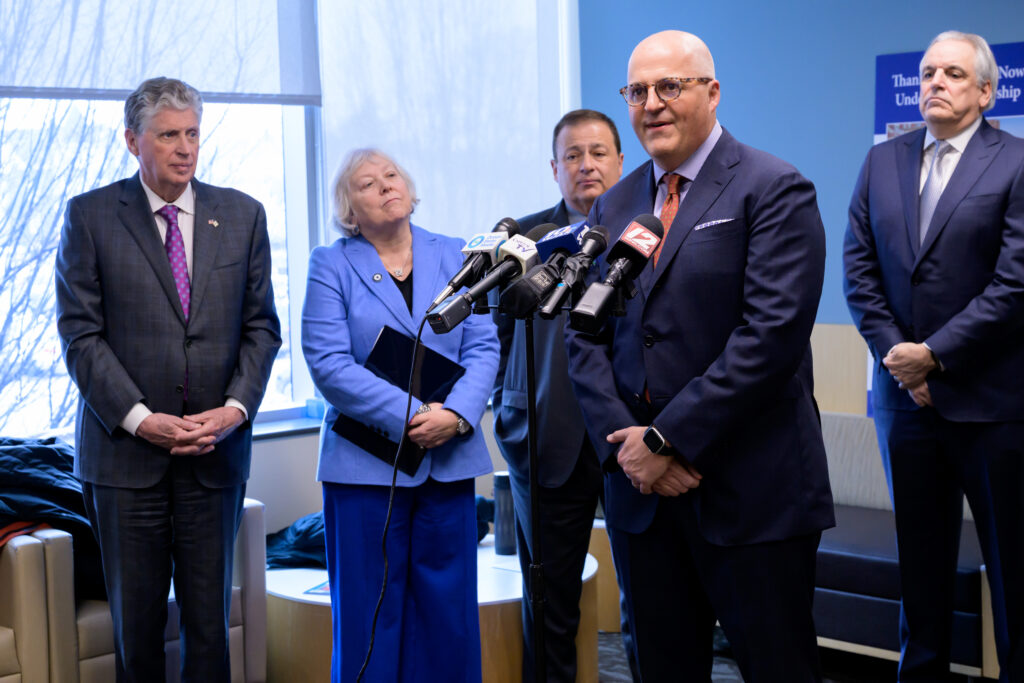
PROVIDENCE — No one actually said directly that the sale of Roger Williams Medical Center and Our Lady of Fatima Hospital had been completed. They didn’t need to.
The throngs of hospital workers and state officials gathered Friday afternoon in Roger Williams’ first-floor lobby knew exactly what was being implied during the hastily announced press conference: The Centurion Foundation had closed the deal.
“Welcome to the new CharterCare Health of Rhode Island,” Jeffrey Liebman, CEO for Centurion’s local subsidiary, said.
His announcement, met with overwhelming applause, confirms the long-awaited transfer of the community hospitals to Centurion Foundation. The Atlanta nonprofit has spent more than four years navigating state regulatory hurdles, a federal bankruptcy court and a wary investment market in its attempt to buy the hospitals from Prospect Medical Holdings. Friday was the final day to complete the sale under the court-ordered deadline.
“It wasn’t easy,” said Ben Mingle, Centurion CEO and president. “It was very hard, probably one of the hardest things I’ve ever done.”
Mingle teared up as he referenced his wife, a 20-year health care veteran.
“We pushed further than anybody might have thought possible,” he said of the deal. “We wanted to see it to the end.”
Centurion has characterized its purchase of the hospitals as a path to salvation, restoring local control and injecting much-needed cash into the facilities after more than a decade of financial and operational mismanagement by Prospect and its former majority stakeholder, private equity firm Leonard Green. But even after receiving conditional approval from state regulators in June 2024, Centurion struggled to lure investors to back the private bonds needed to finance the sale.
After multiple deadline extensions and an $18 million boost from state reserve funds, rushed through by lawmakers and signed into law on Feb. 11, the bonds are set to close by the end of the day, Mingle said. He declined to share the identities of the private bond investors, nor the terms of the sale, such as interest rates, but noted they will be publicly reported online, as mandated for municipal bond offerings, after the close of business.
The Rhode Island Health and Educational Building Corporation, a quasi-public state financing agency, executed the $101 million in bond financing on behalf of Centurion.
The change in ownership takes effect immediately, but restoring the aging facilities to their former glory won’t happen overnight. Since Prospect bought the hospitals in 2014, capital projects were put off and supply vendors unpaid, while Leonard Green ransacked the balance sheets to pay out shareholders. Many of the conditions imposed by the state health department and the attorney general’s office in approving the sale seek to prevent this mismanagement from repeating itself. They include requiring Centurion start spending money on hospital operations immediately, with regular reporting requirements to state officials.
Centurion projects it will be able to bring the hospitals back into the black in the first year through savings on prescription drugs, property taxes and other benefits of returning them to nonprofit status.
Despite the celebratory mood, state officials acknowledged the dark reality if Centurion had been unable to complete the sale: the risk of closure. The two hospitals offer 500 beds and 50,000 annual emergency room visits between them, along with specialty services in cancer treatment and geriatric psychiatry care, and employ more than 2,400 workers.
“Failure was not an option,” Senate President Valarie Lawson said.
House Speaker K. Joseph Shekarchi, whose father once worked as surgeon in the now-closed Memorial Hospital in Pawtucket, noted the consequences of hospitals closing for the entire health care system.
“It would have had a very bad impact, if the hospitals closed, on the other hospitals in the state,” he said.
The urgent need to avoid closure brought together some unlikely teammates, like Gov. Dan McKee and Attorney General Peter Neronha, who are known for butting heads. McKee also worked alongside Mingle, despite his administration simultaneously courting another hospital operator, Prime Healthcare, as a backup plan.
Mingle on Friday acknowledged his written rebuke of the state’s courtship of Prime, which made it harder for Centurion to advance its own bond sale.
But, Mingle concluded, “we got where we wanted to be.”
McKee also appeared nonplussed by Mingle’s prior criticisms given the end result.
“Today is a day worth celebrating,” he proclaimed.
Praise also came from Dylan Zelazo, executive director for the R.I. Health and Educational Building Corp, who thanked lawmakers, the governor’s team, and Bank of America, which was brought on as co-senior managing underwriter.
“We would not be here today with this positive result without the hard work of so many people,” Zelazo said in a statement.
Lynn Blais, president of the United Nurses and Allied Professionals, which represents nearly 1,200 workers across both hospitals, issued her own expression of gratitude.
“We look forward to working with Centurion Foundation to ensure a high-quality level of patient care for the tens of thousands of Rhode Islanders who depend on these community hospitals,” Blais said.