Heritage Restaurant Group and Audrain’s Nick Schorsch is snapping up property and building a restaurant empire in Rhode Island. But what’s his long game?
by Eli Sherman
Originally published in Rhode Island Monthly. “Copyright permission granted Rhode Island Monthly 2026.”
PROVIDENCE — Walking into Olneyville N.Y. System — the Providence wiener joint marked by a giant neon “EAT” sign hanging over Plainfield Street — a familiar aroma hits the nose: spiced meat sauce, mustard, onions and celery salt mixing with warm buns.
The smell will cling to my clothes all night and linger on my hands until morning, despite washing them multiple times. But I have no complaints — it’s my favorite wiener joint in town.
Open until 3 a.m. on weekends, N.Y. System is what many might call “quintessential Rhode Island,” where you could bump into cops, questionable characters, politicians and partygoers at any moment.
It lives rent-free inside Rhode Islanders’ shared food psyche, alongside Del’s Lemonade, Awful Awfuls and stuffies.
It’s 9:30 p.m. on a warm June night, and behind the shop’s long-running dining counter is the now-former owner, Greg Stevens. His family owned and operated N.Y. System for three generations before selling to Heritage Restaurant Group, a deal that closed a week after my visit.
“It’s the same people who bought the Old Canteen,” Stevens explains to a throng of customers sitting at the counter.
I missed the first part of the conversation, but they’re unmistakably talking about what’s brought me here tonight: Nicholas Schorsch, the man who runs Heritage.
For more than a year, Schorsch and his partners’ Newport-based restaurant group have spent upward of $125 million buying iconic restaurants, including N.Y. System, along with the Old Canteen, Providence Coal Fired Pizza and Union Station Brewery in Providence and more recently, Mews Tavern in South Kingstown. [Editor’s note: Heritage Restaurant Group is an advertiser with Rhode Island Monthly.]
On Aquidneck Island, where the sixty-four-year-old lives in the Hopedene mansion in Newport, his eateries include Brick Alley Pub & Restaurant, The Red Parrot, Wally’s Wieners, The Reef, Flo’s Clam Shack, Caleb & Broad, Cluck House and La Forge Casino Restaurant inside the International Tennis Hall of Fame.
The list goes on.
“Here is Heritage again, saving a heritage of Rhode Island,” Stevens tells me about selling to Schorsch, explaining that until he met the billionaire, he didn’t know what the future held for N.Y. System.
For decades, Stevens has worked long hours late into the night without vacations. And without a succession plan or another generation to take over the iconic restaurant, he says Heritage was nothing short of a godsend.
“This is almost like my dad is saying, ‘All right, Greg, you’ve had your run, I’m going to send you this opportunity,’” he says, referencing his late father.
Stevens’ optimism about selling to Schorsch is a sentiment shared by many others who have made deals with Heritage. Running a restaurant can be a thankless endeavor with long hours and razor-thin profit margins, making closure far more likely than generational succession.
Still, Heritage’s buying spree has drawn scrutiny from many quarters of the state, spilling out most publicly online whenever the group announces a new acquisition — something that happens at times at seemingly dizzying speeds.
“I (personally) don’t trust the pace, process and acquisition of numerous local brands by this group, in several different communities in such a short period of time,” cocktail writer and hospitality consultant Matt Simmons wrote on Facebook last winter.
“Our environment (401) is vulnerable, ripe for picking and socioeconomically disadvantaged,” he added. “People here are acutely aware of this, and are uneasy with big owners swinging in. Look at BlackRock across the country and apply that analogy to Heritage Restaurant Group.”
For Schorsch, he says his motives are straightforward.
“I have my kids; I have my grandkids. I want my children who are in the business to take over and run these businesses as well and have a place to take over that I’ll be proud of,” Schorsch tells me during a wide-ranging interview last June.
“I’m interested in being a good family business, and that’s what this is,” he says.
But interviews with more than two dozen people, along with a review of hundreds of pages of legal, regulatory and business documents, suggest Schorsch’s burgeoning notoriety in Rhode Island is more complicated, calculated and far more consequential than he suggests.
Where many see Schorsch as a savior, preservationist and philanthropist, others see a sharp-elbowed billionaire looking to buy his way back into prominence after getting a black eye on Wall Street. And many are wary about his long-term intentions for Rhode Island and its hospitality industry.
“They’re used to just doing their thing and belong to that mentality and that paradigm of being rich and powerful, so nobody can really touch them,” says Kim Soo Joy Seawell, a small-business owner near Schorsch’s Audrain Automobile Museum.
Another group of people see Schorsch simply as a man who loves money, deals and unique items — especially when all three are involved. He’s a collector and hobbyist, they say, who sees the world through the lens of business and all the excitement that comes with it.
“Nick is a dealmaker,” says Bruce Kelly, a senior reporter at InvestmentNews who covered Schorsch for years on Wall Street. “He loves action, he loves the tension of money.”
‘We’re just a family that is here doing our thing’
Schorsch grew up in Philadelphia in a family of Quakers, raised in a reproduction Colonial house decorated with vignettes from the Colonial Revival era.
He remembers spending his early years traveling the East Coast in the back of a station wagon to buy antiques with his family.
“I was a collector; my parents were collectors,” he says, adding that he and his two older brothers weren’t super interested at first. But he learned a lot about furniture, wood, ceramics, textiles, iron, paintings and painters.
“Almost every room was decorated in my parents’ house,” he says.
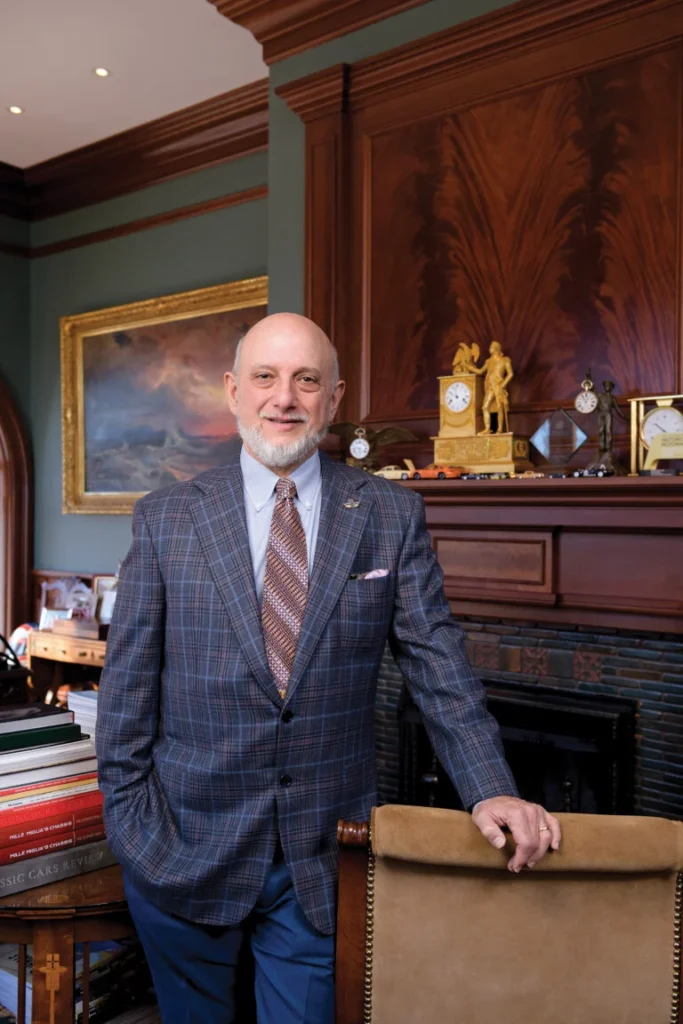
Schorsch talks while sitting in a wingback armchair beside an unlit fireplace on the second floor of the Audrain Automobile Museum in Newport. There’s a bar cart in the
corner and a long conference table behind us with nearly fifty wooden seats.
Trophies for “Best in Show” and “First in Class” from various car shows, along with model ships and a couple of gold clocks, decorate the walls and mantel. One of the ships is a replica of the USS Constitution, made famous during the War of 1812.
A small bookcase includes The Republic of Letters: The Correspondence Between Thomas Jefferson and James Madison, 1776–1826; Reflections on the Revolution in France; The Wealth of Nations; Democracy in America and The Federalist Papers.
The Quran — English with original Arabic text — stands out. Schorsch says he keeps it there for some of his Muslim staff because it’s a quieter space.
“We leave it there for them to be able to come and take a few minutes with it,” he says. “The whole Quaker belief is that we appreciate all the options out there. All the teachings have their own unique aspect.”
Outside, the clattering of plates from CRU Cafe drifts in. Behind the museum, courtside bleachers at the International Tennis Hall of Fame are visible, where Maria Sharapova and doubles legends Bob and Mike Bryan were inducted months earlier.
One method of getting to Schorsch’s second-floor office requires walking through the museum’s main entrance and taking a custom-made elevator with wood paneling and frosted glass upward at a crawling pace. The doors open into a suave foyer blending antiquity and modernism.
Inside the conference room, the table end looks out over Bellevue Avenue, a street known for its Gilded Age mansions built by the ultra-wealthy around the turn of the 20th century.
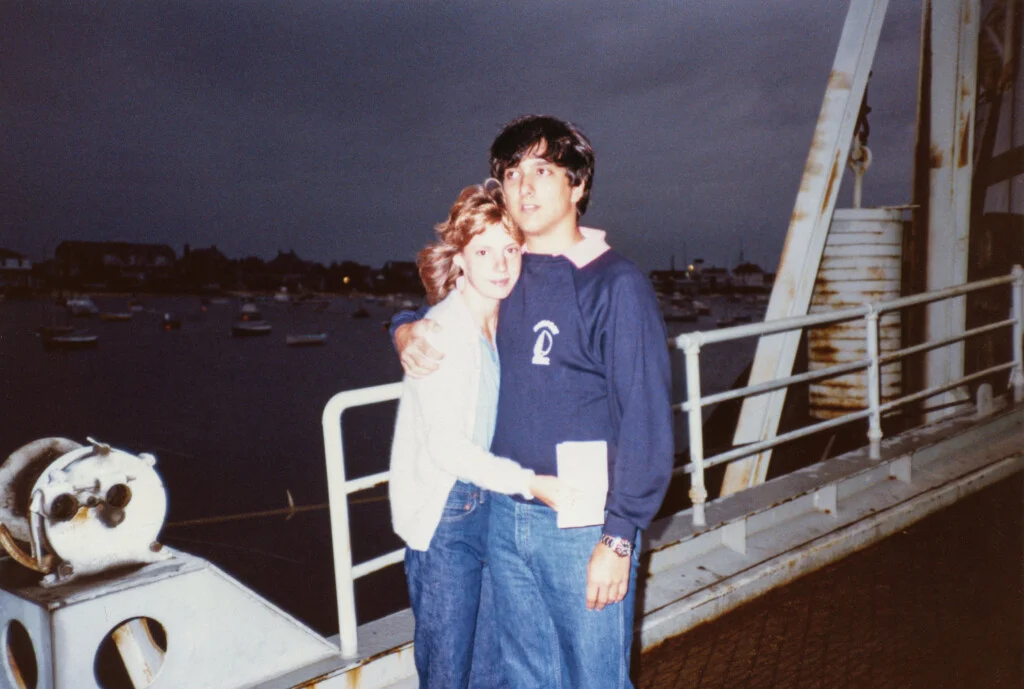
Schorsch and his wife, Shelley, have five children and ten grandchildren, all living in Newport. Despite his enormous wealth, the oceanfront mansion and the acquisition of the hotel named after the famous New York family with Dutch roots, he dismisses any suggestion he’s trying to build a Vanderbilt-like family empire.
Instead, he says the Gilded Age elites “went to their houses and they closed themselves off.
“That’s not what we do,” he says.
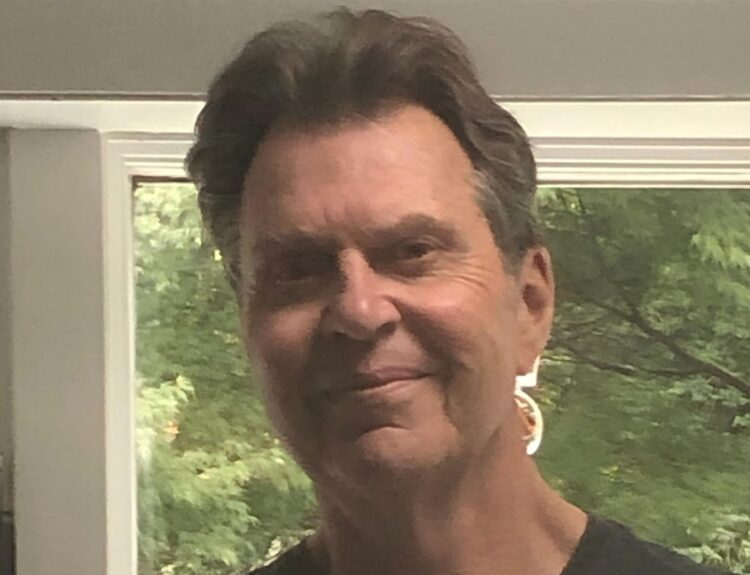
Schorsch wears a purplish suit jacket with a light-toned shirt and no tie. His semicircle of hair and chin-strap beard are tidy with a hint of scraggle. He’s calm when he speaks and attentive when listening, even if he tends to interject.
“We’re out all the time,” he says about his family. “I like First Beach — it’s what I grew up on with the original promenade. The red tide isn’t my favorite.”
We’ve been talking periodically for about six months, and today we’re focusing on his personal life — which requires gentle guardrails given his inclination to pivot back to business.
He speaks business fluently.
On his personal life, Schorsch says he spends weekends mostly with family or walking his two black Russian terriers, Athena and Apollo, with his wife. He also has a Boston terrier named Poppy that “lives in our bed.”
“I’m not a ‘get up early on a Sunday morning and go play golf’ guy,” he says. “Most of the time I’m walking my dogs or hanging out in town. We’re just a family that is here doing our thing.”
His station-wagon trips as a kid typically happened when his father took two weeks off in the summer. The initial goal was Nantucket, but logistics quickly changed that.
“My father was like, ‘This is ridiculous — let’s find a place closer,’” he says. “We came right to Newport and we loved it.”
They stayed at the Sheraton on Goat Island. Schorsch spent summers visiting mansions and falling in love with the 19th century, which inspired his move to Newport and fascination with restoration. He describes it as “almost a religion.
“My brothers went to the beach, and I went to the mansions,” he says.
He returned to live in Newport around the time he purchased Hopedene in 2012, coming back to the community that enchanted him as a child.
But his homecoming and subsequent restaurant empire were only possible because of a lucrative business career that began when he was a teenager and involved a different type of buying spree in New York City.
It would earn him a fortune — and make him enemies.
‘We started buying real estate’
Raised a few blocks from his future wife, Shelley, Schorsch grew up surrounded by business. While their families knew each other, Nick and Shelley finally met when they were dating each other’s best friends. And when those relationships didn’t work out, they began dating each other.
Nick’s father worked in metals. His grandfather worked in real estate. His great-grandfather worked in metals. Schorsch gravitated toward both industries.
He says he fell in love with business when he started his own company at eighteen and began attending Drexel University in 1979. He dropped out a year later, according to a college spokesperson, which Schorsch attributes to “bad stomach issues” that caused him to lose sixty pounds in three and a half weeks.
Doctors wanted to hospitalize him. Schorsch refused.
“I couldn’t do that — I had a lot of people working for me, relying on me,” he says.
He was eventually diagnosed with gluten intolerance and severe allergies to dairy, alliums and many spices.
The irony isn’t lost on him that he now owns restaurants serving everything from raw seafood to hot wieners.
Schorsch credits his wife with helping him get his health under control. He now requires all his restaurants to provide full allergy information, gluten-free and vegan options. For restaurants he doesn’t own, eating out can be difficult.
“The dietary restrictions restrict where we can eat,” he says. “But I love to go out, so if we want to go out (to a new spot) — it’s a drink.”
Today I’m talking with Schorsch over Zoom. It’s back in June and we’re focused on business.
He’s patching in from his historic farm in Virginia, where he and his family run a conservancy program. They breed and raise rare endangered domestic livestock, including Milking Devons — a rare red cow with black-tipped white horns. He estimates there are about 700 left; he owns about 12 percent of them.
They also breed hogs and crossbreed some with Ossabaw hogs at Mount Vernon, the estate of President George Washington.
“We have goats, we have peacocks, we have Dominique chickens — rare-breed chickens,” he says, adding the farm is especially important to his wife, whom he repeatedly describes as his best friend.
After leaving Drexel, Schorsch grew his nonferrous metal business into a multimillion-dollar corporation that he eventually sold for a small fortune in 1994.
He and his wife decided to get into mergers and acquisitions. But they also wanted to diversify their growing fortune, leading to a massively lucrative pivot.
“We started buying real estate,” he says.
The decision catapulted him into becoming an elite investor on Wall Street, where he closed multibillion-dollar deals and became fabulously rich through Real Estate Investment Trusts, or REITs.
REITs allow people to invest in large-scale, income-generating real estate without buying or managing properties themselves.
Schorsch started a lot of REITs — many intertwined. How many businesses did he start, buy and sell?
“Well, it doesn’t have anything to do with New York — I could do it here, too,” he says before turning to his attorney, Michael Anderson. “What is it, Michael? Sixty-five companies?”
“Somewhere in that neighborhood … about seventeen went public with a market cap of about $55 billion,” Anderson says.
Schorsch is clearly proud of what he built in NYC. But Wall Street is also where he got jammed up in such a dramatic way that his CFO of American Realty Capital Properties,
Brian Block, went to prison after being convicted of securities fraud tied to a $23 million accounting misstatement in 2014.
Schorsch wasn’t charged, but he and his empire of REITs paid $60 million to settle with federal regulators. He was hit personally with $7 million in penalties and injunctions.
Civil lawsuits followed.
A 2015 class-action lawsuit accused him of owning and/or controlling the “dizzying array of companies” used to further the alleged scheme. It settled for $1 billion in 2019.
Vanguard accused him and his company of misleading investors; that settled for $90 million in 2018.
He stepped down as CEO. The empire rebranded as Vereit Inc. and was eventually acquired by Realty Income Corporation in 2021.
Schorsch downplays it all, shrugging off the accounting issue as a $23 million error in a $30 billion company.
“I’m a big boy,” he says. He insists he was already transitioning to other interests.
One of those interests was returning to Newport, where he bought the Hopedene mansion for $16 million in 2012 — one of the highest home sales in Rhode Island history at the time.
He moved to Newport full time around 2015, the same period when civil lawsuits tied to his REITs were unfolding. But he insists the timing was coincidental and rooted in childhood nostalgia.
“When I was in Newport as a child … I would get on the bus and go to all the Gilded Age mansions,” he says.
‘How’s it working with Schorsch?’
Schorsch’s time in New York helps explain some of his playbook in Rhode Island.
He’s rapidly amassed a growing number of companies controlled by him or his family, mostly in the restaurant and hospitality industry, including The Vanderbilt, Auberge Collection hotel and the boutique Hilltop Inn.
“Restaurants are relatively new for us,” Schorsch says. “All businesses are pretty much the same.”
As of late July, he reported owning or controlling more than thirty-eight Rhode Island entities — some split into multiple companies, such as the Audrain Automobile Museum, Audrain Motorsport and Audrain Park Place.
Six more fell under Wally’s Wieners — the hot-dog eatery and bar that replaced the Old Canteen.
The strategy mirrors what he did with his REITs: breaking up organizations and spinning off entities to manage risk and accelerate growth.
Since my last count, Heritage has added several more entities: two Providence Coal Fired Pizza locations, Union Station Brewery, Scales & Shells (now Claw & Hammer), Jo’s American Bistro and the Mews Tavern. The empire keeps growing.
Despite narrow restaurant margins, Schorsch insists his strategy of buying established businesses means most are profitable. His companies are private, so no financials are publicly available.
“Every one of the restaurants, with the exception of one startup — and that’s very close — but all of them are profitable,” he says.
Heritage employs more than 1,500 people full- and part-time.
Like Stevens at N.Y. System, Wally’s founder Brad Head is a big fan. Head and his wife, Morgan, launched their business with a peddler’s license in 2019 and grew it through social media and pandemic demand. He met Schorsch through Schorsch’s son-in-law, Brendan O’Donnell, and quickly struck a deal.
A lot of people ask him: How’s it working with Schorsch?
“The simplest answer is the guy made my dreams come true,” Head tells me at Wally’s soft opening on Federal Hill.
But not everyone is enamored.
Brent Ryan and Derek Luke founded Newport Storm in 1999, later becoming Newport Craft Brewing & Distilling Co. They sold a majority stake to an investment group controlled by Schorsch in 2017. Both left three years later, selling off their minority share, which Ryan says didn’t grow in value without them at the helm.
Asked about working with Schorsch, Ryan says that in his opinion, “Loyalty to him and his ideas was the top priority — and a penchant for using lawyers.”
Ryan worries about what happens to Newport’s social fabric if a billionaire buys everything up.
“If the food, venue and employees are the only reason you choose to go out, then having a wealthy owner to keep them going is a good fit,” he says. “If … part of the draw … is to support small, owner/operator establishments, then obviously that component disappears.”
In hindsight, Ryan says he would have sold outright rather than staying on as a minority partner.
Schorsch pushes back, saying Heritage is no different from other multi-restaurant groups. He declined to name competitors, but Newport Restaurant Group’s website lists sixteen businesses. DeQuattro Restaurant Group owns five restaurants, including two on Federal Hill, and one each in Johnston, Warwick and Dedham, Massachusetts. Schorsch’s decision to buy the Old Canteen and replace it with Wally’s drew sharp criticism, including a Boston Globe column asking whether Federal Hill was being cheapened.
Rick Simone, president of the Federal Hill Commerce Association, initially criticized the move, saying the group had been led to believe Heritage would keep the Old Canteen as is. But after meeting with Heritage, he changed his tone, saying the group acknowledged communication missteps and made assurances.
Simone later said Heritage kept its word and restored the historic building, including neglected upper floors.
“The building needed a ton of work,” Simone says.
He also visited other Heritage-owned restaurants and found owners and staff satisfied with upgrades and investment.
“You don’t find people like this often,” Simone tells me. “As a state, we should be appreciative.”
Heritage agreed to remove “Wieners” from the Federal Hill sign. Schorsch brushed aside criticism, saying much came from online bots.
He offered a different perspective on buying the Old Canteen, saying they saved a failing business.
“Sal [Marzilli] was going out of business,” Schorsch says. “Nobody was wanting to eat there … he couldn’t afford to run the restaurant.”
Other owners defend him, too. Flo’s Clam Shack posted on social media that it had rejected other buyers and chose Heritage because of its commitment to preserving iconic restaurants.
“People bad-mouth Audrain out of pure jealousy,” the post said.
The criticism hasn’t slowed Schorsch’s long-term vision. He says his phone is ringing off the hook with would-be sellers who see him as a lifeline in an industry where succession is tough.
He’s also increasingly involved in Newport civic life — welcomed by some, distrusted by others.
‘I can’t be bought’
Schorsch comes across as altruistic when describing his decade-long presence in Newport.
He points to his charitable giving, which supports organizations including the Boys & Girls Clubs, the Dr. Martin Luther King Jr. Community Center, the Potter League for Animals, Newport Hospital and more.
“We’re very active charitably in probably every organization,” he says.
After listing them, he emphasizes that his donations are given quietly — which is striking considering he’s telling a reporter.
“Everything is anonymous,” he says. “It’s just the right thing to do.”
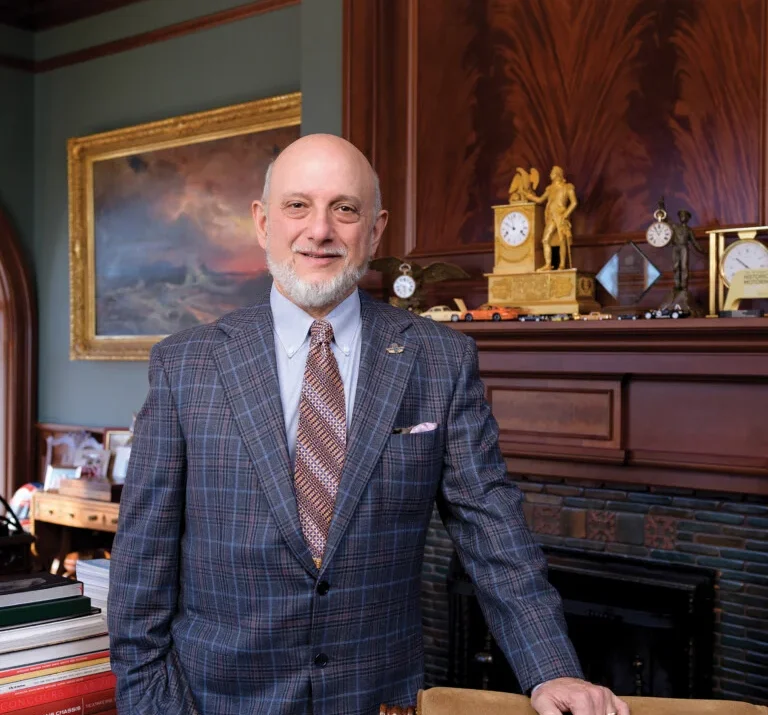
Schorsch stands in front of a Ferrari F40 at the Audrain Automobile Museum in Newport. Photography by Andy DelGiudice
He talks a lot about cars, including 160 “rare and remarkable automobiles” at his museum, such as pre–World War I Ford Model A and Model T vehicles.
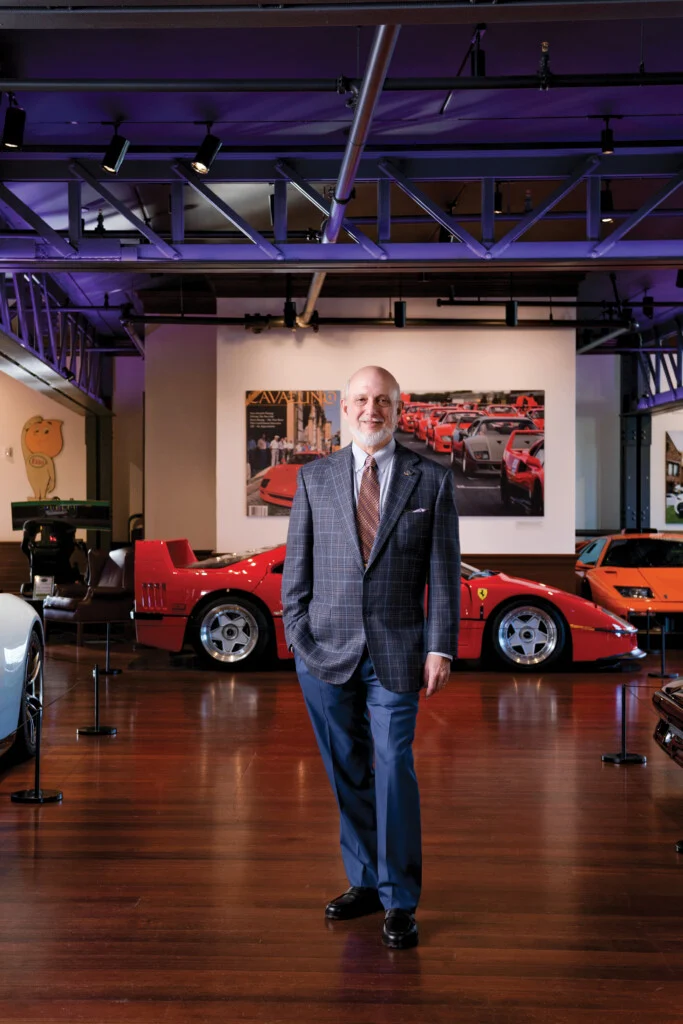
A museum fundraiser, however, is where Kim Soo Joy Seawell says her issues with him began. She bid $14,000 at a 2021 fundraiser for a car tour with Jay Leno, hoping to raise awareness about veteran suicide after her nephew’s death. The tour never happened. Museum employees offered a settlement requiring a nondisclosure agreement. She refused.
“Giving me back my money with interest is not only the right thing to do but also the legal thing to do,” she wrote. An “NDA has nothing to do with this … I can’t be bought.”
Schorsch and attorney Anderson disputed Seawell’s account, citing scheduling issues and Leno’s injuries in a 2022 fire.
The museum ultimately delivered a cashier’s check for nearly $18,000 without requiring an NDA and made a $4,000 donation to Stop Soldier Suicide.
Beyond philanthropy, Schorsch has put his wealth to work in the state’s political scene — even though he insists he wants nothing to do with politics personally.
“It’s the absolute opposite of anything I want,” he says with a laugh when asked about his political aspirations. “I have zero interest in influencing politics.”
Since 2016, he and his family have donated about $60,500 to the Rhode Island Democratic Party and its members.
Recipients included Governor Dan McKee; his challenger, Helena Buonanno Foulkes; former Governor Gina Raimondo; U.S. Senator Seth Magaziner; Newport Mayor Charles Holder;
House Speaker K. Joseph Shekarchi and Senate Finance Committee Chair Louis DiPalma.
Schorsch also tapped DiPalma to serve on the audit committee of American Strategic Investment Co., a New York real estate holdings firm he controls. DiPalma says he vetted the role to ensure no Rhode Island ties that would trigger an ethics review.
DiPalma acknowledged the optics might suggest Schorsch was trying to curry favor — his compensation was valued at $123,219 — but says Schorsch has never asked for anything in return.
“Be skeptical, don’t be cynical,” DiPalma says. “Let the results speak for themselves.”
Cynicism is part of Rhode Island’s DNA.
With that in mind, I reached back out to Greg Stevens seven months after we first spoke.
So far, he says, Schorsch has kept his word. No major changes to Olneyville N.Y. System. And Stevens can finally relax after decades of uncertainty.
“It’s awesome,” Stevens says.
For now, Rhode Island watches — wary, hopeful and unavoidably curious — as Schorsch continues to shape and buy into the state’s restaurant landscape.