
This story was originally published in Rhode Island Current, a publication partner of Ocean State Stories.
PROVIDENCE — Students from Alfred Lima Elementary School in Providence came to the State House Tuesday to champion the important role librarians play in public schools and support a bill that would mandate a dedicated library and certified school librarian in every public school in Rhode Island.
“I think the libraries are very important because they’re places where everybody can learn new and different things, like reading, coding, how to be safe on the internet, and so many more fun and awesome things,” fifth grader Narella Estrada said during a legislative advocacy event in the State Library. She is a member of the Lima School News Crew, which produces newscasts on school happenings with the help of the school librarian.
Tuesday’s event during School Library Month was organized by the Rhode Island Library Association and School Librarians of Rhode Island.. The Senate version of the bill, S2078, is sponsored by Sen. Hanna Gallo, a Cranston Democrat and chair of the chamber’s education committee, while the House variant, H7417, bears the sponsorship of Rep. Rebecca Kislak, a Providence Democrat. Both lawmakers submitted versions of the legislation last year.
Under both bills, school libraries would need to have a “permanent and dedicated space” in their respective schools. Schools with 250 or more students would need at least one full-time certified librarian, while schools with smaller student populations would be allowed to hire a half-time certified librarian.
Students would need to have access available during every school day, and secondary schools would need to be able to ensure access and staffing outside regular school hours, whether “before-school, after-school and/or Saturday hours,” according to the bill text.
In their respective education committee hearings in March, however, the library legislation encountered resistance because of the cost.
‘In an ideal world …’
In the March 10 House hearing, the Rhode Island Department of Education (RIDE) shared concerns about the bills via Andy Andrade, the agency’s special assistant to the commissioner for legislative relations.
“Honestly, in an ideal world, we would prioritize this,” Andrade said, but added, “When you look at the bill, it’s very comprehensive and it would be very costly.”
Lobbyist Tim Ryan from the Rhode Island School Superintendents Association struck a similar tone during the March 4 Senate hearing on Gallo’s bill, saying he had “no argument” with the advocates’ core premise.

“But as we all know, we have very scarce resources in a challenging fiscal environment,” Ryan said, adding superintendents around the state say“the pipeline for librarians is slowing” and that Rhode Island lacks a “plethora” of certified librarians.
“I think we certainly want to accomplish the aims and the aspirations of this bill, but I think we have to be realistic about the personnel and the ability to fill these jobs,” Ryan said.
It would take an estimated $311,553 to meet the bill’s high school staffing requirements, and another $476,770 for all middle schools statewide to adhere, according to a handout provided to Rhode Island Current. The sheet used an average starting teacher salary of $47,205 to determine the cost for each tier of the K-12 system.
The largest ask would be at the elementary school level, with an estimated $1.38 million needed for compliance to hire about 29 school librarians needed to meet compliance with the bill.
The same sheet says that, of Rhode Island’s 44 public high schools, 36 already have full-time librarians, as do 33 of 47 public middle schools. It does not specify an exact count for grade schools. Providence, Warwick, Woonsocket and Pawtucket had gaps in their librarian coverage, according to the sheet.
The handout lists Barrington, Burrillville, Jamestown, Middletown, Portsmouth, and West Warwick as employing full-time librarians in every school in their district. Block Island, Chariho, East Providence, Exeter-West Greenwich, Little Compton, Middletown and Scituate would also meet the staffing requirements described in the proposal.
Gallo’s bill as drafted is the same as written when submitted last year, while Kislak’s version is updated to include additional language on responsible use of artificial intelligence in the bill’s policy statement section.
Kislak’s version also phases in the staffing mandate one year earlier than Gallo’s bill, starting in the 2026-2027 academic year and ending by the 2030-2031 academic year. High schools would need to comply with the mandate first, followed by middle schools and then grade schools.
“I don’t think we outgrow how important our librarians can be,” Kislak said, giving a shoutout to her own local librarian — Cheryl Space, the director of the Community Libraries of Providence in the audience. Space distributed the handout with the cost breakdown.
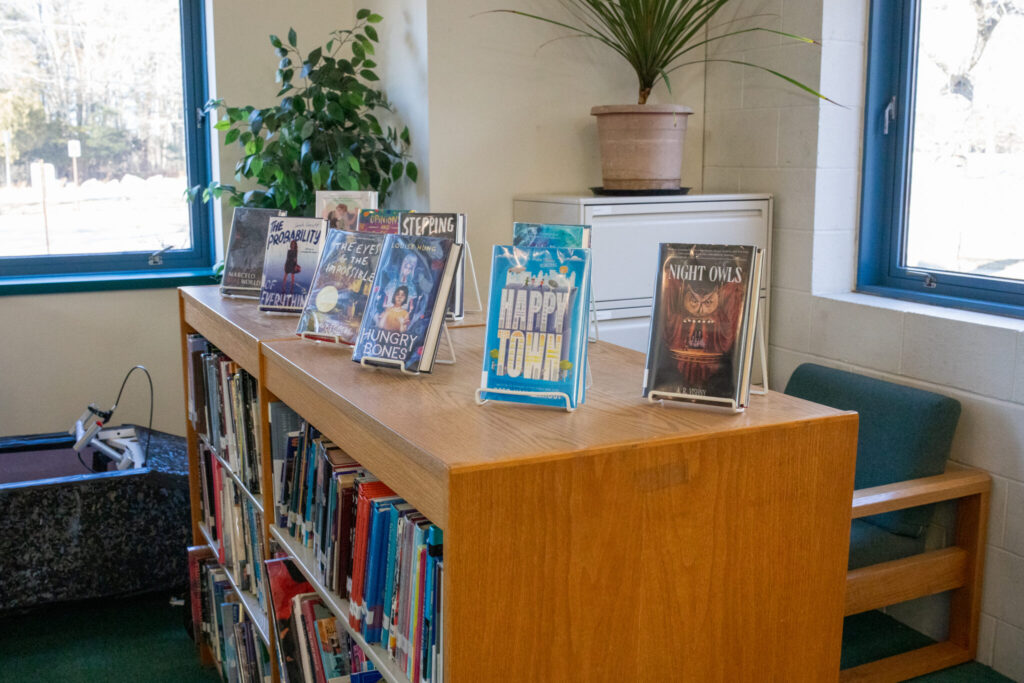
Gallo, who works in the Cranston School Department as a speech language pathologist, said, “School libraries are magical places where young learners can let their imaginations soar.”
The legislation, Gallo added, is meant to make clear that school libraries are “not an extra,” but “an absolute necessity.”
The most passionate testimony at both hearings and at Tuesday’s press event came from Tasha White, the school librarian at Alfred Lima Elementary School who works with the student news crew. White, who was Rhode Island’s 2025 School Librarian of the Year, described in loving detail how much being a librarian means to her. White got choked up a bit during her speech, and when she finished, her students hugged her.
Asked shortly afterward about the importance of libraries, White explained that, since “the first librarians [were] delivering books on horseback,” the idea of a library has evolved into curated spaces that are much more than just books.
Libraries help kids “in being able to create things and not just consume it,” she said. “The impact that it has, and the impact that [students] are going to have on the world. It just makes me feel really inspired.”
“I think that having [my students] here just really was so emotional for me and powerful,” she said.
Bill supporter and retired school library media specialist Peter Quesnel, who testified at both committee hearings, acknowledged Tuesday that cost has usually proven its biggest obstacle.
“All the legislators tend to support it,” Quesnel said. “But they balk at the cost.”
Still, Quesnel added he wasn’t totally convinced the librarian job pipeline is as arid as the bill’s opponents suggest. After all, the University of Rhode Island graduates library students every year, he said.
“And there are librarians, who are working in public libraries and other jobs, who would come back to schools if there were positions,” he added.