
Juneteenth ceremony dedicates bench at a once-troubled shore
By ROSEGALIE CINEUS Beacon Media Staff Writer
Jun 25, 2026
This story was originally published in the Warwick Beacon, a publication partner of Ocean State Stories.
Read this story in its original form and all other Beacon stories by clicking here.
As the afternoon sun shone brightly above and the water quietly ebbed and flowed ashore on the banks of Stillhouse Cove, a large crowd gathered to witness a project of five years come to life.
Last Friday, in honor of Juneteenth, a memorial and dedication ceremony was held at Stillhouse Cove in Pawtuxet Village. There, a bench honoring enslaved Africans and recognizing the land’s role in the Trans-Atlantic slave trade was unveiled.
A federal holiday since 2021, Juneteenth commemorates the day, June 19, 1865, that enslaved African Americans in Galveston, Texas, finally learned that they were free – more than two years after President Abraham Lincoln had signed the Emancipation Proclamation.
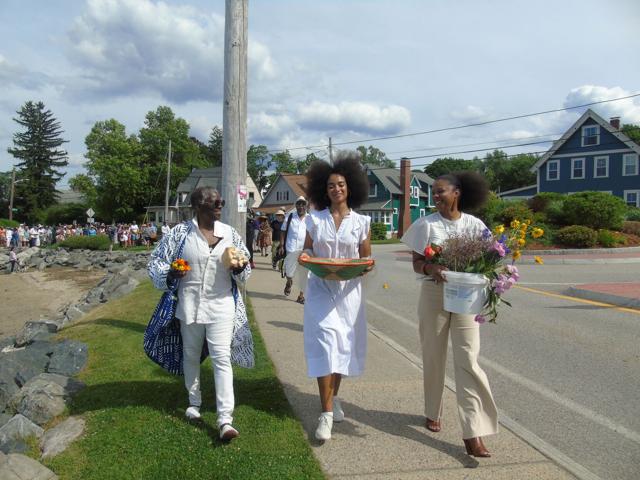
Ahead of the ceremony, a community procession to the memorial bench took place as residents marched from 1 Rhodes Place to the Ocean Avenue end of Stillhouse Cove.
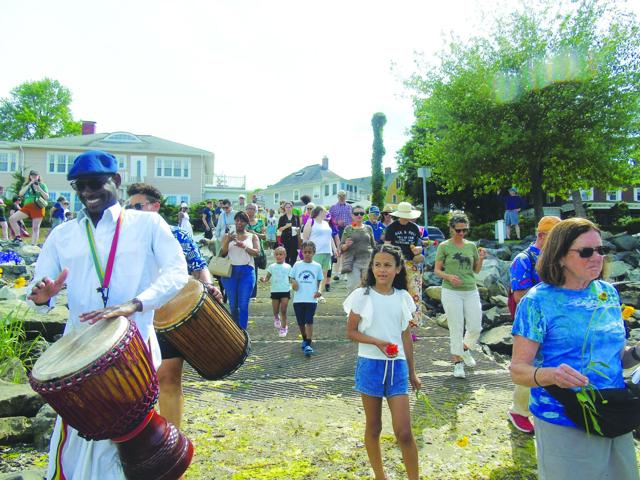
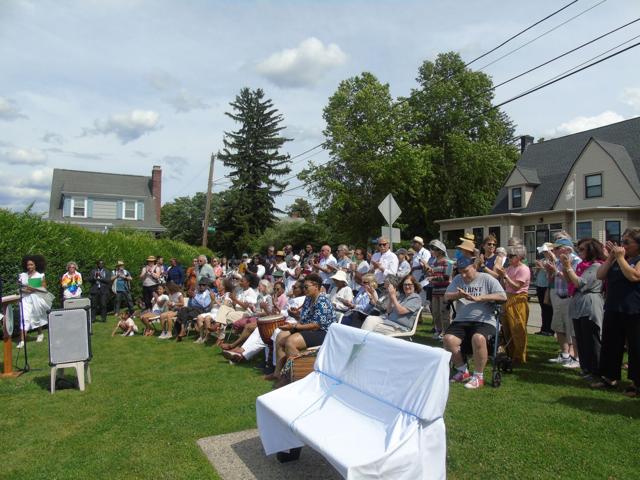
As the summer day’s heat settled in, a crowd of residents, elected officials and community leaders gathered for the Juneteenth event as speeches were made and special moments were shared.
U.S. Rep. Gabe Amo spoke about his own lineage as a “recent son of West Africa,” and why he sees Juneteenth as a celebration.
It is “a celebration for so many who had so little,” Amo said. “A little claim to being full Americans according to the laws of the time – but we know that’s not true. But I think more than a little hope that tomorrow would in fact be better than today and we carry that on this great holiday.”
The Stillhouse Cove Remembrance Project, is “a community-led initiative dedicated to recognizing, remembering and memorializing enslaved Africans and their descendants connected to Stillhouse Cove in Cranston, Rhode Island,” according to the group’s mission statement.
The centerpiece of the event was a deeply personal ancestral recognition and libation ceremony – a ritual and African tradition that commemorates the lives of its ancestors – led by Tasuma Goodwin of Warwick, who helped organize the project.
Along with Goodwin, eight other members were involved, said Joyce Bernau, a Cranston resident from the Edgewood area who also worked on the project.
In addition to Melaine Ferdinand-King, associate director of the state’s African American Museum and Emlyn Whipple, a member of the project, Bernau noted Alma Gottlieb, an anthropologist, Philip Graham and Carolyn Fluehr-Lobban, both are professors, as being instrumental to the project.
Whipple called it “deeply meaningful work,” underscoring the need for people to know history “so we don’t repeat it, so we can honor those who came before us.”
Part of that history is acknowledging that Narragansett Bay contributed to the Trans-Atlantic slave trade, Whipple said. She added that it is history “almost hidden in plain sight,” noting that Stillhouse Cove is a well-known area of Pawtuxet Village, but many don’t know or are not “acknowledging what is Stillhouse.”
Goodwin lives in the last-standing Colonial era stillhouse – or distillery – in the area. She shared a poem she wrote in 2020 and talked about the history of her home, which was once a site for slave auctions and part of the rum trade, which was a means of trade used to exchange for enslaved Africans.
According to Goodwin, her home was once a site of slave auctions, with slave quarters and once a blacksmith forge where she says “most likely many torture devices were made. Neck irons, chains, anklets [and] wrist cuffs were forged and made to enslave and torture my ancestors.”
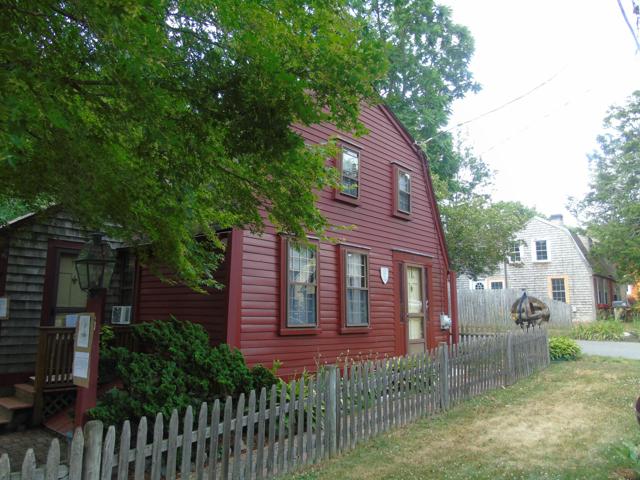
“I walk my property in almost a silent protest to the establishment. A march of freedom for my ancestors as I water my garden. I wake this morning at 3:33 a.m., with the screams of my ancestors’ souls asking for peace. I say to them they have not broken our spirits, and they will not enslave our souls for I stand for you. This is my home. This is my spirit,” an excerpt from her poem which she read at the ceremony.
As she read, a poignant silence permeated the air, interrupted only by the sounds of nature’s clear presence, the occasional sound of a car as it drove by, and the steady sounds of traditional African drums, the Djembe and Dundun, being played as people listened to Goodwin’s poignantwords.
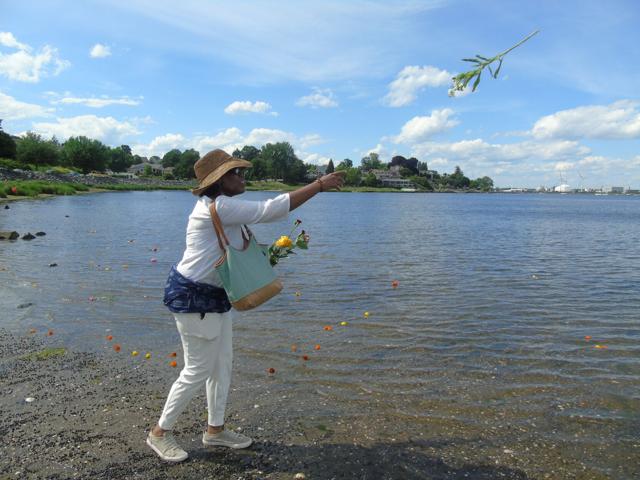
Shortly after, the public was invited to throw flowers into Narragansett Bay, Goodwin said, to honor the ancestors. People of all ages, kids to adults, walked the path down to the Bay, stepping right into the wet sand, unbothered by the soft touches of the water as it lapped ashore, and threw their flowers into the cove.
“It’s a very profound event,” said Soul Brown, of Providence. She said over the last few weeks she has been learning the extent of the slave trade in Rhode Island and how much people want to learn about it, bring it forward and uncover it.
“This is really powerful, to think that this stillhouse exists and that a Black woman who descends from this history is living in that house and helping to keep the ancestors’ stories and spirits alive. It’s moving, and it’s moving me to tears,” Brown shared.
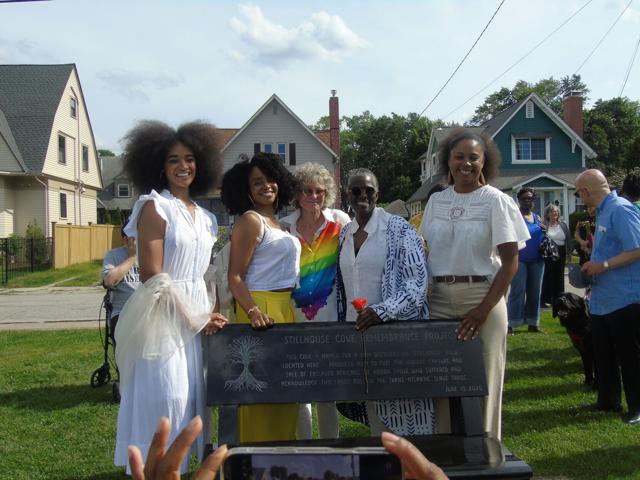
The ceremony concluded with the unveiling of a monument to honor the ancestors. The artwork was created by local artist Jheneire Loreus.
Loreus said it was a huge deal to be a part of the project. She said the opportunity came at a time when she was feeling the weight of work and being a mom (her 5-year-old daughter was with her at the ceremony) and the project helped her relaunch her creative spark, get in touch with her roots and find so much joy in the process.
“I’m still trying to grasp it, because this is history. This is not just a canvas. This is for the community. This is a monument,” Loreus said. “That is phenomenal; it’s an absolute blessing.”
Flowers were given to those present as people walked to where the Providence River meets the sand and released the blooms into the cove, honoring those who endured through the Trans-Atlantic slave trade.
Following the ceremony, many residents gathered at Goodwin’s historical home, concluding an event that left some with new insight into the area’s history, some with a deeper connection to their own history, and for others it reaffirmed the path forward.
Such was the stirring ambiance of the Stillhouse Cove Remembrance Project ceremony that one could easily forget that although steps have been made to rectify such a cruel and tragic part of this nation’s history, one participant made it clear that there is still much work to do.
Providence resident Lisa Ranglin is the president and CEO of the RI Black Business Association, and she says her focus is about access to opportunities and good-paying jobs for the Black community, because “I think if we are able to close the racial wealth gap, we [can] lift everyone up.”
Ranglin says it is important to celebrate a day like Juneteenth and acknowledge what has happened to ancestors but underscores that it is only a step. It is not the end of the work that remains to be done for the overall improvement of the Black community.