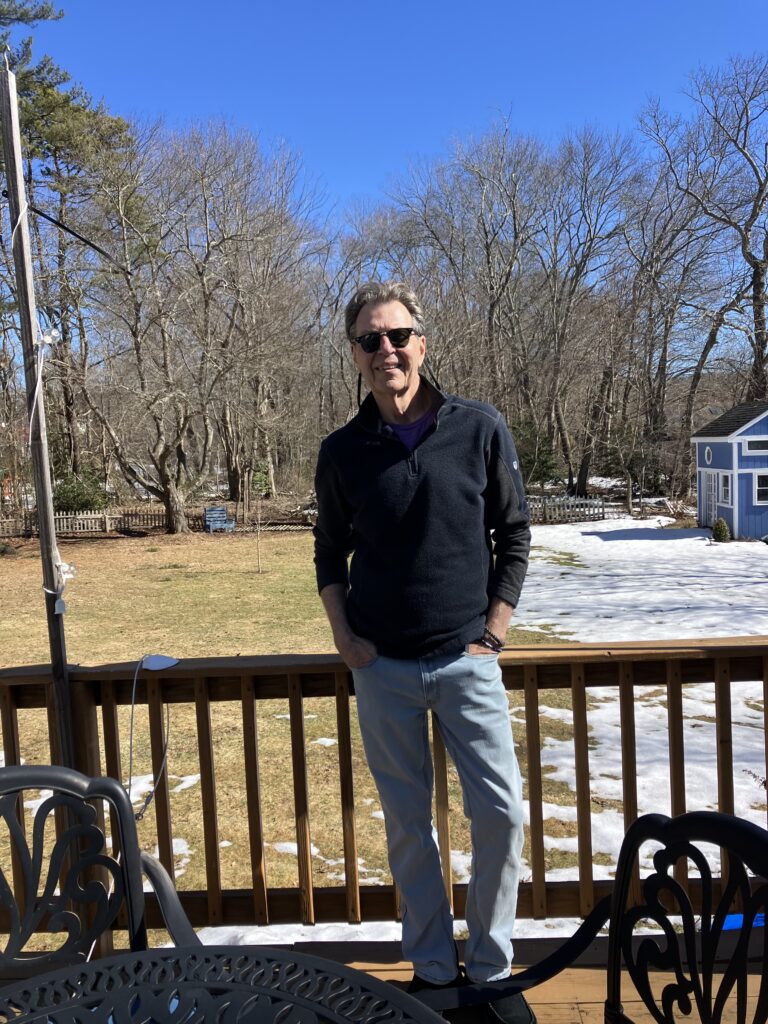

Peter, thanks for joining the Ocean State Stories crew! You have another critically acclaimed new book out, I’m Old, Not Dead: Dispatches from the Desk of an Aging Poet. We’ll dive into it shortly, but first we’d like to learn about you.
Where were you born and raised?
I was born and raised in South Buffalo, NY. I’m a long-suffering, though incurably optimistic Buffalo Bills fan, like everyone else in Buffalo..
When did writing first interest you?
Looking back, it’s clear that I’ve always been interested in the “Word’ and attracted to telling and listening to stories. I was raised as an Irish Catholic in the 1950s and 1960s, so I was spent my youth reading Bible stories at school, not to mention I had the privilege of listening to the exaggerated and outlandish tales of my Irish father and his brothers and their Irish cronies. One of those stories is in the short memoir that is the penultimate chapter of I’m Old, Not Dead. All these oral stories made me realize how “real” tales could easily become fiction—very often comic fiction, because every time my uncles retold their stories, those tales would change in ways to make the teller more heroic. In a sense, all those Irish men I grew up around would’ve made great fiction writers. Let’s face it, novelists are, by nature, liars.
Then, at fourteen, I was fortunate enough to get financial aid to attend a prestigious Jesuit high school where I studied Latin and Greek and took a deep dive into classical mythology and poetry. That’s when I began writing my own tortured love poetry, which I gleefully inflicted on a variety of girlfriends. I’m lucky there’s a statute of limitations on punishing young girls with terrible poetry; otherwise, I’d be jailed by now.
All the above educational information makes me sound highbrow, but at the same time I was translating the Odyssey, I was reading Mad magazine and re-watching the satiric parodies of The Rocky and Bullwinkle Show. That accounts for the satire and parody in my adult poetry and fiction.
Was there a person or a literary figure who inspired you?
James Joyce was an obvious influence in the beginning because of his darkly Irish Catholic humor, though I was also attracted to F. Scott Fitzgerald’s The Great Gatsby because of its depiction of hyper-romanticism, and because of the socioeconomic disparities he exposed in that novel. As a working-class kid going to school with a lot of wealthy kids, I could relate. A lot of above themes appear and reappear in all my books. I’m a wise guy by nature, a satirist by trade, but I’m aware that ever wise guy is in fact an idealist. A writer ends up being a satirist precisely because he’s angry that real life can’t reach the kind of perfection he so desperately craves.
Is it true you were a steelworker before you went to college?
I don’t want to hyperbolize my time at Republic Steel because I was only there for about eight months, but that time was a major influence on me as a person and writer. In general, because I spent my first ten years just a stone’s throw from the plants, and because my father and grandfather worked in them, the plants provided a kind of moral and physical geography for me, as that short memoir I mentioned above suggests. I guess what I’m saying is that although I may have a Ph.D. in literature, I will always identify as working-class.
What else did you do before academia beckoned?
From 1969 to 1973, I worked manual labor jobs. I was a carpenter in Colorado, and back in Buffalo, a drywall subcontractor, which I probably would have stayed at, but when the plants closed, the housing market dried up. With no houses to build, I went back to college and rediscovered my love for literature, especially the classics. I also realized that I wanted to teach literature on some level. As it turned out, all my siblings also ended up as teachers, so it must be in the genes.
What college(s) did you attend?
I received my B.A. from the University of Buffalo in 1975 at a time when that school had an incredible English Department. While there, one of my professors told me I was smart enough to get an assistantship to a university, which meant I could get an M.A. or Ph.D. for free. Consequently, I ended up with a Ph.D. from the University of New Hampshire. The way I felt was that even if I couldn’t get a teaching job after graduating, why not get a Ph.D. for free, especially since no one in my family had ever gone to college?
You were a professor of English for many years at Providence College (now emeritus). Please tell us about that.
I don’t think I would have been as successful as I am without the encouragement of many of my colleagues, though I was mostly inspired by my students. I often think about them, especially the ones who became teachers. They were so driven at that time, so idealistic that I always felt I had to raise the bar for myself. Also, in my early years, one of the vice presidents, Jim McGovern, gave me a stipend to start a literary journal, called The Prose Poem: An International Journal, which I edited for nine years. It has been called “legendary” by many poets in the sense that it made the prose poem more legitimate in America, though “legendary” seems a bit exaggerated to me, so let’s just call it “significant.” It’s all been digitized at https://digitalcommons.providence.edu/prosepoem/about.html
How would you describe “prose poetry”?
To make it simple, prose poetry uses all the techniques of verse poetry. The only difference is that prose poetry appears on the page as paragraphs., while verse poetry has line breaks. This is of course an oversimplification, but it’s a good start.
You have written many middle-grade and YA novels, besides short stories, essays, and poems for an adult audience. Do you have a favorite genre?
Not really, I enjoy them all because they appeal to different sides of me. The short stories, which are realistic, appeal to the Irish-I’m-full of-bull side of me, while allowing me to work through, for lack of a better word, my “male” issues; prose poetry provides me with an avenue for parody and satire; and the essays often combine prose, poetry, and humor. The YA and middle-grade novels gave me a place for my idealistic side to flourish, because those novels, unlike my “adult” work, which is often cynical, always offer hope. I really miss my visits to middle schools where 300 kids would read my book, make posters inspired by it, and often ask unscripted off-the-wall yet incredibly insightful questions.
You’ve mentioned humor a number of times in this interview, which suggests it’s a very important part of your work and who you are.
Oh, yeah. I couldn’t exist without it. What troubles me about this current political scene is that people can’t find any common ground on almost any topic. Lots of anger, lots of fear, but little humor. I’m talking about the kind of humor that unites, not divides. It’s not funny to say that a woman looks like a pig, or to make fun of a disabled person at rally, and I could go on and on. That kind of laughter is the laughter of the bully who pulls down a kid’s pants during gym class. In contrast, I recall how the young black and white guys at the plant could joke with each other about things that, today, would get us canceled by both the right and the left. But back then, humor broke through all the racial tension of 1969-71 and gave us permission to hang out with each other.
Concerning humor in literature, the South American poet Nicanor Parra wrote: “Humor makes contact with the reader easier. Remember, it’s when you lose your sense of humor that you begin to reach for your pistol.”
I agree wholeheartedly with Parra.
OK, now let’s get into I’m Old, Not Dead: Dispatches from the Desk of an Aging Poet, published in April by BlazeVOX books. An overview, please.
Most of the essays in I’m Old, Not Dead are rewrites of Substack posts from my site Old Man Still Howling at the Moon https://johnsonp.substack.com/ They are hybrids, each essay often opening with a short poem, and each of the six parts ending with a short piece of fiction. The publisher describes it best when he says, “Framed as ‘dispatches from the encampment of an aging humanist,’ I’m Old, Not Dead confronts a world increasingly shaped by disinformation, vanishing cultural narratives, and the erosion of shared values. Yet even amid disillusionment, Johnson’s work remains animated by humor, compassion, and an enduring belief in literature as a vital force for understanding and survival.” That works for me.
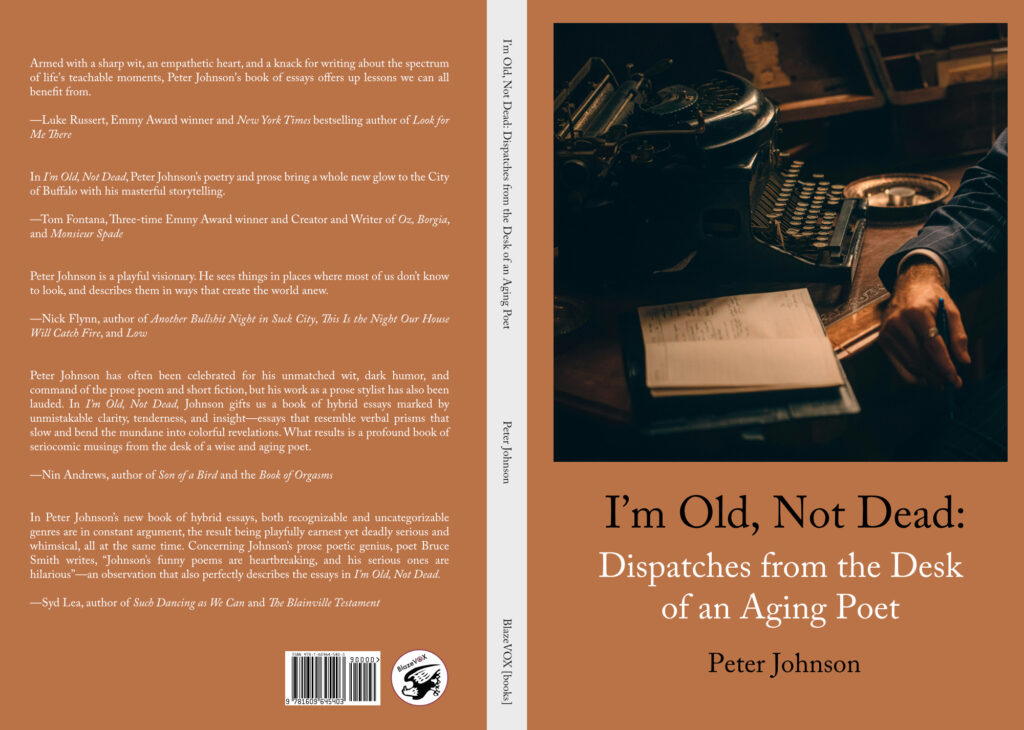
And where does the title come from?
In a way, this whole book is my response to a thirty-something editor who, three years ago, rejected one of my novels without reading it, writing that her agency would wonder, in her words, “how many books you have left in you.” As dismissive and ageist as that comment was, I appreciated its brutal frankness. Even I had to laugh as I pointed out to her that “1) I’m old, not dead; 2) unlike UFC boxers, writers become better as they age; 3) I’m still surfing [could she do that?]; and 4) I think what you just said is illegal.”
Was there anything else that drove you to write the book? I mean, you call it a “final reckoning” in the preface.
Yeah, definitely. After recently losing two members of my immediate family, and after attending the funerals of two other friends, while living daily with the symptoms of two overlapping and (hopefully) slow-moving blood cancers, I now exist with an odd anxiety that is, paradoxically, both troubling and exhilarating. What better way to manage this mixed bag than to distract myself by writing I’m Old, Not Dead. I guess you can think of the book as a collection of notes in a bottle launched out to sea by an aging humanist who is baffled and challenged by the world he’s living in—a world of conspiracy theorists and conmen, a world where the grand narratives he’s embraced and playfully satirized over a lifetime are beginning to vanish faster than the working-class values he grew up with. All this disenchantment sounds depressing, but, in fact, as I’ve said earlier, much of the book is comic.
Okay, let’s explore a couple of the pieces in I’m Old, Not Dead. Chapter 7, “Fate, Fortune, Chance, Luck,” wraps humor, fate, irony and tragedy into one fine essay. It’s autobiographical, correct?
Yes, throughout the book, I often mention “big” ideas like the above and then try to develop them through autobiography. The above title, for instance, takes on the question of why bad things happen to good people, while often nothing happens to bad people. The first few sentences of the essay say it best: “By all rights I should be dead, imprisoned, or paralyzed. There are many occasions I could refer to, but let’s stick with the time I lived in Hermosa Beach, California between 1970 and 1971.” And from there I follow the precarious and impulsive adventures of a guy I call the California Peter Johnson as he wanders about, playing Russian roulette with death. In short, I did some dumb things as a youth that seemed perfectly normal to me at the time.
And what about the short piece of fiction in Chapter 16, called. “For All of the Covid Deniers and Anti-maskers and Conspiracy Theorists.”
That’s my favorite short story in the book, a kind of Covid love story. It was my response to all those people who didn’t follow the rules out of sheer selfishness or political stupidity, sometimes causing the deaths of others around them, especially vulnerable people with preexisting conditions.
What’s surprising to me is how you can shift gears between the serious and comic in the book, as in Chapter 18, called “Random, Unconventional Thoughts on Easter and Jesus.” Most people would be afraid to write “unconventional thoughts” on Jesus, for fear of being canceled.
I’ve always relished those opportunities and view them as a challenge. As a writer, it’s not so much what you say, but how you say it. In that essay, I start with fond childhood memories of Easter and then try to humanize Jesus. I begin by asking what if Jesus, like the rest of us, would sometimes like to be just left alone? To find out, I place him outside a “Compassion Center,” standing in the snow with nothing on his feet but sandals. His feet are cold, man, and all he wants are some warm socks. But, unfortunately, he runs into a guy who is more interested in impressing Jesus with his imaginary accomplishments. What results is a very comic encounter, which, I hope, ends up being both profound and entertaining.
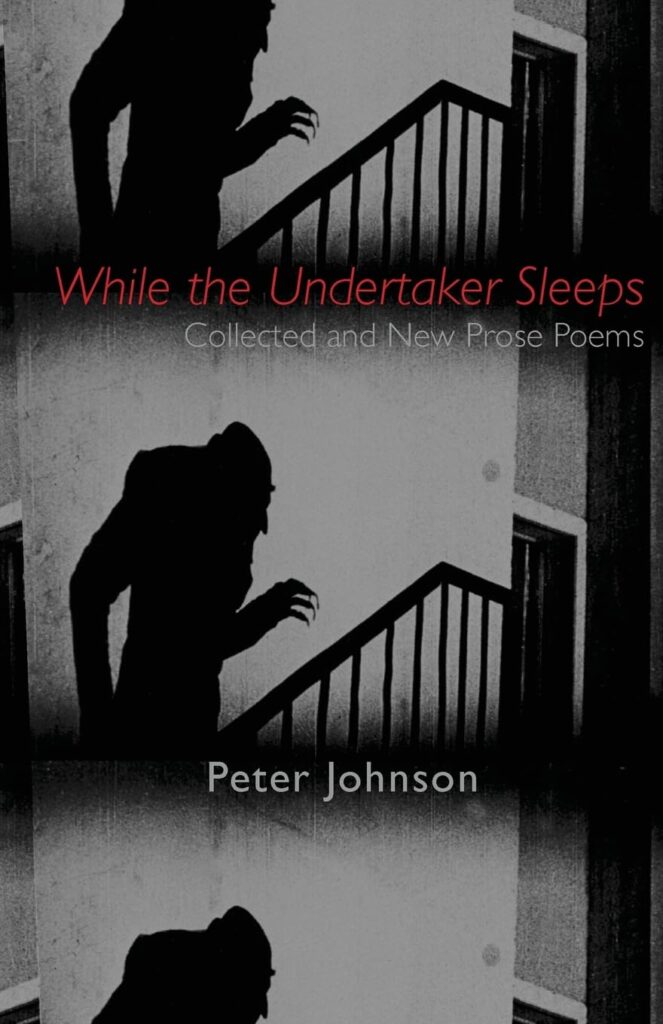
Let me finish by mentioning your While the Undertaker Sleeps: Collected and New Prose Poems, published in 2023. Its cover, by the way, (taken from the old black-and-white movie, Nosferatu), is fabulous, as is the cover of I’m Old, Not Dead!
That book was a huge publication for me, because it contains my whole career as a prose poet. It gathers all my books, plus new poems, into one volume, and it has a very lengthy introduction, written by the world’s foremost critic of the prose poem, Australian poet and critic, Cassandra Atherton. I’m really proud that book. It made me stop for a moment and look at my entire literary career. Thankfully, I wasn’t disappointed or embarrassed by it. It was almost as if I was reading poems written by someone else.
Anything new in the works?
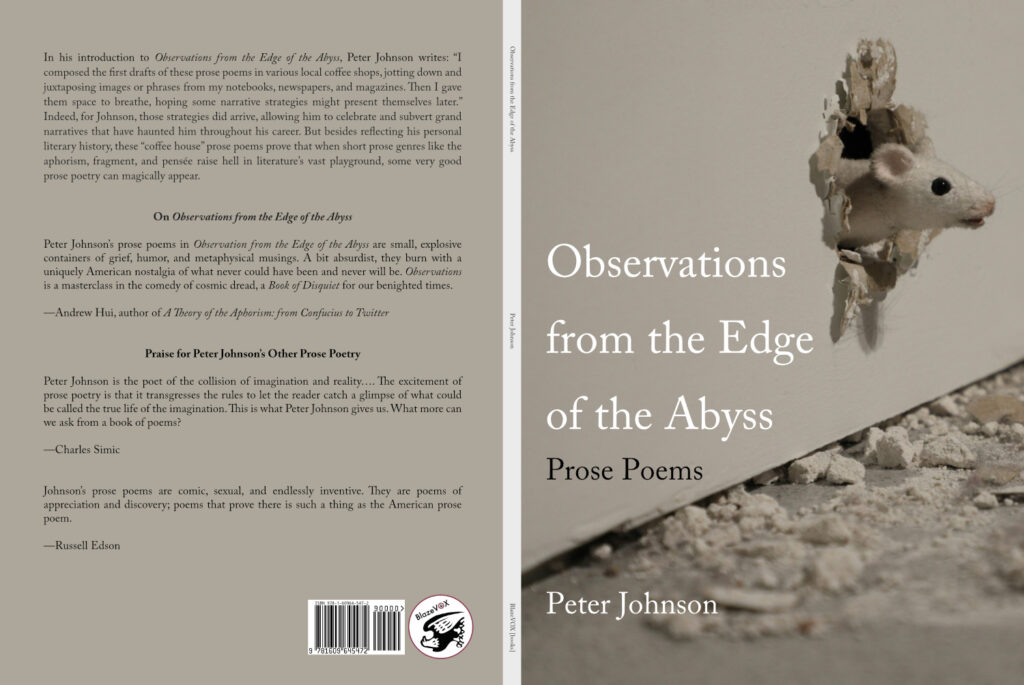
Usually, a “Collected and New” signals the end of a career, so imagine my surprise when three years ago an idea for a new book of very short prose poems came to me, which I ended up calling Observations from the Edge of the Abyss. Although the title sounds apocalyptic, the poems in Observations, like those in the Undertaker and the essays in I’m Old, Not Dead, are darkly comic, as they follow the journey of unnamed and often clueless first-person narrator, as he traverses a landscape of failed grand narratives. It was just published and can be found here: https://www.blazevox.org/shop-1/p/observations-from-the-edge-of-the-abyss-by-peter-johnson
What do you mean by failed grand narrative?
Simply put, we all have grand narratives we choose to live by or that are inflicted on us—stories we tell ourselves in order to create some kind of order. But problems occur when the grand narratives of others, whether they be religious or political or whatever, aren’t the same as yours, and so you decide to exclude, deport, or jail them. Fortunately, in our culture, we aren’t dumb enough to do something like that, right?
Do you have any other forthcoming projects that are not writing-related?
Right now, I feel as if I’m coming up for air after publishing or editing eight books in eight years. Lately, though, I’ve been disappointed in myself because, since Covid, I haven’t been involved enough in community service. In the future, I’d like to use my skills as a writer and teacher, not to mention my complex background, and give back to a world that, in spite of inflicting some physical and emotional bumps and bruises, has been very kind to me. I know that sounds corny but so be it.
Finally, what advice do you have for aspiring writers — in any genre.
Write what you want and the way you want to write it. Don’t try to please others. You’ll hate what you’re writing, and it will probably stink. Above all, be humble and don’t complain if you don’t end up famous. Most of that is luck. If someone decides to be a plumber, they’re going to end up with bad knees. If you want to be a writer, you’re going to get kicked around a bit. Finally, don’t count on your writing to pay the bills. If you want to be wealthy, don’t be a writer. Instead, marry rich.
From https://www.peterjohnsonauthor.com/about/:
Selected Publications:
• Observations from the Edge of the Abyss. 2026.
• I’m Old, Not Dead: Dispatches from the Desk of an Aging Poet, BlazeVOX [books], 2026.
• While the Undertaker Sleeps: Collected and New Prose Poems, MadHat Press, 2023.
• Dreaming Awake: New Contemporary Prose Poetry from the United States, Australia, and the United Kingdom, co-editor with Cassandra Atherton, Madhat Press, 2023.
• Shot: A Novel in Stories, MadHat Press, 2021.
• Truths, Falsehoods, and a Wee Bit of Honesty: A Short Primer on the Prose Poem, with Selected Letters from Russell Edson, essays, 2020 from MadHat Press.
• A Cast-iron Airplane That Can Actually Fly: Commentaries from 80 American Poets on their Prose Poetry, edited by Peter Johnson. MadHat Press, 2019.
• Old Man Howling at the Moon, prose poems, from MadHat Press, 2018.
• The Night Before Krampus: A Christmas Carol, 2017.
• The Life and Times of Benny Alvarez, a middle-grade novel (HarperCollins, June, 2014)
• Out of Eden, young adult novel (Namelos Press, February, 2014)
• The Amazing Adventures of John Smith, Jr., AKA Houdini, a novel (HarperCollins, 2012)
• Rants and Raves: Selected and New Prose Poems, 2010 (White Pine Press).
• Loserville, novel, 2009 (Front Street; namelos).
• What Happened, novel, 2007 (Front Street; namelos).
• Eduardo & I , a book of prose poems, 2006 (White Pine Press).
• Sentence: A Journal of Prose Poetics, guest editor, 2005
• I’m a Man, a collection of short stories, 2003 (White Pine Press).
• Miracles & Mortifications, a book of prose poems, 2001 (White Pine Press).
• The Best of The Prose Poem: An International Journal, editor, 2000
• Pretty Happy!, a book of prose poems, 1997 (White Pine Press).
Awards:
• Book of the Year for RI Secondary Schools for Out of Eden (2016)
• Houdini chosen by Kirkus Reviews as one of the “Best Children’s Books of 2012.”
• Houdini chosen by RI Center for the Book to represent RI at the National Book Fair in Washington, DC.
• Creative Writing Fellowship from Rhode Island Council on the Arts (2010)
• The Paterson Prize for What Happened (2008)
• Book of the Year for RI Secondary Schools for What Happened (2008)
• Creative Writing Fellowship from Rhode Island Council on the Arts (2002)
• James Laughlin Award from The Academy of American Poets (2001)
• Creative Writing Fellowship from the National Endowment for the Arts (1999)