
Untreated, infections can cause chronic suffering
PROVIDENCE — ‘Tis the season to be wary — of ticks, those parasitic arachnids that carry the bacteria that cause Lyme disease and other potentially debilitating illnesses.
Deer carry ticks along with smaller so-called “reservoir host” animals, including mice chipmunks and shrews
In Rhode Island, Lyme is the third most common infectious disease, after COVID and chlamydia, with 2,850 cases in 2025, the latest year for which Rhode Island Department of Health statistics are available.
“It’s TickSmart to #BeReadyForTicks even in the Fall,” Thomas N. Mather, University of Rhode Island professor and director of the URI Center for Vector-Borne Diseases, wrote in an email. “Now is NOT the time to stop your pet’s tick meds, or your own tick prevention efforts either. In the fall, do quick tick checks at least once or twice a day, especially focusing above the waist.
“And remember to tuck in your shirt, to keep ticks from crawling underneath. Wearing permethrin-treated clothing (InsectShield) or tight-fitting compression shirts (Rynoskin) and leggings are effective tick deterrents. You CAN prevent adult deer tick bites if you’re TickSmart.”
The Centers for Disease Control and Prevention describes the onset of Lyme Disease:
Early signs and symptoms (3 to 30 days after tick bite)
–– Fever, chills, headache, fatigue, muscle and joint aches, and swollen lymph nodes may occur in the absence of rash
–– Erythema migrans (EM) rash
–– Occurs in approximately 70 to 80 percent of infected people
–– Begins at the site of a tick bite after a delay of 3 to 30 days (average is about 7 days)
–– Expands gradually over several days reaching up to 12 inches (30 cm) or more across
–– May feel warm to the touch but is rarely itchy or painful
–– Sometimes clears as it enlarges, resulting in a target or “bull’s-eye” appearance
–– May appear on any area of the body
–– Does not always appear as a “classic bull’s-eye” rash
Later signs and symptoms (days to months after tick bite)
–– Severe headaches and neck stiffness
–– Additional EM rashes on other areas of the body
–– Facial palsy (loss of muscle tone or droop on one or both sides of the face)
–– Arthritis with severe joint pain and swelling, particularly the knees and other large joints.
–– Intermittent pain in tendons, muscles, joints, and bones
–– Heart palpitations or an irregular heartbeat (Lyme carditis)
–– Episodes of dizziness or shortness of breath
–– Inflammation of the brain and spinal cord
–– Nerve pain
–– Shooting pains, numbness, or tingling in the hands or feet
“In addition to the Lyme disease bacteria,” Mather stated, “blacklegged ticks may also carry the germs that cause babesiosis, anaplasmosis, a relapsing fever borrelia, and much more rarely, the deadly Powassan virus.”
While rare, the Rhode Island Department of Health, RIDOH, on Sept. 21 reported a confirmed case of the tick-borne Powassan virus disease.
“This resident is a male in his 60s who lives in Washington County,” RIDOH stated in a press release. “He began experiencing symptoms of Powassan in late August.
“ ‘We all need to be thinking about tick prevention measures when outdoors,’ ” said Director of Health Dr. Jerry Larkin. “ ‘Repel and reduce your exposure to ticks, check your body for ticks, and be sure to remove ticks if you find one on yourself, a family member, or a pet.’ ”
RIDOH continued: “This is Rhode Island’s third case of Powassan in 2026 and the eleventh case overall since it was first reported in Rhode Island in 2016. Powassan is a tick-borne disease that is found mostly in the Northeast and the Great Lakes region of the United States and in eastern Canada. Over 397 cases of Powassan have been reported in the US in the past 10 years (2016-2025).
“Powassan cases are rare, but the reported number of cases has increased in recent years. In 2025, there were 76 cases reported nationwide, which represented the most Powassan cases ever in a year. That year, there were 27 cases of Powassan reported in New England: 12 cases in Massachusetts, 6 cases in Maine, 5 cases in Connecticut, and 4 cases in New Hampshire.
“Initial symptoms of Powassan include fever, headache, vomiting, and generalized weakness. The disease usually progresses to meningoencephalitis, which may include meningeal signs, altered mental status, seizures, aphasia (difficulty understanding or speaking), paresis (muscular weakness or paralysis), movement disorders, or cranial nerve palsies. People with severe Powassan disease often need to be hospitalized. There is no vaccine or treatment for Powassan, so preventing exposure to ticks is the best strategy to avoid this disease.”
According to the CDC, “Powassan virus spreads to people through the bites of infected ticks. Three types of ticks spread Powassan virus: groundhog tick (Ixodes cookei), squirrel tick (Ixodes marxi ), and blacklegged or deer ticks (Ixodes scapularis). Rarely, the virus can also spread through blood transfusion.”
According to RIDOH, Washington County reported the most cases of Lyme Disease in 2025, with 1,082 people affected. Next was Providence County, with 856 cases; followed by Kent, 394; Newport, with 391; and Bristol, with 127. All age groups were affected.
So, too, with the state’s 39 cities and towns. Central Falls, reporting eight cases last year, had the lowest incidence. South Kingstown, with 284 cases was highest. Other municipalities with large numbers were North Kingstown, 175; Hopkinton, 124; and Coventry, 120.
New Shoreham in 2025 reported 58 cases — but the island had by far the highest rate, 4,113 per 100,000 residents.
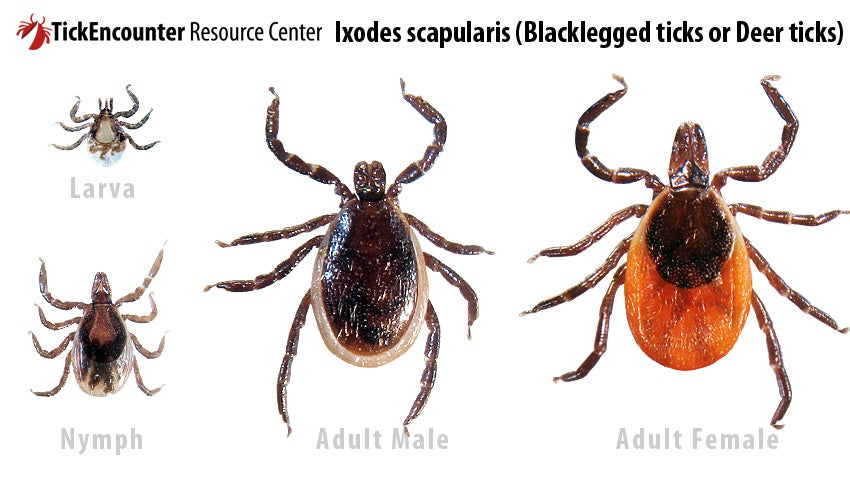
“Even after the first, second, or even third frost or killing freeze… this time of year, ticks ARE still active!” Mather wrote. “They’re not killed off like mosquitos, but there’s something different about the Fall tick season. In Spring and Summer there are a few different types of ticks active in Rhode Island, but in the Fall, the ticks people and pets encounter are pretty much ALL one type of tick — adult stage blacklegged (deer) ticks.
“The tiny poppy seed-sized nymph stage ticks that got a blood meal in late Spring and Summer have now grown into either the adult stage male or female form, and the black and red-colored adult females are extremely active NOW, looking to steal a blood meal, mainly from deer, but people and pets are victims as well. The all-black male deer ticks are active, too; they don’t engorge but they do get on hosts looking for a mate.”