
“The biggest compliment I’ve received from parents is that it gives them the opportunity to just breathe.”
SOUTH KINGSTOWN — What began as a student’s capstone project has become a homegrown solution to a growing need among caregivers of children with special needs across the state. Now, the program has a need of its own — a permanent home.
Imagine having to pack up everything in your office on Friday of each week — computers, desks, printers, etc. — only to unpack it all again every Monday morning.
This would be an unthinkable way to begin the workweek. But moving day comes every Saturday for Christine McGrane, clinical associate professor in the College of Nursing at the University of Rhode Island, who moves yoga balls, mats, specialized chairs, wagons, tables, fidgets and other items from a storage closet a few doors down into a space on the University of Rhode Island campus where she offers free respite. The program also travels to other locations, such as the imPOSSIBLE DREAM playground and Salty Brine Beach in nicer weather; the equipment must travel, too.
“We’re still trying to find a space that we can borrow permanently. Because currently, I’m like a traveling circus, with all the stuff packed up in my husband’s pickup truck,” said McGrane. It is an apt description for a program that depends on borrowed spaces, student volunteers, equipment and the willingness to move everything from one place to another.
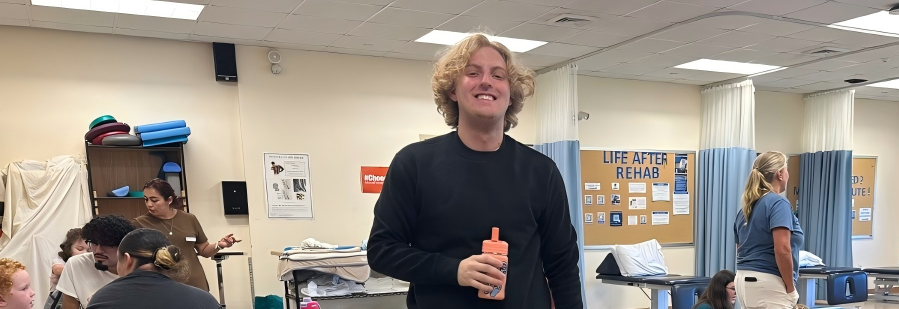
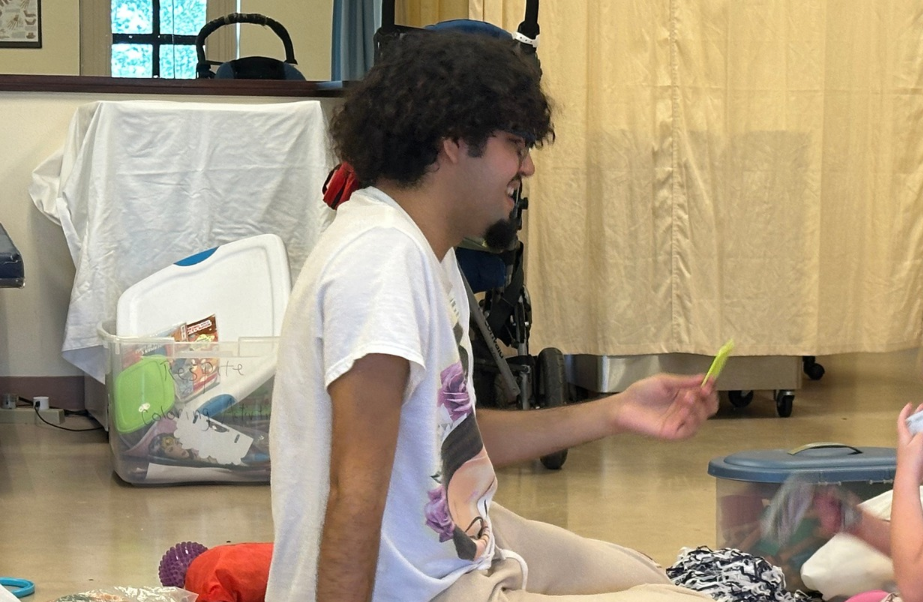
Every Saturday, McGrane and a team of students from local colleges and universities — the University of Rhode Island, Community College of Rhode Island, New England Tech and Johnson & Wales — provide four hours of free respite care, from noon until 4 p.m. Unlike state respite, which requires families to find and coordinate their own workers, McGrane’s program provides a consistent team of caregivers in one location each week.
Those workers are students studying fields such as nursing, social work, speech, early education, physical therapy, and other programs that work with individuals with developmental disabilities. They give their time in exchange for hands-on experience, while families get caregivers they can count on each Saturday.
Judith Dixon, a Barrington resident who uses McGrane’s respite, said, “At one point, it was all we really had — the only time I had a break.” Currently, she has friends who provide respite for her in addition to the respite McGrane offers, but as it is through the state, its limit is four hours a week. And she acknowledges that help is not guaranteed.
“If my friends could no longer do it, then what? Where are the workers?” asked Dixon. “Other families don’t have what I have, and it’s from years of advocating for it.”
That lack of available respite workers is a problem that Don’Trae Odufunade, CEO & president of the Autism Corner, who helps caregivers in Rhode Island navigate services for their children and the adults they care for, describes as “the first thing we all need to focus on.”
He said that out of the 45 parents he is currently helping, 24 of them cannot find a respite worker.
Both he and McGrane have been working together to try and find a way to solve this issue, acknowledging the dire need for families seeking respite workers in the state.
“If the parent can care for themselves, then the parent can care for the child,” Odufunade said.
But what that break means for caregivers is hard to explain. According to Odufunade, “For a parent of a child with special needs, you’re their advocate, their voice, their pediatrician, their everything.”
Dixon echoes this, saying, “People who have typical kids don’t get that our kids are very exhausting, but a level of exhaustion that cannot be explained. If you aren’t in it, you don’t get it.”
Respite care can also be misunderstood by the families who need it.
“Some parents don’t realize you can use respite services during the day, go grocery shopping if you want,” Odufunade said. Many families think of it more like a babysitting service to be used when their children are sleeping, according to him.
And for families who do find a worker to give them a break during their children’s awake hours, there can be other challenges. Workers may not show up or may need additional training to properly care for their children, Odufunade explained.
One of the unique parts of McGrane’s respite program is the consistency of coordinated care, which includes additional care for siblings — giving the whole family a true break.
What parents do with those four hours is up to them.
One option is the URI campus itself. McGrane said parents often use the walking paths while their children are in the program. One of the biggest compliments she has received from a parent, she said, was that the program gave her “the opportunity to just breathe.”
Dixon has used the time to walk the bike path, stop at a coffee shop to do some work; sometimes, she does go grocery shopping or pick up other things she might need. Sometimes, a friend will meet her for lunch. She might sit at the library or simply take some time for herself.
“Really, just anything I feel like doing,” she said.
But the time away is more than a break for Dixon.
“I’m frustrated by his behavior when I don’t have the help, but he wants to get a break from me too. You know, he doesn’t have these social opportunities away from his parent the way other kids do,” Dixon shared.
She noted her son’s excitement to attend the respite program on Saturdays.
For McGrane, the program has the students — the workers — the families and the need. What it does not have is a permanent place to bring them together.
“It’s a win-win. Why can’t I get a building?” McGrane said.
A permanent location would also need to accommodate children with different sensory and physical needs. One large room, such as the space at the imPOSSIBLE DREAM playground, would not work for every child, according to McGrane. Some need low lighting. Others need less noise or more room to move. That’s why this space is only used in nicer weather, when the outdoors can also be utilized.
Another option came up with a space at the American Legion in Pawtucket, but again, it was one large room and wouldn’t be adequate for the specific needs of the children.
McGrane also wants to remain connected to the university, so students will continue to participate, while also creating a space designed around the needs of the children and families she serves.
She has recently turned her attention to finding a permanent home for the program on the URI campus, but determining whether a suitable space can be made available has proven more difficult. For now, McGrane continues searching for answers — and for a place to call home, on or off campus.
“If we lose this space, my worry is I have nowhere to go,” she said.
A permanent space would mean less time packing up an entire workspace and more time with the kids. It would also give the program room to grow. McGrane envisions additional respite hours for children with special needs and adults, eldercare and, eventually, overnight care — while also creating a place where students can complete hands-on hours.
For McGrane, it could be a permanent solution that brings together the people who need care, the caregivers who provide it and the students who gain experience along the way — helping address one of the biggest challenges facing families seeking respite care in the state, a lack of workers.
For Dixon, it was a combination of years of advocacy and luck in finding respite workers for her child. Her question remains: “What about the people who don’t have that luck?”