‘Strong environmental ethic’ influenced his decisions
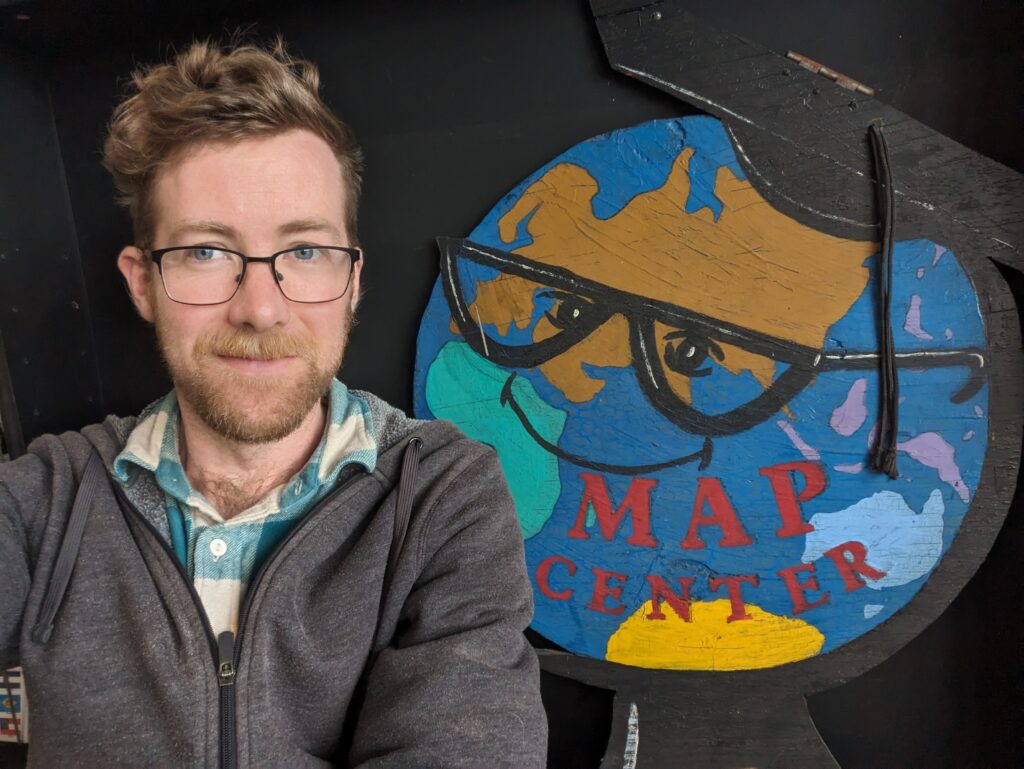
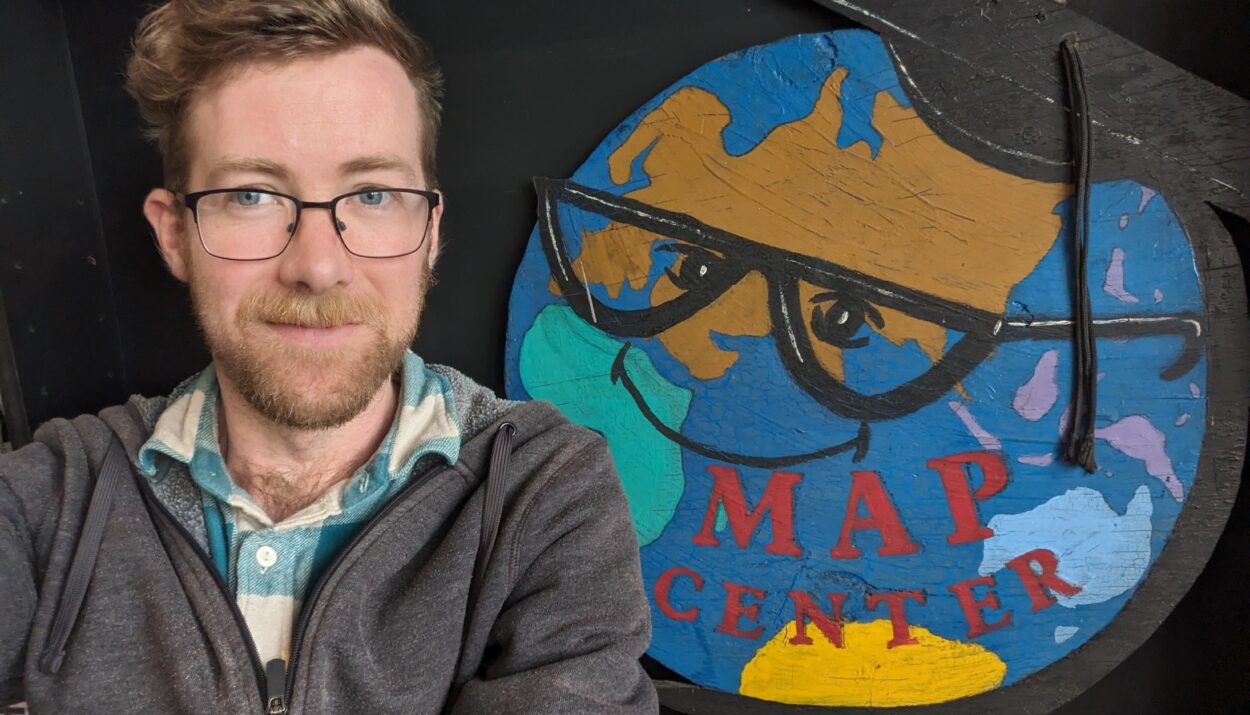
PAWTUCKET — A map of Andrew Middleton’s life would begin in New York state, where he was born, and would take him on a winding course to New Hampshire, California and, most improbably, to Rhode Island, where today he owns and operates The Map Center.
His store sells old and new globes, atlases, hiking and biking guides, calendars, jigsaw puzzles, compasses, prints, books — and, of course, maps.
Respect for the environment has been Middleton’s guidepost along the way.
“I went to the University of New Hampshire to get my bachelor’s degree,” Middleton said in an interview with Ocean State Stories. “ I studied environmental science, mostly because, in addition to having a strong environmental ethic, I didn’t like choosing between chemistry and physics and law and policy and writing.
“But I liked that in order to be a good environmental scientist, you have to be a broad-minded individual who can think about biostatistics, as well as climatology and geophysics.”
While attending the University of New Hampshire, Middleton “took a Geographic Information Systems course that turned into a summer job,” according to the Map Center web site. What followed was an “Americorps position in the Coal Country of West Virginia” and a move to “California where I settled in making maps of neighborhoods in Brazil for Apple Maps, maps of groundwater contamination for environmental consulting firms, and maps of power lines across Northern California for one of the largest utility companies in the world.”
Middleton had no plans to become a proprietor until Andrew Nosal, third owner of 70-year-old Map Center, decided to retire a couple of years ago. In March 2023, The Providence Journal’s Katie Landeck wrote about his decision:
“When you get to a certain age, it’s time to start passing on the things you’ve built up in your life.
“Or start putting them in a dumpster.
“Andrew Nosal, owner of The Map Center in Pawtucket, is hoping it’s the first one, which is why he recently posted this note on his website:
“ ‘Are you the right person to be the next owner?’ he wrote. ‘Act now! I am in the mood to give the shop away for little more than the pleasure of seeing someone adapt this venerable local institution in today’s environment and have as much fun as I did for the last few decades.’ ”
Middleton was living in Oakland.
“I was working as a consultant and I was starting a new job that I wasn’t really that excited about,” he said. One day, “I was on social media and one of my map nerd friends on the internet was passing around this article in The Providence Journal — on the other side of the country — about this guy who was getting rid of a map store that hadn’t made money in 10 years. And he said, ‘if you want to own a failing map store, send me an email and maybe I’ll give it to you.’ ”
Sending it, Middletown recalled, “was such an absurd thing to do. What was the likelihood he’d give it to me anyway? He’d probably say no.”
Nonetheless, Middleton emailed Nosal.
“And what do you know? Of all the hundreds of responses that he got from all over the world he liked mine. And I flew out to Rhode Island, a place that I had been to before, where I have some family connection to, but a place that I’ve never lived. I checked the place out. And I shook the guy’s hand and I said, ‘yeah, absolutely. This is the thing that I’ll do.”
The price to Middleton?
Nothing.
Nosal, who today visits his old store regularly, gave it to him for free.
Watch a video of Middleton. Click here.
Middleton can wax poetic when discussing maps and map-making.
“People often ask me, ‘are you disappointed that people don’t make maps anymore?’ ” he told Ocean State Storties. “That is extremely not the case. There are more maps being made today than ever before in human history. And the reason is it is cheaper and faster and the maps are better. They are more accurate. We’re cranking out maps all the time — but most of them are pretty ugly.”
When handcrafting a map, however, Middleton said, “we get to be intentional. We get to think about color. We get to think about text. We get to think about the stories that images tell. Maps are symbols: simplified objects that help us understand a really big, complicated place, which is this planet that we live on. And one way that we as human beings digest really big, complicated ideas that are difficult to describe is we use poetry. We use analogy. We use metaphor.”
He continued: “There are poems that do in 50 words what a novel can’t.”
Example: “If you’re talking about what it means to lose someone important to you, someone that you love, that’s a big feeling. The metaphor of a coat rack that’s empty — that’s a really simple metaphor that really slices to the core of it.”
Middleton said that old or new, maps can be “about places that are important to us. Maybe it’s about places that don’t exist anymore. Maybe it’s about places that are named something different because of a language that is no longer spoken there. A map can be quite a metaphysical thing. And one of the pleasures of getting to own a map store is I get to invite people into this world where maps are more than finding directions. It’s what makes doing what I do worthwhile.”