“I have had a pretty strong throughline in my career working to improve policies and systems to help kids.”
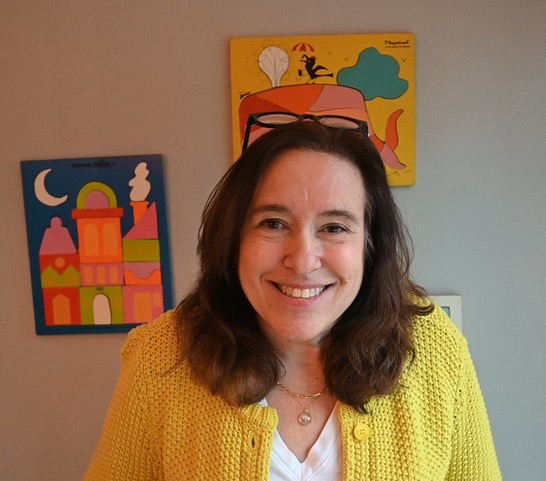
Congratulations, Leanne, on your new position. You are succeeding Susan Dickstein, who announced her retirement at the end of last year. We want to hear about the association and what you will do there, but first, please fill us on your background. You come to RIAIMH from Rhode Island KIDS COUNT. How long were you there and what were your responsibilities?
I am excited to follow in the footsteps of my longtime friend and colleague, Susan Dickstein, as the new Executive Director of the RI Association for Infant Mental Health. Before this new role, I worked at Rhode Island KIDS COUNT focusing on early childhood policy and advocacy for 21 years. I started at KIDS COUNT when my son was just a few months old and he is now 21 and about to graduate from college — so it has been a big part of my life, and I will miss working there.
At KIDS COUNT, I was very involved in facilitating the development of several early childhood infrastructure projects such as BrightStars, RI Pre-K, and the T.E.A.C.H. Early Childhood workforce development program. I also advocated at the State House for paid family leave, earned sick leave, Head Start, child care, family home visiting, Early Intervention, and other critical supports for families with babies and young children. I managed the RI Early Learning Council for 14 years and for the last 8 years, I coordinated the RIght from the Start Campaign, a coalition led by eight organizations focused on early childhood policy and funding. I also wrote lots of Policy Briefs, Fact Sheets, and grant applications.
And before joining KIDS COUNT, where did you work?
I was Vice President at United Way of Rhode Island where I was responsible for initiatives focused on children and families. That was a great job where I met and worked closely with Elizabeth Burke Bryant, who was on the Board at United Way and was the Executive Director at Rhode Island KIDS COUNT.
You also hold degrees from Tufts and Brown. Details, please.
At Brown, I concentrated in Psychology and had the amazing opportunity to do my undergraduate Honors thesis with Arnold Sameroff, Ph.D. – one of the founders of the field of infant and early childhood mental health! After I graduated, I stayed in Providence and worked for him managing data collection for a large federal research grant focused on understanding infant temperament – and that is where I first met Susan Dickstein! I then moved up to Boston and got a master’s in policy at Tufts where I focused on child and family policy. One of my internships at Tufts turned into an 8-year job at Work/Family Directions, a national consulting company that helped large corporations develop policies and programs to help working parents.
Where did your passion for helping others come from?
When I was a kid, I was very interested in becoming a teacher, which was my plan at Brown — to major in math and to get certified as a high school math teacher. My experience doing field work in the Providence Public schools made me realize that I didn’t really want to teach high school math, but I did want to help children succeed in school and in life. I wanted to work on fixing systemic problems that interfere with the success of children and families. That’s why I decided to get a graduate degree in policy. I have had a pretty strong throughline in my career working to improve policies and systems to help kids.
Any early inspirations?
I remember attending a lecture at Brown University given by Dr. T. Berry Brazelton, a nationally known pediatrician (the “Dr. Spock” of the 1980s) who was a strong advocate for paid family leave. He was a pivotal figure in securing passage of the federal Family and Medical Leave Act in the early 1990s. I remember him talking about the importance of policy and advocacy and I think that inspired me to move in that direction.
We see on the RIAIMH press release about your hiring that you hold an “Infant Mental Health Endorsement” from the Alliance for the Advancement of Infant Mental Health. What is that?
The Infant Mental Health Endorsement (IMH-E®) is an internationally recognized, competency-based credential confirming that professionals have specialized knowledge, training, and experience in relationship-focused, culturally sensitive practice for families with children aged prenatal through five. The Alliance for the Advancement of Infant Mental Health is the organization that partners with RIAIMH and other state Associations for Infant Mental Health to award the credential. My endorsement is specific for policy professionals.
The release states that you were “the first person to earn Mentor-Policy certification in R.I.” Again, details.
I was part of the first small cohort of people to earn an IMH-E® endorsement in the State of Rhode Island. There are several levels and types of endorsement available. I earned the highest level of endorsement (mentor level) and focused on early childhood policy. The credential indicates you have the skills and knowledge for systems-level advocacy, policy creation, and leading large-scale programs. To earn the mentor-level endorsement you must have a graduate degree, work experience in the field, and pass a three-hour test to demonstrate your knowledge of infant/early childhood development and how to apply this knowledge in real life scenarios. Currently, in Rhode Island, there are a total of 80 individuals with an IMH-E® and of these, 11 have earned the highest level of the IMH-E® (3 in policy, 7 in clinical, and 1 in research/faculty)
OK, now the RIAIMH. Give us an overview of its mission please.
RIAIMH’s mission is to promote and support the mental health of babies and young children and the way we do that is by working to build the skills, knowledge, and confidence of professionals who work with young children and their families – early educators, home visitors, health care providers, mental health clinicians, child welfare staff, and others. RIAIMH is also a founding member of the RIght from the Start Campaign and helps to advocate for improved state policies and systems that help families with young children.
We see three pillars of RIAIMH’s aims. Can you elaborate on each please?
— Educate
We offer professional development opportunities that are aligned with nationally recognized infant/early childhood mental health competency guidelines. Just this month, RIAIMH offered a 12-hour training for clinicians to learn how to use a nationally recognized evaluation framework to identify and understand early childhood mental health challenges in young children under age 6.
— Engage
We provide reflective supervision and on-site consultation to frontline professionals working with young children across the state. We build community by helping the early childhood field advocate for resources and programs that support the social and emotional well-being of Rhode Island’s youngest children and their families.
— Elevate
We support individuals who are seeking to earn a national endorsement in Infant/Early Childhood Mental Health. Endorsement honors and elevates the specialized knowledge and expertise of professionals across the infant, early childhood, and family-serving workforce – recognizing their commitment to high-quality, developmentally informed care.
In the press release, you stated: “As we see family stress increase, the percentage of young children in Rhode Island who have identified mental health challenges has grown significantly – from 10% in 2017 to 22% in 2025 among children under age 6 with Medicaid insurance.” That’s a disturbing increase. What are some of the factors behind it?
Some of this increase is probably attributable to increased recognition of mental health challenges in very young children. RIAIMH and national organizations such as Zero to Three have been doing great work to build more awareness of the infant and early childhood mental health field and to ensure professionals recognize that young children can and do suffer from mental health challenges, including anxiety and depression.
Experts estimate that about 1 in 6 young children have a diagnosable mental health condition and they are more common for children in families with significant economic hardship, so young children in families with Medicaid insurance would be expected to have relatively high levels of mental health challenges.
We know many families with babies and young children struggle economically because of the very high cost of raising a child. Housing and child care costs are usually the two biggest challenges, but health care, food, utilities, transportation, and parents’ student debt also add a crushing weight to many families. Stanford University’s RAPID Survey Project has been collecting data nationally since 2020 and reports that growing economic hardship and difficulty meeting basic needs has led to growing emotional distress and mental health challenges among parents and their babies and young children.
How can RIAIMH address this?
RIAIMH is working to strengthen state systems that help children and families thrive. We are also working to promote awareness of young children’s developmental needs and build systems to identify and respond to young children’s mental health challenges as early as possible.
RIAIMH has been working to…
Provide support and professional development opportunities to early educators, home visitors, clinicians, and other health care professionals.
What advice do you have for parents and families of young children with mental health challenges?
My first suggestion is to talk to your child’s pediatrician about any concerns you might have. Mental health care is part of health care. Your pediatric health care provider can help you figure out what your child’s behavior means and they can get help from Rhode Island’s PediPRN program, a phone consultation system that helps pediatric health care providers screen and make referrals for therapeutic interventions. The PediPRN program has expert consultants who specialize in infant/early childhood mental health and can refer families to a variety of services including the Incredible Years and Circle of Security parenting programs. Rhode Island also has a growing group of therapists trained in Parent-Child Interaction Therapy (PCIT), an evidence-based treatment of young children who struggle with frequent tantrums, aggression, or emotional regulation difficulties.
And finally, any advice for young people who might want to work someday with this population?
Seek out volunteer or work opportunities where you can spend time with young children and their families. I babysat regularly as a teenager and especially loved taking care of babies and young children. Working as a research assistant was also wonderful experience – I was able to visit families once a week from the time their children were 6 weeks old until they were 14 months old. You really learn a lot when you spend time regularly with the same child or group of children. Working with young children and their families offers profound rewards, including forming meaningful bonds and having fun! Although there are major challenges that often prevent people from entering and/or staying in the field, we are working hard to ensure early childhood professionals get the recognition and compensation that they deserve.