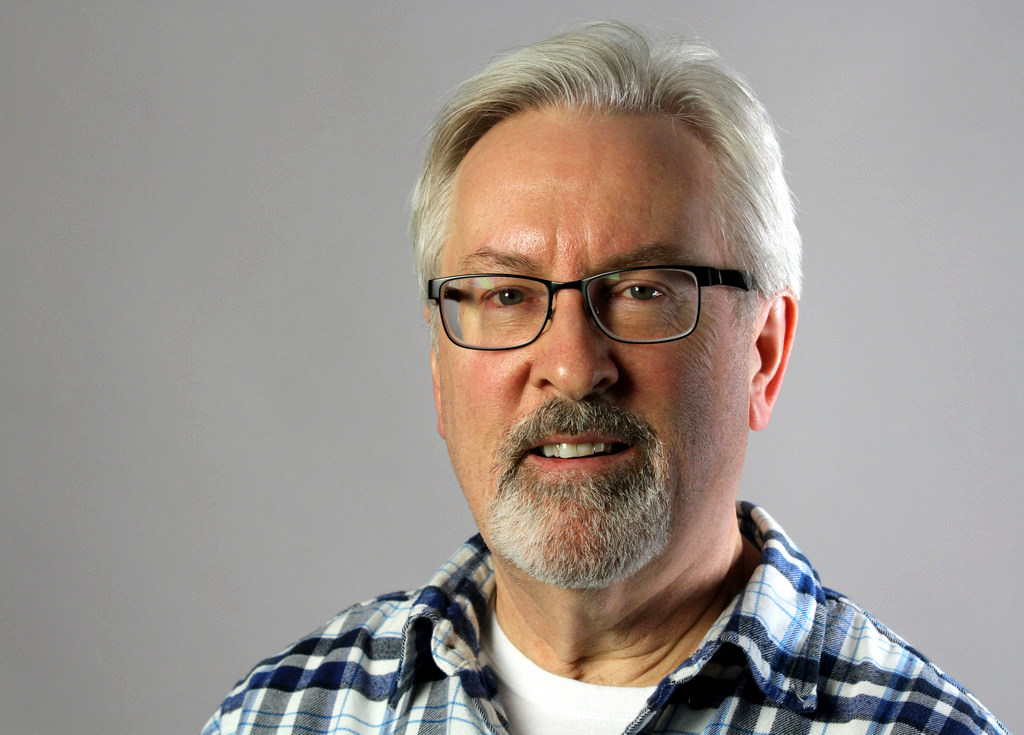
Providence resident’s latest is the critically acclaimed Blue White Water
Welcome Xue, and congrats on the recent publication of Blue White Water, which contains your latest poems — in Chinese and translated into English. We will dive into the collection momentarily. But let’s begin with the journey you traveled to Rhode Island. We note from the brief bio at the start of the book that you were born in Beijing. Details please.
I was born in Beijing, though my ancestral home is Liaoyang in Liaoning Province. The year I was born coincided with the rapid expansion of China’s Anti-Rightist Campaign, a political movement that profoundly altered the country’s intellectual climate and foreshadowed decades of subsequent political campaigns. I grew up in Beijing. When I was nine years old, the Cultural Revolution began. My younger sister and I were sent to Xiaoshan, in Zhejiang Province, where we lived with our grandparents for a time. Xiaoshan is close to Hangzhou, one of China’s most beautiful cities. Later we returned to Beijing. It is an immense metropolis, and I grew up immersed in the atmosphere and rhythms of urban life.
Did poetry and writing interest you from a young age?
When I was twelve, my parents divorced, and I lived alone in my father’s work-unit dormitory. Those were the turbulent years of the Cultural Revolution, when society was in extreme chaos. Separated from my parents, I felt an overwhelming sense of loneliness and pain. At that time I tried many different paths. I trained at a table tennis sports school, hoping to become a professional player. For two years I also studied operatic singing with a renowned vocal instructor from the Central Conservatory of Music. At one point I dreamed of becoming a sailor, imagining a life in distant places, far away from the confusion and anguish that surrounded me. Then, one day, I found a volume of Pushkin’s poetry lying in the corridor of the building where I lived. Those poems changed the course of my life. I began writing poetry myself. That was the moment I became the person I am today.
Did you have any mentors who inspired you?
As I mentioned, the poets who shaped my writing most profoundly were Alexander Pushkin of Russia, Charles Baudelaire of France, and W. B. Yeats of Ireland.
What led you to come to America?
After the June Fourth crackdown in 1989, my life changed completely. The entire country was engulfed in grief and fear, and I lived day and night with anxiety. A collection of my literary essays and two poetry anthologies that I had edited were halted before publication. Because I had supported the democratic movement led by students and citizens, I constantly feared that the state police would break into my home and send me to prison. Around the end of September, I learned that I had been awarded the Hellman/Hammett Grant in the United States and had been invited by Brown University to serve as a Writer-in-Residence and Visiting Scholar. It took me two months to obtain a passport under extremely difficult and dangerous circumstances. Eventually I received a U.S. visa and arrived in America in January 1990.
We must mention that now that you are here, in addition to writing, you are a fellow in Brown University’s Freedom to Write program. That’s an honor! Can you tell us a bit about the program?
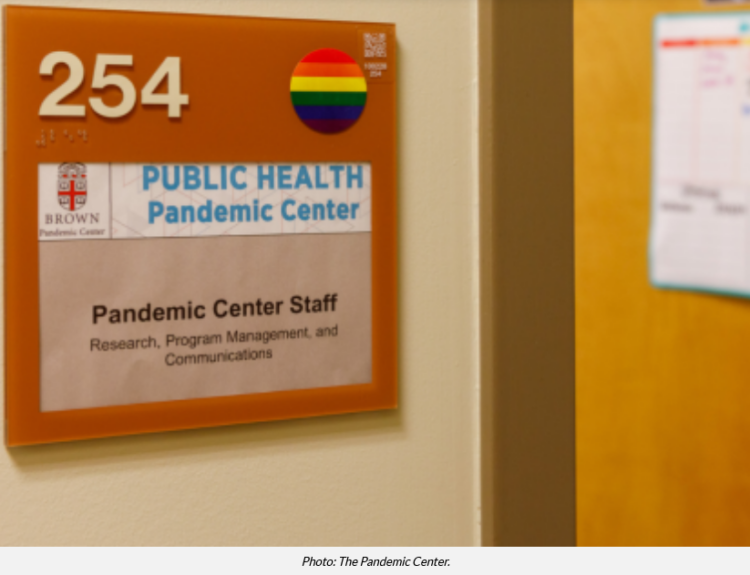
Brown University’s Freedom to Write Program was founded in 1989 by the distinguished novelist Robert Coover and the University’s former president, Vartan Gregorian. Its mission was to support international writers whose lives or freedom were under threat. The program brought political dissidents and persecuted writers to Brown and later became the foundation for what is now the International Writers Project. The first group of writers in the program included the novelist Ma Bo, then living in exile in France; the poet Bei Ling, then based in New York; and myself, a poet and literary critic living in Beijing. Later participants included the poets Meng Lang, then living in Shanghai, and Li Lu, then living in Beijing. Ma Bo eventually returned to mainland China. Bei Ling now lives in Taipei. Meng Lang later settled in Boston, where he sadly passed away after an illness. Li Lu later made her home in New York.
We also see on the Brown Freedom to Write page that in 1999, you “received a grant from the Joukowsky Foundation that has allowed [you] to remain at Brown and continue his writing. Details please.
In September 1999, with the support of the novelist Robert Coover, I was awarded an Artemis A. Joukowsky Fellowship at Brown University. The fellowship allowed me to continue writing and to complete my poetry collection The Depths of Parallel, along with other works. Much of that book was written during a residency at the MacDowell Colony in Peterborough, New Hampshire. It was later published in a bilingual Chinese-English edition under the title Zone.
The page also states that “Three volumes of [your] collected works, prepared for publication in mainland China in 1999, were stopped in press due to governmental censorship.” That must have pained you.
It did. The books had already been typeset and sent to press, and advance orders had been placed through the nationwide Xinhua Bookstore system. But because of the political aftermath of the 1989 democracy movement and its violent suppression, publication was halted. The two publishers involved—Writers Publishing House and Workers Publishing House—were both highly respected in mainland China. Earlier, in 1993, Morning Sunlight Publishing House had planned to publish a collection of my literary criticism. The manuscript had already gone through the final proofreading and was ready for printing when another political campaign began in China. Once again, the project was cancelled.
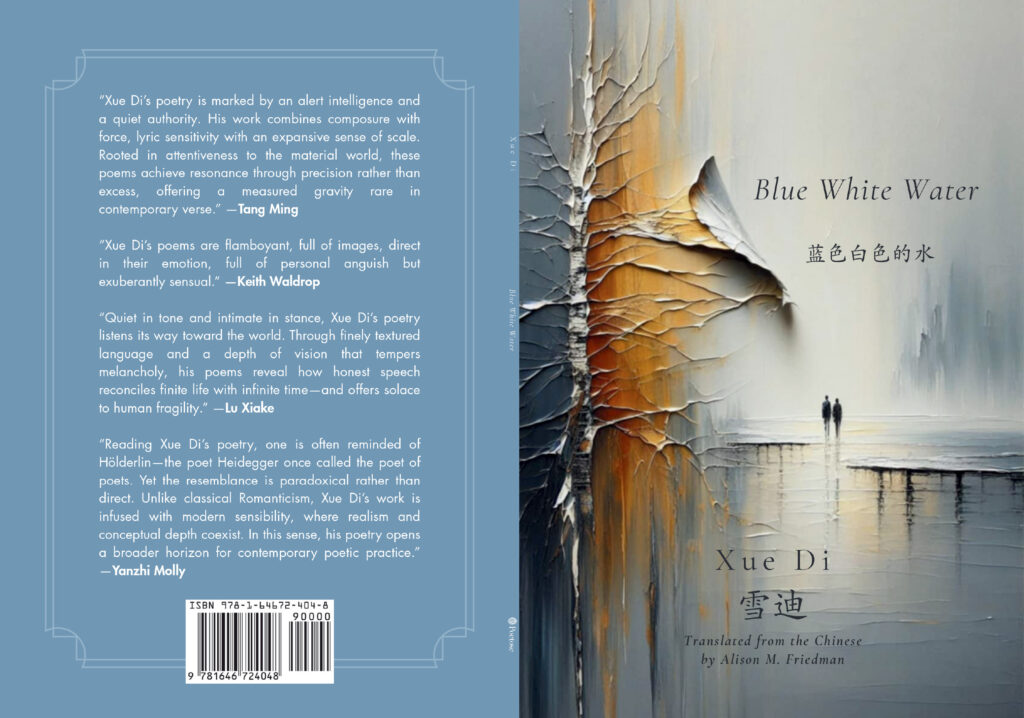
OK, let’s get into Blue White Water. Please tell us how you chose the title.
Blue White Water is a sequence of twelve interconnected prose poems. At its heart is a melancholy love story based on a relationship I experienced while living in mainland China. The work explores urban life, the landscape of the modern city, the restlessness of youth, and the atmosphere of repression, longing, and illusion that defined that era. It tells the story of a lonely poet and his love for a beautiful, gentle woman. That love flows like water—bringing joy and bewilderment, tenderness and distress. Desire is inseparable from the pressure of the political climate. At times the water is clear; at others it is polluted. Sometimes it rushes forward in torrents; sometimes it dries up altogether. That is the blue and white water flowing through the heart of a young poet.
So many themes, images, sensations and emotions are beautifully woven into the collection. Let’s learn about a few:
— Nature. An overview, please.
Because I was born and raised in a city, the long poem is filled with images of nature, while its depictions of urban streets remain both lyrical and faithful to reality. I was trapped in the city. Everywhere I looked there were crowds of people, endless streams of bicycles, and the wind carrying autumn dust through the streets. I longed for nature almost to the point of madness. The landscapes in the poem belong largely to my imagination. They are pure, untouched places, separated from the polluted crowds of the city. They became an island within my own spirit, encircled by blue water. There, too, is a beautiful young woman who leads me through days of grace and beauty.
— Memory. An overview, please.
Memory is like a diamond. At first it is simply a rough stone. Our remembrance and reflection are like the process of polishing it. The beautiful moments begin to glow with brilliant colors and crystal-like clarity. The difficult and regretful moments grow darker, revealing the diamond’s hidden shadows and imperfections. Yet those very flaws make us even more grateful for the wholeness of its existence. The poet’s task is to preserve what is beautiful, allowing it to remain in the world and bring comfort to those struggling through life. At the same time, poetry must also portray what is ugly, so that perhaps we may recognize those traps and avoid them.
— Love. An overview, please.
Love is one of the essential experiences of being alive. Through love we mature, we grow, and we gradually become whole. Love enables us to see ourselves more clearly, to hear our own inner voice, and to understand who we truly are. Through the person we love, we come to understand ourselves more deeply and discover the meaning of our lives.
— Night. Yes, an overview, please and thank you!
Night is my favorite time of day. I love its stillness, its power to gather one’s thoughts, and the harmony it offers to solitude. At night you can hear your own inner voice more clearly. You can also hear nature breathing peacefully as it rests. That quiet breath carries a fragrance of its own, one that completely captivates the creative spirit.
There are links on the Brown page to several readings you have given. We urge folks to listen. Any more in the works?
I recently participated in the 2026 Vermont Literary Festival, where I had the privilege of reading alongside many outstanding poets and was honored to give the closing reading. I enjoy reading my poems aloud and interacting with audiences. Reading a poem in public is a completely different experience from reading it alone. I also enjoy sharing stories about my writing process and moments from my life that lie behind the poems. Future readings are already being discussed.
Where do you find inspiration for your poems?
From nature; from a deep understanding of the present moment and the realities of the world; from the awakening that comes in solitude. It also comes from memory, from reflecting on the past, and from the insights gained through lived experience. Imagination, dreams, language itself, and the images awakened by people and things all become sources of inspiration. Reading and history are equally important. Each of these possesses its own unique voice and frequency. Much of my inspiration comes from capturing those voices, but even more comes from listening to the voice within myself.
What do you do for relaxtion?
Music and reading both help me relax. Music allows me to soar freely, filling my mind with countless visions. Reading carries me across different eras and cultures, allowing me to experience lives completely unlike my own, while somehow discovering myself within them. Travel has long been one of my greatest passions. Before becoming a Senior Technical Instructor at Brown University in 2016, I traveled extensively throughout the United States and visited many European cities. Before leaving China, I had also traveled widely throughout mainland China and Taiwan. Good food and fine wine also help me unwind. So do walking, occasionally getting together with friends, and simply sleeping. During my working years I averaged only three or four hours of sleep a night, so now I feel as though I am making up for years of lost rest. I also treasure driving through scenic landscapes and natural surroundings while traveling. Experiencing such purity and beauty, feeling the joy and fulfillment they awaken within me—those moments of gratitude have enriched my life beyond measure.
Do you get out of the city to explore other parts of the Ocean State — or other states?
As I mentioned earlier, I have traveled throughout many parts of the United States, giving poetry readings and participating in literary festivals, including the Hawai’i Book & Music Festival and the Seattle International Arts and Music Festival. I’ve also written at a number of artists’ residencies, many of them located in remarkable natural settings, including Rocky Mountain National Park in Colorado, Isle Royale National Park on Lake Superior in Michigan, and Buffalo National River in Arkansas. Other residencies include the Lannan Foundation in Marfa, Texas; MacDowell in New Hampshire; Yaddo in New York; the Blue Mountain Center in the Adirondacks of New York; and the Hermitage Artist Retreat in Florida, among others. I hope to continue traveling, giving poetry readings, and participating in literary festivals. At the same time, Rhode Island is a beautiful state, with the charming coastal city of Newport, numerous restaurants along the bay, and autumn maple leaves that are hard to leave behind.
Do you speak English or Chinese when you are with others, or does that depend on the company you’re with?
Yes, it depends on whom I’m speaking with. In daily life I mostly speak English because I live in an English-speaking environment. At work, while shopping, and in everyday conversations, English is the language I use. Once a week I have video calls with my mother and younger sister in Beijing through WeChat, and of course we speak Chinese. I also communicate in Chinese with friends in mainland China and Taiwan.
Where and when do you write?
When I was at writers’ residencies, I would begin writing as soon as I got up in the morning. At that hour my mind was free of distractions and still carried the momentum and reflections from the previous day’s work. I usually write for about three hours. I’ve found that after that point my concentration begins to fade. The lines become looser, they lose their tension, and the language becomes too casual. So I stop, have something to eat, go for a walk, and let my mind rest. When I return, I rewrite the poem in my mind. That is the time for revision and refinement, because I compose all of my poems by hand on paper. When working on a sequence of poems, I try not to watch television in the evening. I want to preserve the current of thought from the day’s writing, go to bed early, and continue the work the following morning. As for where I write—the answer is simple. Wherever I happen to be, that is where I write.
Do you discard drafts ever? I know I do in my own writing when I re-read them and find them unsatisfactory (and wonder where did that come from?!).
If I become stuck on a line, I never move on to the next one. Each line must feel as complete and satisfying as possible, because every line is deeply connected to the one before it. The direction of the next line, along with the images it chooses and develops, all depend upon the previous line. If one line fails to express exactly what I intend, the next line will lose its way. The same is true of imagery. Images are like stepping stones across a river: where each stone is placed determines whether the traveler can cross safely. I know every writer has a different process. Mine is rather stubborn. If a line isn’t right, I simply refuse to continue. Because of that, once a poem is finished, it is usually very close to its final form and requires little revision—unless many years have passed and my understanding has changed. When I write a sequence of poems, I rarely produce conventional drafts. I begin only with a general direction and an overall outline, allowing the work to develop organically. If I become dissatisfied at any point, the poem simply stops until I find a way forward that truly satisfies me. After completing the sequence, I select the poems I feel are strongest. Those that ultimately fail to satisfy me are destroyed.
What’s next for Xue Di?
I hope to complete a new poetry collection, publish several manuscripts that are already finished, and assemble a selected volume bringing together poems from my previous books alongside new work. I also hope to write the autobiography and the novel that have long been waiting in my heart. At the same time, I hope to work with an outstanding poet whose native language is English and who has extensive experience in literary translation. Together, I would like to polish and finalize the existing English drafts of my poems so that more of my work can be translated accurately and successfully for English-language readers.
Thank you for this interview.