
By MATTHEW LAWRENCE, Beacon Media Contributor
This story was originally published in the Warwick Beacon, a publication partner of Ocean State Stories.
Read this story in its original form and all other Beacon stories by clicking here.
WARWICK — Rick Boudreau couldn’t imagine what was wrong when he went to move his wife’s car from beneath the giant willow tree at the end of the street in Conimicut. He could see out the windshield, although it looked like fog outside. He tried the windshield wipers, but they were stuck in place.
On closer examination he discovered the glass was covered with thousands of pinpoint drops of sap and that the leaves of the tree had been severely chewed. It didn’t take him long to discover the root of the problem: the tree was infested with thousands of spotted lanternflies.
Boudreau knew what they were and he knew he should try to kill them. But he could not even step on the one he had brushed off his arm. It hopped from under his foot as soon as he stepped out to crush it.
Some homeowners have been besieged by the flies, but others have escaped them entirely. Kenneth Quaranto, owner of KDQ Landscaping, said his customers in the Edgewood section of Cranston were especially hard hit, while customers farther inland others haven’t been affected.
“Maybe the salt has something to do with it,” he speculated.
The good news is that they have no interest in humans and are harmless to pets. The bad news is that they are seemingly unstoppable. A non-indigenous species introduced from China, the flies have no natural predators here.
When birds learn they are a source of food, Quaranto is hopeful their numbers will decrease significantly.
One Warwick resident was appalled to discover the flies were so thick that they obscured the bark of three trees in her yard. Her husband suggested a fly swatter, but the thought of using that was equally appalling. A friend, Rick Rego, had another idea.
Regohad heard of a spray and supplied the recipe: to a quart of water, add a quarter cup of dish detergent and one tablespoon of vegetable oil. Spray the flies directly. The concoction worked. The trees were sprayed and the flies fell to the ground.
Studying lantern flies
“I just had someone complaining that their neighbors were cutting down trees that had spotted lanternfly on them,” says Lisa Tewksbury, Biological Lab Control Director at the URI Biocontrol Lab. “It doesn’t make any sense, because it’s not an infestation that stays. They can all be there one day, and then the next day, if they decide to go, they move on another tree, and there really isn’t a reason to think that something is infested forever.”
Tewksbury has been studying the lanternflies since they first arrived in Rhode Island a few years ago.
A spotted lanternfly lands on Matthew Lawrence’s sock. Beacon Media photo by Matthew Lawrence
“When I first saw the insect on a fact sheet, I thought it was a butterfly because it had its wings open,”Tewksbury said. “And then I saw one inperson,and I started talking to other entomologists who said no, that’s a plant hopper. I said it’s the biggest plant hopper I’ve ever seen! Our native planthoppers, potato leafhoppers, are these tiny bright green insects that kind of hop around on your potatoes. The spotted lanternfly is like them but much bigger.”
It’s sticky
“It has a proboscis, kind of like butterflies do,” she explains.The lanternflysucksplant sap. This meansthey also pee and poop plant sap, and so it makes everything sticky.
“If you’re ever in an area that’s really infested, all the foliage underneath where they’re feeding gets kind of covered with this honeydew. It’s very sticky, and sometimes if it’s bad enough a mold can grow on this sticky substance. The other thing people probably don’t love is that the sweet sticky honeydew brings in yellowjackets and other wasps.”
Tree of Heaven
According toTewksbury, the spotted lanternfly came from China and landed in Pennsylvania first. In Berks County, there was a company that brought in stone pavers from China. The most likely scenario is that the eggs had been laid on these stones. The stones were put near Tree of Heaven, a Chinese treethat is alsoinvasive.
Cynthia Kwolek is an environmental scientist and State Survey coordinator for the Department of Environmental Management’s Cooperative Agricultural Pest Survey (CAPS) program. She too has been studying spotted lanternflies since they first appeared in Rhode Island.
“TheTree ofHeaven was brought over from China during the nineteenth century,” Kwolek said. “People in that era were fascinated with exotic ornamental plants and trees.”
“The tree thrives in poor soil,” she explains. “It’s very resilient and basically impossible to get rid of. You see it a lot near railways and bike paths thatwere oncerailways,” Kwoleksaid. “There have been lanternfly infestations near the bike path in Coventry and at the Rail Explorers site in Portsmouth.
According to Kwolek,A Tree Grows in Brooklyn was written about was a Tree of Heaven. In Philadelphia, they were planted in cemeteries
In addition toTree of Heaven, Tewksbury says, the flies have been known to eat about 140 species of trees and vines.
“Aside fromTree of Heaven, they also feed on black walnut, butternut [white walnut], and grapevines,” says Kwolek.
“They’re not super interested in gardens,” she adds.
“I haven’t heard people complaining about their hydrangeas or anything like that,” Tewksbury confirms. “Whenever we’re told that we want to go look at something, it’s almost alwaysTree of Heaven.”
17 states and counting
So far, the lanternflies have been spotted in seventeen states. “It hasn’t crossed the Mississippi yet, but you can find them in Illinois, Ohio, West Virginia, Kentucky, and Tennessee,” says Kwolek.
“We’ve gotten over a thousand reports,” she adds. The DEM lacks the staffing to manually reply to everyone, but they send people out when there are multiple sightings in the same area.
Concerns and prevention
The biggest concern right now is agriculture. Spotted lanternfly will feed on hops and apple trees, and in other states apple tree infestations have led to reduced yield.
“Only two types of plants have been killed because of repeated spotted lanternfly feeding,” Tewksburysaid. “That’s the tree of heaven. And it’s not the big ones, but it’s the saplings. Thesaplings can be susceptible, and nobody really cares about that because it’s an invasive. But then in Pennsylvania, they did have some vineyards that lost grapevines.”
The DEM will spray certain at-risk areas. Contact sprays protect the part of the tree that gets sprayed. Systemic sprays are absorbed by a tree’s roots and last longer,though that method is significantly more expensive and is more environmentally impactful, according to Kwolek.
The most efficient way to get rid of them is to prevent eggs from hatching in the first place, what Kwolek refers to as egg mass scraping. Eggs are laid in October and November and hatch in April and May.
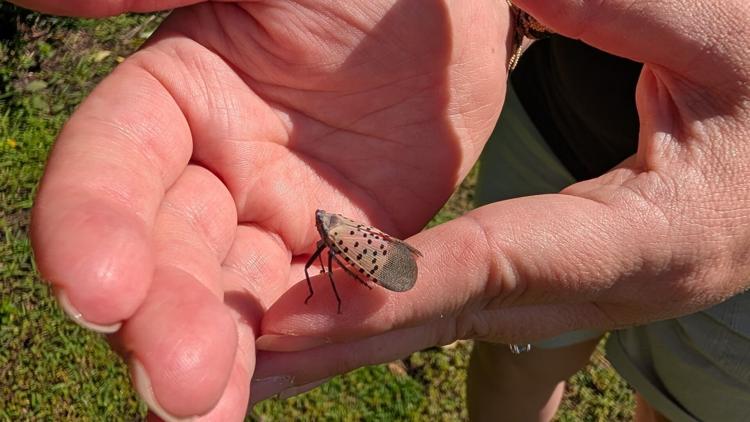
Cynthia Kwolek of the Rhode Island DEM holds a spotted lanternfly on September 4, 2026. Beacon Media photo by Matthew Lawrence
They will lay eggs on any tree, she says, but also places like wood fences, grills, undercarriages of cars. They have also been found on concrete, brick, and even on metal poles. Eggs are laid in a grid and then covered with a sticky protective coating.
“It’s grayish and looks like clay, about an inch long,” Kwolek says.
“Birds are certainly eating them,” Tewksbury says. “Praying mantises are eating them” The lanternflies are alsostarting to get some diseases.
“I think this is along-termproblem,” Kwolek says. “We might see natural predation happen over time, but we’ll have to live in harmony with them.”