
By MATTHEW LAWRENCE Beacon Media Contributing Writer
June 10, 2026
This story was originally published in the Warwick Beacon, a publication partner of Ocean State Stories.
Read this story in its original form and all other Beacon stories by clicking here.
PROVIDENCE — Rhode Island has two new centers for studying Black history. In Providence, the African American Museum of Rhode Island opened to the public earlier this spring, and on Aquidneck Island, Newport Historical Society will officially open its Edward W. Kane & Martha J. Wallace Center for Black History this Juneteenth.
Juneteenth, a national holiday since 2021, is celebrated each year to mark the emancipation of enslaved people in Texas in 1865. Juneteenth has been a state holiday in Texas since 1979, though formerly enslaved people and their descendants have been celebrating the occasion since the 1860s.
A number of events are happening throughout the state that week, the largest of which is a festival at Roger Williams Park from 12-7 p.m. on Sunday, June 21. For more information on that festival, visit juneteenthri.com.
The African American Museum of Rhode Island
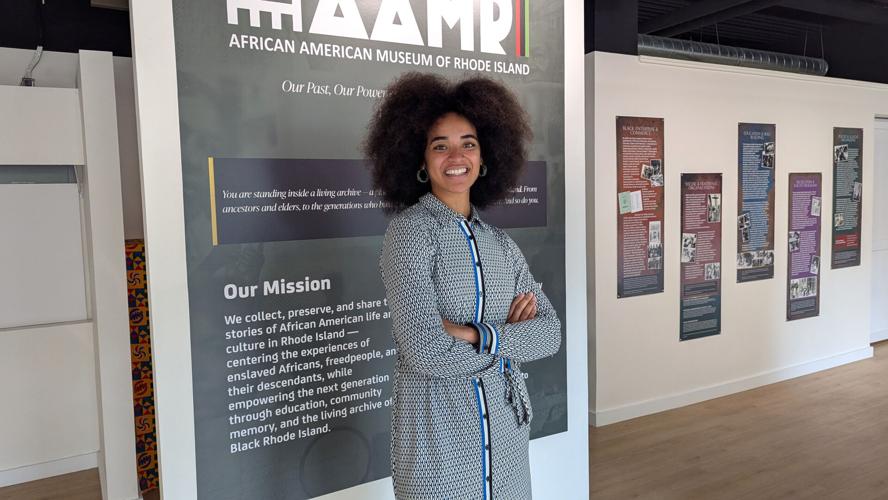
The African American Museum of Rhode Island is by, for, and about the state’s Black communities, says Executive Director Melaine Ferdinand-King, and particularly for descendants of the formerly enslaved. The museum has a number of programs to mark Juneteenth.
The roughly 1,100 square feet museum is located at 500 Broad Street. Ferdinand-King says that the museum is focused on programs, partnerships, and exhibitions. The inaugural exhibition is appropriately called Welcome to the Neighborhood: Mapping Black Providence 1940s–1970s. The show features the photographs of Omar Bradley, a Providence photojournalist whose work documents urban residents from the 1940s through the 1970s. The photos were uncovered in a private home by Valerie Johnson, who is also a photographer.
The exhibition describes four historically African American Providence neighborhoods, some of which no longer exist and some of which were changed drastically by the construction of Interstate Highway System as Routes 95 and 195 in the middle of the twentieth century. And the Lippitt Hill neighborhood was razed to build the University Heights complex in the 1960s. Six hundred and fifty homes, 450 of which housed Black families, were condemned and demolished, according to the wall text.
“I have curated a lot of exhibitions on Black life in Providence,” she says, citing the Black Biennial at RISD and the Providence Biennial for Contemporary Art as two examples. She also curated an exhibition at Brown’s Simmons Center featuring the art of political activist Mumia Abu-Jamal, who has been imprisoned for over forty years.
Ferdinand-King stresses that the museum is a community effort, relying on grants and private donors to grow at a sustainable scale at a time when government funding for arts and humanities is under threat. Because the museum is physically small, without much room for collection storage, they are building its digital collections.
Originally from New Jersey, Ferdinand-King received her doctorate in Africana Studies from Brown University while also curating art exhibitions.
Stillhouse Cove project
Partnerships include work with the Bristol Middle Passage Project and with the Community College of Rhode Island. Ferdinand-King is also one of the organizers of the Stillhouse Cove Remembrance Project, “a community-led initiative dedicated to recognizing, remembering, and memorializing enslaved Africans and their descendants connected to Stillhouse Cove in Cranston, Rhode Island,” according to their group’s mission statement.
Friday, June 19, the group will hold a ribbon cutting and unveiling ceremony for a monument “honoring the lives and legacies of enslaved African people whose histories are bound to this land,” according to a press release.
The monument is a bench, engraved with these words: “This cove — named for a rum distillery or “stillhouse” once located here — produced rum to fuel the violent capture and sale of enslaved Africans. We honor those who suffered and acknowledge this land’s role in the trans-Atlantic slave trade.”
The event begins at 2:30 p.m. in the parking lot of the Shriners Imperial Room (One Rhodes Place) and from there attendees will walk in a procession to the Ocean Avenue end of Stillhouse Cove. The dedication ceremony will begin at 3 p.m.
Later, there will be a 5 p.m. celebration at the Ephraim Bowen Stillhouse (37 North Fair Street, Warwick). Organizers encourage attendees “to honor the day through dress: descendants of the enslaved are encouraged to wear white and indigo blue; allies are welcome to wear colors of the rainbow.”
Edward W. Kane & Martha J. Wallace Center for Black History
In Newport, meanwhile, a series of events will mark the opening of the new Edward W. Kane & Martha J. Wallace Center for Black History. In a written release, Newport Historical Society Executive Director Rebecca Bertrand describes it as “an exciting milestone for both the Historical Society and the City of Newport.”
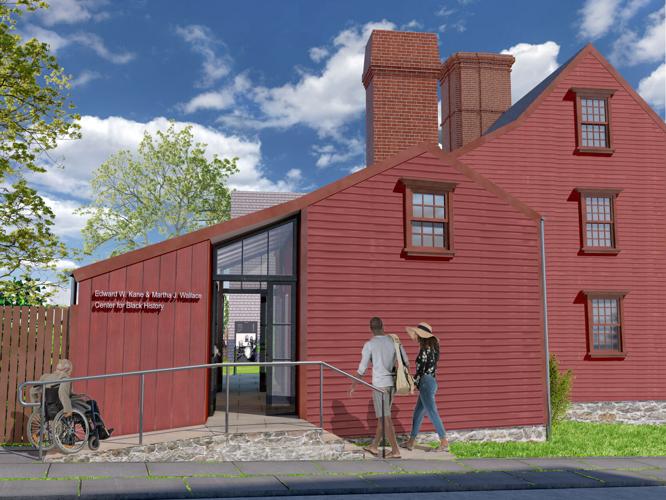
The Center for Black History will be located in the Wanton-Lyman-Hazard House, a building that dates to roughly 1697. It is the oldest surviving house in the city. Records of enslaved people living in the house date to the 1740s.The historical society purchased the home in 1927 and became a national historic landmark in 1960, according to its website.
Read a story about Newport’s 250th celebrations and events.
In 2005, a nkisi—an African spirit bundle—was found under floorboards in the attic. It dates to the 1700s, believed to have been placed there by an enslaved member of the household, and was later included in the inaugural exhibit at the Smithsonian Museum of African American History in 2016.
“The experiences of Black Newporters are fundamental to Newport life and culture throughout history and today,” said Dr. Akeia de Barros Gomes, the center’s director. According to a story in What’s Up Newport announcing her appointment as director, de Barros Gomes, a Newport native has a background in anthropology and African American history. She most recently served as the vice president for the American Institute for Maritime Studies at Mystic Seaport Museum.
According to the Historical Society website, the new center will feature exhibitions and community programs that preserve and share Black history and culture. Visitors and researchers can also explore digitized archives and access more than 5,000 historical records online.
“Through this dynamic new space, we will explore voices and histories that have been too long overlooked and put them at the center of our conversation,” Bertrand says. “We hope to inspire dialogue, deepen understanding, and help preserve and share the enduring contributions of Black Americans.”
There are four events to celebrate the opening. The first is a ribbon cutting at 10 a.m. on Juneteenth at 17 Broadway in Newport.
On Saturday, June 20, there will be free family-friendly activities on the lawn of the center, “including a dance performance by Soul Value, an innovative program celebrating the 250th through rigorous historical research and creative interpretation that foreground New England’s role in shaping the ideals of freedom, equality, and independence.”
That same evening, there will be a keynote lecture at 6 p.m. at the Great Friends Meeting House (21 Farewell Street). Heather McGhee, scholar, expert, and author of the book The Sum of Us: What Racism Costs Everyone and How We Can Prosper Together followed by a fireside chat with Center Director Dr. Akeia de Barros Gomes. Set against the historic backdrop of the Great Friends Meeting House, general admission for the keynote is $175 per person. All proceeds will support the Center for Black History.
Finally, on Sunday, June 21, there is a 1 p.m. Interfaith Celebration at the Center. For more information about the center and the opening celebration visit www.newportblackhistory.org.