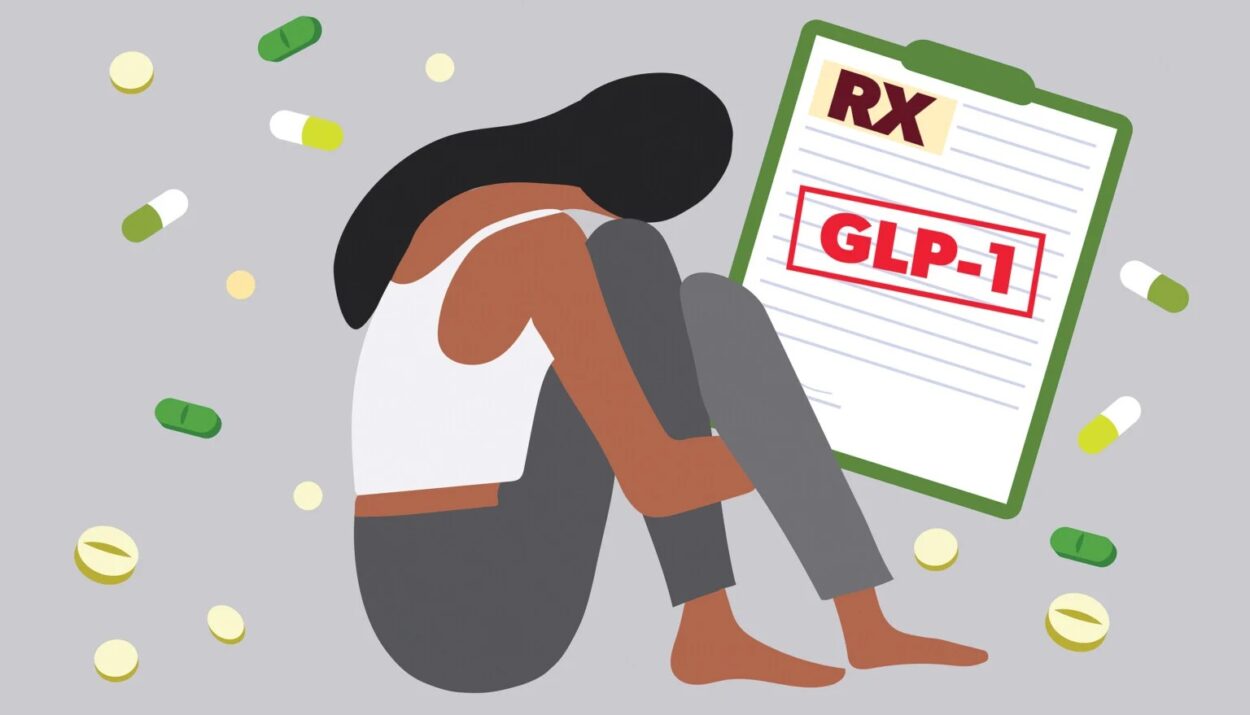
GLP-1s have been lauded as a weight loss treatment. But a first-in-the-nation pilot from a Providence-based nonprofit shows their potential to treat cravings of a different sort.
By Ellen Lieberman
Originally published in Rhode Island Monthly. “Copyright permission granted Rhode Island Monthly 2026.”
Regina Roberts, in recovery from six years of hard drinking, knew when she saw an empty nip bottle on the ground.
“I was just seeing them everywhere and every one of them is screaming at me: ‘Gina, go get a bottle.’ And suddenly I’m walking down the street and I’m like, ‘What is all this trash?’”
Jessica Vega knew when a whiff of alcohol turned her stomach. Before she moved into OpenDoors, a Providence sober house, a daily bottle of “Mad Dog” 20-20 had nursed her through depressions, suicide attempts, trauma stemming from sexual abuse in her family, homelessness and chronic pelvic pain syndrome.
“The other day, a person from here came in drunk and I had to go run away to the bathroom to throw up because it smelled so bad,” she says.
Jessica Massarone stopped having the drug dreams that left her too frightened to sleep. Her life had been barreling down a bad railway of cocaine for seventeen years. Along the way she lost her job as a preschool teacher and custody of her three children, acquired multiple arrests, and served time in the ACI. The last stop was drug court, where she asked the judge to release her to a sober house instead of the streets.
“I would wake up sweating and panicking. They felt so real. I was reliving the trauma of some really bad situations I had been in. But almost instantaneously, no more drug dreams. And I texted my doctor: ‘What is going on? Is this a thing — or am I losing my mind?’”
Roberts, Vega and Massarone are pioneers in what Nicholas Reville, co-founder and executive director of the Center for Addiction Science, Policy and Research, predicts “will be the biggest breakthrough in addiction treatment of all time”: GLP-1 drugs.
Glucagon-like peptide 1 is a hormone the human body naturally secretes in the small intestine, triggering the pancreas to release insulin, which regulates blood sugar and allows the body to convert food into energy. GLP-1 also slows digestion and signals satiety to the brain, but is broken down within two minutes. Scientists identified GLP-1 in 1986. Its potential as a medicine was discovered in 1992 when researchers isolated exendin-4, a longer-lasting simulation of human GLP-1 produced in the saliva of the Gila monster.
In 2005, the Federal Drug Administration approved Byetta, the first glucagon-like peptide-1 receptor agonist drug, to treat Type 2 diabetes. Over the last decade, pharmaceutical manufacturers have been producing improved versions of GLP-1 drugs to treat diabetes, obesity and most recently cardiovascular disease, marketed as Ozempic and Wegovy, among others. Two years ago, researchers examining the link between GLP-1 and substance abuse began to publish large, observational studies showing that patients taking GLP-1s for their prescribed purposes incidentally reported less alcohol, opioid, cannabis and cigarette use and had a lower risk of developing a substance use disorder.
Nick Horton, co-executive director of OpenDoors, was intrigued by the early research. Since 2003, the Providence nonprofit has been helping formerly incarcerated people transition back into the community with holistic programs that provide housing, employment assistance and other social services. In 2020, OpenDoors launched She Thrives to offer intensive wraparound services, including addiction treatment, to criminal justice-involved women staying in one of its transitional sober houses. In the first couple years, the participants did well in the program, but often relapsed once they left.
“It was very hard to identify a success story,” Horton says. “We were looking for any possible new approach that could help people who are struggling with recovery. Desperation is a reasonable way to look at it.”
In discussions with Reville, a personal friend, Horton began to shape a program using GLP-1s to aid OpenDoors clients. It took about a year to assemble the funding for a one-year pilot program, identify a pharmacy to compound the semaglutide — the active ingredient in some of the more costly, name-brand GLP-1s — and find a doctor willing to prescribe the drug for off-label use to uninsured participants. CASPR provided $50,000; Dr. Steven Klein, an addiction medicine physician based in Philadelphia with Caron Treatment Centers, agreed to see the participants as private patients, pro bono.
In April 2025, OpenDoors became the first social service agency in the nation to offer access to GLP-1 drugs as part of an addiction treatment program. Since then, nineteen women and one man who were living in an OpenDoors facility or at Amos House have enrolled.
Massarone and Vega signed on to lose weight.
“Getting sober, I had gained a ton of weight,” Massarone says. “I was feeling discouraged and thinking about relapsing, because it’s the fastest way to lose weight. But I thought: ‘It’s not going to help me with addiction, because I am too far gone.’”
Almost immediately, the women noticed a truce in the daily battle to maintain recovery.
“I thought about drinking all the time, all day, every day, because you’re so mad at yourself and the world for everything that happened, and all you want to do is drown your sorrows in the bottle,” Roberts says. “It took about two weeks before I realized that the cravings were really starting to simmer down.”
“I’m good at getting clean, but I can’t stay clean,” Massarone says. “That was always a struggle for me. I just couldn’t figure out how to not be high. It has changed my life.”
“Addiction is like a record playing in your mind, and that song always ends in using drugs or alcohol,” Klein says. “These medications lift the needle off that record long enough that I can teach you another song. That’s where our real sweet spot is with these medications. We’re helping patients in early and also later recovery to quiet the noise in their minds so that they have capital to invest in other things.”
According to the United States National Survey on Drug Use and Health, 48.4 million Americans grappled with an alcohol or drug addiction in 2024 — a problem that has long vexed legions of doctors, preachers and social architects.
For example, during Prohibition, the U.S. government attempted to discourage drinking by giving industrial alcohol manufacturers tax incentives to add toxic chemicals that rendered it poisonous. Bootleggers employed their own chemists to devise a formula that would counteract the methanol and benzene in denatured alcohol. Both experiments failed — people with alcoholism drank it anyway, and the contraband booze killed 10,000 Americans by the time Prohibition was repealed in 1933.
“For most of our history, we’ve viewed addiction as a moral failing — there was something wrong with the individual who had allowed themselves to become addicted. They were bad people for whom the solution was for them to become good,” says William Stauffer, executive director of Pennsylvania Recovery Organizations Alliance, who has written about the history of recovery movements.
In Prohibition’s disastrous wake, society’s approach to addiction and recovery took a radical turn. Mutual aid societies, combined with the scientific method and a social movement to destigmatize addiction, started chipping the flinty Calvinism that defined earlier efforts. 1935 was a watershed year: Alcoholics Anonymous was founded in Akron, Ohio. The federal government opened the United States Narcotic Farm, a combined prison, hospital and research facility outside of Lexington, Kentucky, where doctors experimented with new treatments for people with drug addictions. Yale University established the Yale Center of Alcohol Studies.
The last ninety years have seen an evolution in society’s understanding of addiction from depravity to pathological disease to a recognition that “substance use disorders are complex conditions. There are a myriad of facets that lead to people becoming addicted — genetic and environmental factors like trauma, poverty and homelessness,” Stauffer says. “We’re moving into seeing addiction on a continuum, and what looks like a gold standard treatment with one person has no effect on another because their individual makeup is different.”
Today, those treatments include self-help groups, behavioral therapies and residential rehabilitation facilities. But the quest for effective medical interventions hasn’t moved much further past Dr. Keeley’s Gold Cure for the Liquor Habit
of the 1880s. Clinicians have lots of pharmaceutical options for other mental health conditions, such as depression, Reville says, “but we just don’t have that in addiction medicine. We have very few treatments. The most effective opioid use disorder treatment is methadone, and it was invented in 1937. That really captures how little innovation there’s been.”
Reville says that GLP-1s have many advantages: They appear to work across all substances, patients don’t have to be abstinent to start treatment, and it’s easy to self-administer the weekly dose. It can be taken with other drugs and is non-habit-forming. In addition to weight loss, GLP-1s appear to reduce inflammation, depression and suicidality, and improve cardio health.
“People can see themselves changing. They feel healthier. A lot of people say it’s the best they’ve ever felt in their life. All of these other benefits are what make it something that’s going to be extremely popular and widely adopted. One of the biggest challenges of addiction medicine is that patients often don’t want to take the treatments that are available because they have negative side effects or may continue a dependency.”
GLP-1s have side effects, too. In the short-term, patients may experience gastrointestinal upset. The rarer, more serious side effects are malnutrition, muscle loss, gallbladder issues, pancreatitis, kidney problems and thyroid cancer. “Ozempic face” refers to the sunken look of patients who have lost too much fat from their faces. Some patients who stop taking GLP-1s report that their cravings and the weight returns.
Sarah Carstens, addictions clinical director of Outpatient Services at Penn Medicine Princeton House Behavioral Health, says the drug’s promise won’t be realized without further study of its long-term efficacy, how it fits into the complex mechanism of recovery, and resolving the problem of access. GLP-1 drug prescriptions are expensive; off-label use is not covered by health insurance — even if the patient has it.
“There has not been enough data to look at diverse populations and how this medication impacts people who don’t have the means compared to the typical population of folks who are currently accessing GLP-1s,” she says. “Only a small portion of folks who have historically struggled with addiction may have the insurance to be able to get this type of medication.”
According to an internal OpenDoors evaluation, the pilot’s preliminary results are encouraging. Only one person dropped out; participants reported a 119 percent improvement in well-being after three months and a 72 percent reduction in self-reported cravings after eight months.
Brandon Marshall, executive director of the People, Place & Health Collective at Brown University, hopes to secure funding for a formal research study to test the benefits of using GLP-1 drugs as part of a recovery program in an unstudied, challenged population.
“How long do people stay on the medications? Can they successfully transition to other types of treatment, or can they go off them altogether and remain in recovery?” he asks. “Can GLP-1s be a bridge — to a job, to friends or to family
— for people to reestablish the types of connections we know are what really leads to long-term recovery and success?”
Right now, Roberts, Vega and Massarone feel planted on that bridge.
Vega is reunited with her daughters and “everything’s sweet,” she says. “I’m doing different activities to keep my head busy. And I help people, saying, ‘Let’s go to talk with the social worker so you can go into the program.’”
Massarone is living independently and was just promoted to manager of a Warwick Subway. She regularly sees her children, who were adopted by their foster family. This spring, they invited her to join their Florida vacation.
“I had been able to get through my cravings, but holding on for dear life. Now when a craving comes, I’m able to process it and let it pass. My mind is clear — something I haven’t experienced in a very long time. I’m in control,” she says.
By April, Roberts had moved to an apartment in Cumberland, got custody of her son, earned her CNA license and was preparing to reenter the work force. She was also preparing to leave the pilot, but not GLP-1s.
“I will find the way to afford it.” she says. “It’s not really a choice.”
Ellen Liberman is an award-winning journalist and columnist who has commented on politics and reported on government affairs for more than four decades.