
By Jonmaesha Beltran / ecoRI News staff
August 6, 2026
This story was originally published in EcoRI News, a publication partner of Ocean State Stories
NEWPORT, R.I. — As the City-by-the-Sea looks ahead to the next decade, one idea surfaced in a natural hazards and climate change slide deck: “A/C for all.” The proposal reflects a growing conversation in the Northeast as extreme heat becomes more frequent: Should air-conditioning become an expectation of housing?
It’s a question leaders are beginning to consider in a region known for its cooler climate. Winters are growing milder, humid summers are hotter, and the urban heat island effect traps even more heat in Rhode Island’s cities. Researchers have found that the Northeast has been warming faster than most of North America.
Yet, Rhode Island’s housing protections have not caught up with the changing climate.
Neither the state nor Newport requires a dwelling or dwelling unit to have cooling during periods of extreme heat, as they do with heat in winter when temperatures drop to freezing. Without similar protection from heat, households are left to find their own ways to stay cool, mostly relying on window units and fans.
The burden of extreme heat isn’t shared equally. Lower-income neighborhoods and communities of color can face some of the highest heat exposure, including residents of Rhode Island’s 799 public housing buildings.
State officials urge residents to seek air-conditioned spaces during extreme heat, but not everyone has that option.
The U.S. Census Bureau estimates that 36,574 households across the state have no air-conditioning at all. Nationally, millions of households have reported experiencing uncomfortable indoor heat for at least 24 hours, with renters and residents of apartment buildings particularly affected.
For households that do have air-conditioning, staying cool can strain budgets in a state with some of the highest electricity costs in the nation. For some families, that means a trade-off: stay cool and risk a higher utility bill, or cut back on energy use and risk dangerous heat.
From May through September 2025, Rhode Island Energy sent more than 170,000 notices warning customers of disconnection for nonpayment. More than 12,000 electric and gas accounts were disconnected, with average balances ranging from $2,014 to $4,524, according to a low-income monthly report.
During the same period, the Low Income Home Energy Assistance Program, or LIHEAP, paid $1.14 million toward the energy bills of more than 5,000 Rhode Island Energy customers, according to the report.
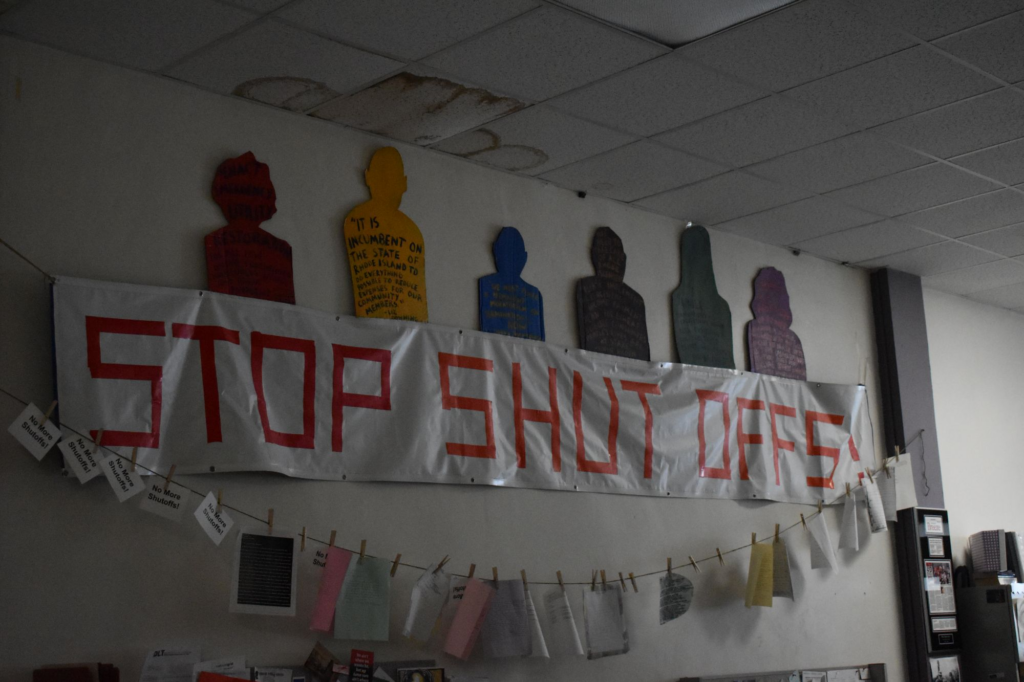
Rhode Island Energy is prohibited from disconnecting customers’ power during a heat advisory or excessive heat warning. But if the advisory or warning comes after the service was disconnected for nonpayment, Rhode Island Energy spokesperson Caroline Pretyman wrote in an email that the company will not restore service until it receives a payment from the customer that puts the account back in good standing.
“It’s important to note that shut-offs are a last resort and we reach out to customers several times before we reach a shut-off situation with letters, several phone calls, as well as bill reminders,” Pretyman added. “We encourage any customer falling behind to contact us so we can help.”
Going without reliable cooling can be deadly. Three Rhode Islanders died from heat exposure or heat-related illnesses during the five-month period from May through September between 2023 and 2025, according to the Rhode Island Department of Health (DOH).
“We shouldn’t have to learn through tragedy,” Camilo Viveiros, executive director of the George Wiley Center, said.
As the state considers how to prepare for more extreme heat, municipalities are also confronting what climate-ready housing should look like and who can afford it. Some have already begun mapping out how they will expand access to affordable, efficient, and cleaner energy while moving away from fossil fuels.
Newport is weighing what those policies could mean for its residents.
“Even though we’re a coastal community that may not experience the same type of oppressive heat as our inland counterparts, we’re certainly aware of the conversations that are being held in other communities concerning extreme heat and the need for mitigative actions,” Newport director of communications Thomas Shevlin wrote in an email.
Newport’s housing faces a new test
Newport County has warmed about 2 degrees over the past 130 years, ecoRI News has reported. Census Bureau data shows that more than 4,500 homes there lack air-conditioning.
Much of its housing stock is older and wasn’t designed for prolonged periods of extreme heat. Nearly 54% of the city’s housing units were built before 1939, according to the city’s hazard mitigation plan.
The lack of air-conditioning is most evident in the city’s North End, its most diverse neighborhood. Census data shows 374 households do not have air-conditioning.
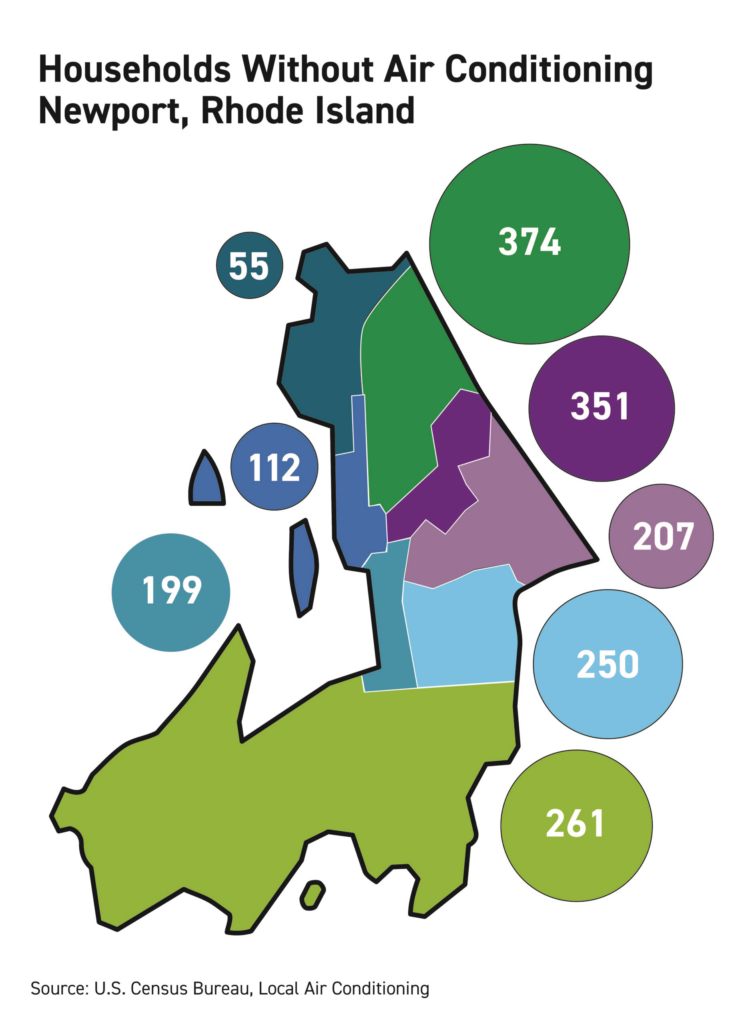
The lack of air-conditioning is most evident in Newport’s North End, where Census data shows 374 households don’t have air-conditioning. (Graphic by Joanna Detz/ecoRI News)
It’s an area that many people overlook in a city known as a summer resort for the wealthy, according to Jazmine Wray, director of prevention for the Newport Health Equity Zone.
City officials recognized the problem nearly two decades ago. In 2006, the Housing Hotline and Community Housing Resource Board collected donated air conditioners for older adults, people with disabilities, and low-income families, The Newport Daily News reported.
The housing hotline didn’t respond to ecoRI News’ request for comment to see whether the program still exists. But Newport City Council member Ellen Pinnock wrote in an email that she has personally dropped off people at cooling centers, and that some nonprofits provided air conditioners during high temperatures.
Pinnock added that a cooling ordinance would be “welcomed here,” but requiring air-conditioning in all homes might be difficult to tackle, even though she agrees with the idea.
A heat wave over a federal holiday weekend exposed gaps in the cooling center network, with some sites closed during business hours. The experience prompted suggestions to activate cooling centers during extreme heat, similar to how the state activates warming centers in the winter.
“There’s not a lot of plans for these major heat events because they’re kind of new,” Aquidneck Resilience community engagement manager Glennie LeBaron said.
The goal, she said, is to prepare before the next heat wave rather than wait until someone comes to harm because Newport County wasn’t ready.
Unequal burden of extreme heat
The Seamen’s Church Institute, serving Newport residents for more than a century, has taken a new role as a cooling center.
Ann Souder, the executive director, said many residents historically didn’t need air-conditioning because Newport’s coastal location brought cooler temperatures and sea breezes.
“It used to be that the middle two weeks of July were hot and steamy, and then the rest of the summer before and after was lovely, and the sea breeze kept it cool,” Souder said.
Warming ocean temperatures and shifting atmospheric circulation patterns are changing that, researchers have found.
Since 1900, Rhode Island’s temperatures have risen almost 4 degrees, according to the National Oceanic and Atmospheric Administration’s (NOAA) National Centers for Environmental Information. State officials project Rhode Island will get even hotter. By 2100, every county is expected to experience more than 30 days each year with temperatures above 90 degrees, according to the state’s coastal resilience plan.
Urban areas are warming faster because buildings, roads, parking lots, and other impervious surfaces absorb the sun’s heat, creating what scientists call the urban heat island effect. The phenomenon raises both daytime highs and nighttime lows.
In Newport, that burden is concentrated in the North End, which developed later than much of the city’s historic core.
Research shows that hot urban neighborhoods often overlap with communities that were historically redlined, when the federal government coded neighborhoods as high-risk for investment and denied residents access to loans and other resources.
While Newport planners found no evidence of redlining, public health researchers found that historically redlined neighborhoods in Providence have fewer trees, more pavement, and higher temperatures.
Studies show that low-income communities with little tree cover and a history of redlining can be up to 12.6 degrees hotter than surrounding neighborhoods.
For many residents, higher temperatures also mean higher costs. Low-income households spend nearly three times their income on energy compared to higher-income households, according to the U.S. Department of Energy.
Energy insecurity forces some families to make difficult choices in New England: 570,000 households report keeping their homes at unhealthy temperatures, while 930,000 report reducing or forgoing food or medicine to pay energy costs, according to the U.S. Energy Information Administration Residential Energy Consumption Survey.
Rhode Island households face some of the highest energy burdens in the Northeast, with residents spending as much as 16% of their income on energy, according to the American Council for an Energy-Efficient Economy. Electricity rates have risen 28% since 2020 and are expected to keep climbing.
The discounts available to income-eligible customers are not enough to substantially reduce energy burdens or alleviate energy insecurity, the council found.
That’s what the George Wiley Center, a grassroots organization in Pawtucket, has been fighting to change. For more than 30 years, the center has challenged energy policies and helped residents navigate utility shutoffs, including people who receive food assistance but are required to pay $1,200 upfront to restore power and keep their refrigerators running.
Health risks of hotter summers
The dangers can begin before temperatures reach what many consider extreme heat.
When daily highs reach 85 degrees, both all-cause and heat-related emergency department visits begin to rise, according to Dr. Katelyn Moretti, an assistant professor of emergency medicine at Brown University.
Moretti noted in a Brown University article that humidity above 75% can make it harder for the body to cool itself.
Brown researchers and New England state health departments found in 2017 that days with a heat index of 95 degrees led to a 7.5% increase in heat-related emergency department visits and a 5.1% increase in heat-related deaths over the following week.
DOH data shows that from May through September between 2023 and 2025, 522 people visited emergency departments for heat-related illness. Eight of those visits occurred in Newport.
Heat-stress emergency department encounters and hospitalizations
From May to September
2023
153
2024
147
2025
222
Chart: Jonmaesha BeltranSource: Rhode Island Department of HealthEmbedCreated with Datawrapper
The numbers might not capture the full burden. Moretti noted in the article that traditional tracking methods can undercount the toll of extreme heat, as emergency departments often see spikes in heart and kidney problems, asthma attacks and mental health crises during heat waves.
Those risks are relevant in Newport’s North End, where residents experience higher rates of asthma and other chronic health conditions than the citywide average, according to a Newport Tons of Trees Initiative report.
But identifying heat as the cause is not always straightforward.
Emergency physicians first rule out other common causes before determining whether heat may have contributed to a patient’s condition, said Dr. David Lindquist, assistant medical director of the Newport Hospital emergency department.
“Something like, ‘Oh, this was just related to heat,’ is almost what we might call a diagnosis of exclusion,” he said. “Meaning, we’ve ruled out a whole bunch of other things that could also cause that.”
Emergency departments in Newport and across Rhode Island have been busy this summer, particularly in June and July, Lindquist said. But the types of patients coming through the doors haven’t changed much.
“Now you’re just kind of layering on heat on top of that,” he said, adding that it’s difficult to determine whether heat worsened a patient’s illness.
For those seeking to stay cool, Lindquist recommends keeping blinds closed during the hottest part of the day, staying hydrated, and placing a fan across from a bucket of ice water to circulate cool, moist air.
Newport looks to trees for relief
When living collections manager Joe Verstandig joined the Newport Tree Conservancy in 2021, the organization had a goal of increasing the city’s tree canopy.
Newport has one of the lowest tree canopy cover rates in the state, and the North End has one of the smallest shares in the city.
Since then, the conservancy has planted around 350 trees throughout the North End, particularly near low-income housing, to provide shade, cool surrounding streets, and help reduce energy use. Including a reforestation project at the Miantonomi Memorial Park, the organization has planted about 750 trees, Verstandig said.
The city hasn’t measured how much its tree canopy reduces energy costs or improves air quality, according to Green Infrastructure Center community forester Alexander Elton. But that could change soon.
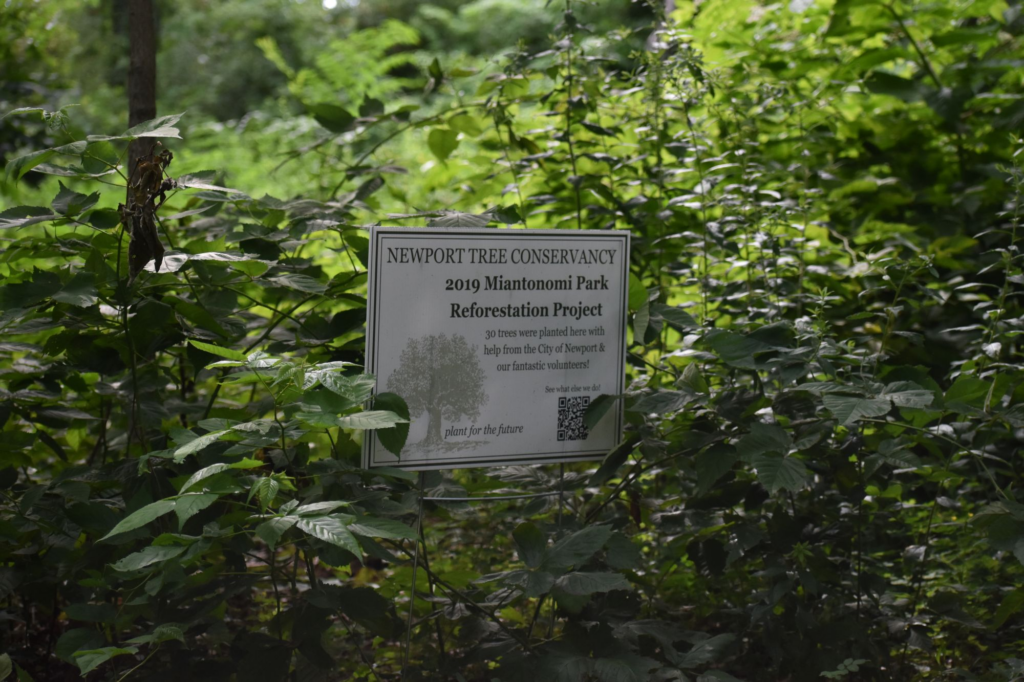
Miantonomi Memorial Park is Newport’s largest public park and urban forest. It sits between housing developments in the city’s North End. (Jonmaesha Beltran/ecoRI News)
Once the City Council adopts its new tree canopy study, potentially this month, officials plan to begin ongoing air quality measurements, targeted plantings, and, where possible, the establishment of micro-forests, Shevlin, director of communications, wrote in an email.
Heat-related emergency department encounters and hospitalization cases
May–September 2023–2025
| Table with 3 columns and 9 rows of data. (column headers with buttons are sortable) | ||
| Race | Ethnicity | Count |
| White | Non-Hispanic | 400 |
| White | Hispanic | 8 |
| White | Other | ≥5 |
| Black | Non-Hispanic | 36 |
| Black | Hispanic | ≥5 |
| Black | Other | ≥5 |
| Other | Non-Hispanic | 28 |
| Other | Hispanic | 35 |
| Other | Other | 7 |
The source suppressed some cases for confidentiality reasons.
Table: Jonmaesha BeltranSource: Rhode Island Department of Health Embed Created with Datawrapper
Research suggests that every 10% increase in urban tree canopy can lower ambient air temperatures by 2 degrees. Nationwide, the USDA Forest Service estimates that urban forests save $7.8 billion annually by reducing heating and cooling costs.
Providence is the only Rhode Island municipality with local estimates. Its PVD Tree Plan shows the city’s urban forest saves an estimated $591,000 annually in building energy costs while removing 91 tons of air pollutants.
Newport’s 2026 Strategic Tree Canopy Plan aims to increase canopy coverage from 19% to 21% over the next decade. In Newport’s North End alone, Verstandig estimates adding just 3% to 5% more canopy would require nearly 2,000 additional trees.
The North End has just over half the tree canopy recommended for the neighborhood. Its canopy currently covers 26% of the area, compared with a recommended 50%, according to American Forests’ Tree Equity Score.
Reaching the goal isn’t easy, as most streets lack tree lawns, where there is space between the sidewalk and the street to plant a tree, Verstandig said. Some residents worry about fallen branches, fruit or damage to their property, he added.
Maintaining trees also stretches the conservancy’s limited capacity, while drought, extreme heat, and invasive pests threaten trees.
Development pressure adds another challenge. After residents protested the removal of five trees for a hotel project, the city adopted a tree preservation and landscaping ordinance, Newport This Week reported.
“We have some tree momentum, and it’s a great time to see what we can do to continue the planting work into the North End neighborhoods,” Pinnock wrote.
Rethinking housing for extreme heat
State and local officials are looking beyond cooling centers and tree planting to rethink how homes themselves can keep residents cool.
Climate planning documents recommend increasing access to air-conditioning, strengthening energy-efficiency programs for low-income multifamily housing, and redesigning buildings to stay cooler.
A Newport presentation on climate hazards recommends adopting building codes and incentives to encourage reflective roofing materials, such as green roofs, to reduce the urban heat island effect.
Shevlin wrote that Claiborne Pell Elementary School, the city’s largest and newest building in the North End, showcases construction features leaders hope to incorporate into future development.
The school uses daylight harvesting, green infrastructure, insulated roofing, and light-colored roofing membranes designed to improve energy efficiency, reduce summer heat gain, and stabilize interior heating costs.
The presentation recommendations mirror those in Rhode Island’s coastal resilience plan, which cites New York City’s property tax incentives for green roofs as a model for lowering rooftop and neighborhood temperatures.
Officials have also proposed investing in passive cooling strategies, such as shade structures, improved ventilation and insulation, and incentives for energy-efficient retrofits in densely developed neighborhoods.
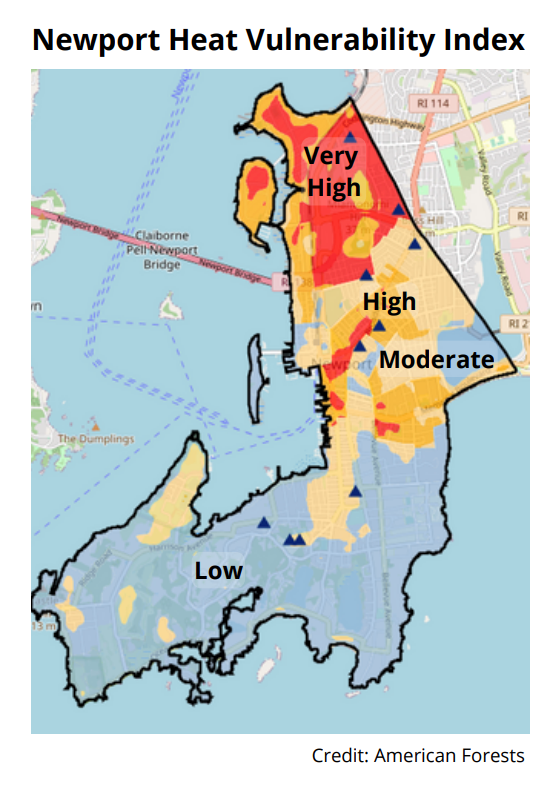
Urban areas are warming faster because buildings, roads, and parking lots absorb the sun’s heat, creating what scientists call the urban heat island effect. The phenomenon raises both daytime highs and nighttime lows. In Newport, that burden is concentrated in the North End, as this map shows. (Newport Tons of Trees Initiative)
Some of those strategies are already taking shape in Rhode Island’s public housing.
The state’s coastal resilience plan shows that the buildings built before 1975 are particularly vulnerable, as they were built before air-conditioning became common across Rhode Island.
State officials proposed creating a dedicated Clean Heat Rhode Island program for low-income, multifamily housing, allowing public housing authorities to install heat pumps while reducing administrative costs.
At Carroll Tower in Providence, the Rhode Island Office of Energy Resources replaced electric baseboard heating with 277 window heat pumps across 194 apartments.
The project provided elderly, low-income residents with heating and air-conditioning for the first time in the history of the Providence Housing Authority building.
Nearly 90 residents had bought their own window air conditioners to cope with summer heat before the upgrade, according to a project case study.
Newport has not yet received a similar project. The Office of Energy Resources hasn’t worked with the Newport Housing Authority, but is exploring ways to bring heating and cooling upgrades to additional public housing authorities, according to chief public affairs officer Robert Beadle.
Health officials are also targeting housing conditions as part of the state’s response to heat and respiratory illness. Rhode Island’s asthma strategic plan calls for improving heating, ventilation, and air-conditioning systems in asthma hot spots, particularly in public housing.
Since 2020, the DOH has operated a program that provides air conditioners to residents of Providence Housing Authority buildings who have been diagnosed with respiratory illnesses.
It’s the only program the department has for distributing air conditioners, according to public information officer Joseph Wendelken.
The Newport Housing Authority didn’t respond to ecoRI News’ request for comment. But Shevlin wrote in an email that, to his understanding, the newest phase of Park Holm, now under development, will include mini-spits providing electric heat and central air.
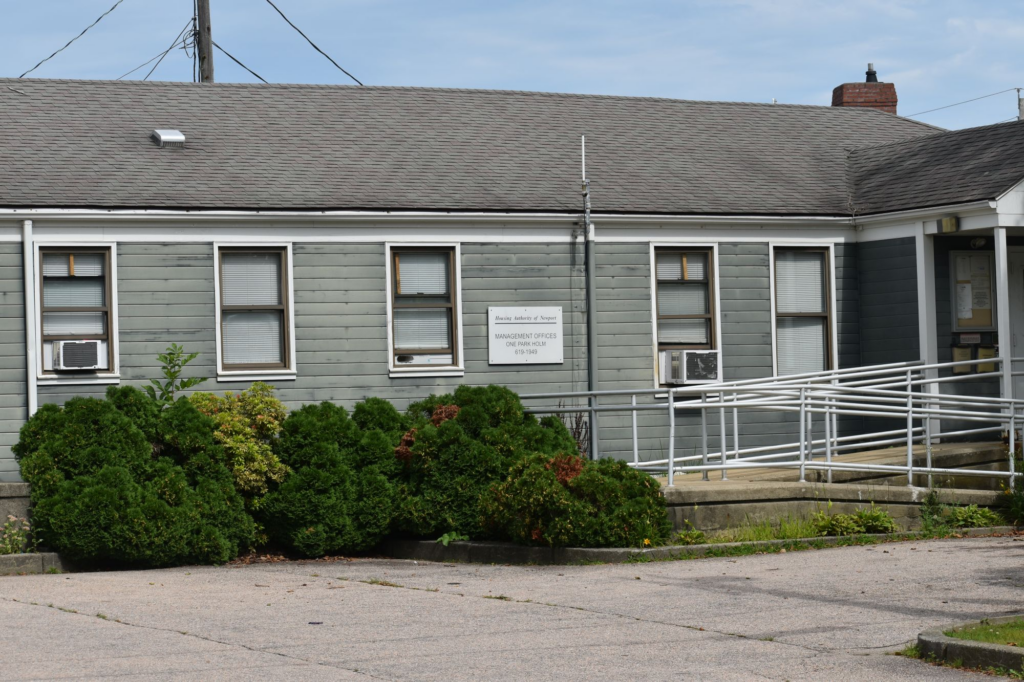
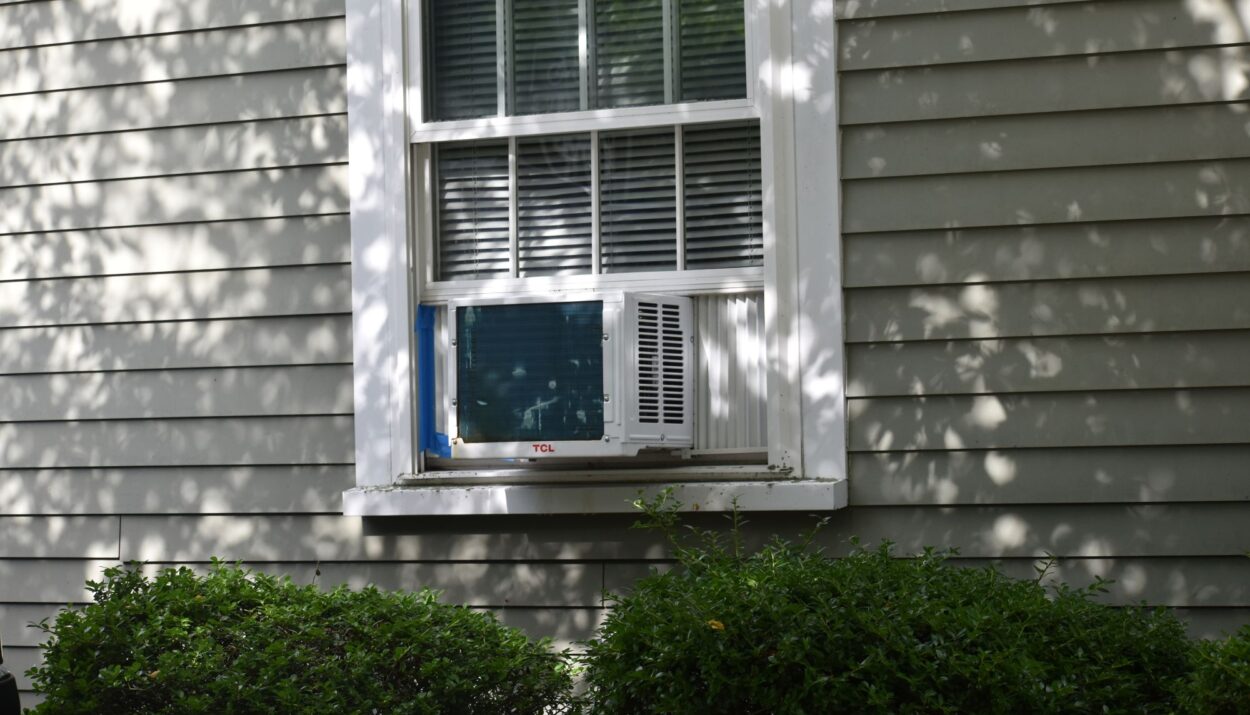
The Housing Authority of the City of Newport building relies on window air-conditioning units to keep cool. (Jonmaesha Beltran/ecoRI News)
For properties without personal air-conditioning units, North End residents can seek relief in the housing authority community spaces, including the Donovan Manor community room, Park Holm Senior Center, and Florence Gray Community Learning Center, which is expected to reopen in the fall.
Planning for a cooler future
Lighter-colored pavements and permeable surfaces have also emerged as potential tools for reducing urban heat.
The state’s coastal resilience plan points to California, where officials applied high-albedo cool pavement coatings to 700,000 feet of streets in a heat-vulnerable, low-income neighborhood.
But Climate Central, an independent group of scientists, notes the strategy has limits, adding that cool pavements are more complicated than roofs. In dense urban areas lined with tall buildings, streets might receive too little direct sunlight for the coatings to significantly lower temperatures.
Newport has not done this anywhere in the city, but Shevlin added that it is of interest.
The coastal resilience plan also recommends refining heat maps with public health data to make investments in those communities.
Newport’s presentation on climate hazards further encouraged officials to weave heat resilience into capital improvement plans, public health initiatives and long-term infrastructure planning, with attention to under-resourced neighborhoods.
The presentation is part of Newport’s 2037 Comprehensive Plan update. The city is currently developing its vision, goals and strategies, with a community open house scheduled for Aug. 27. Drafting is expected to begin in September, with local approvals expected by the end of the year.