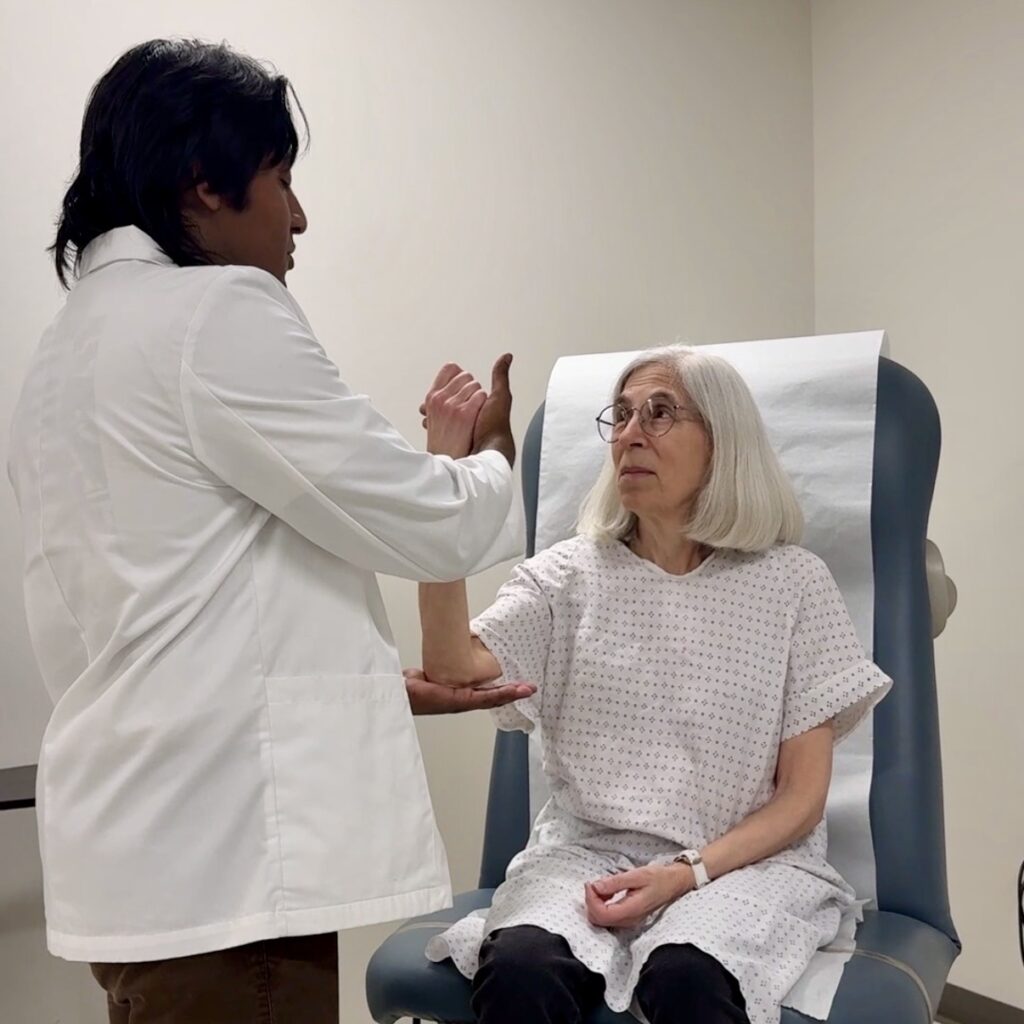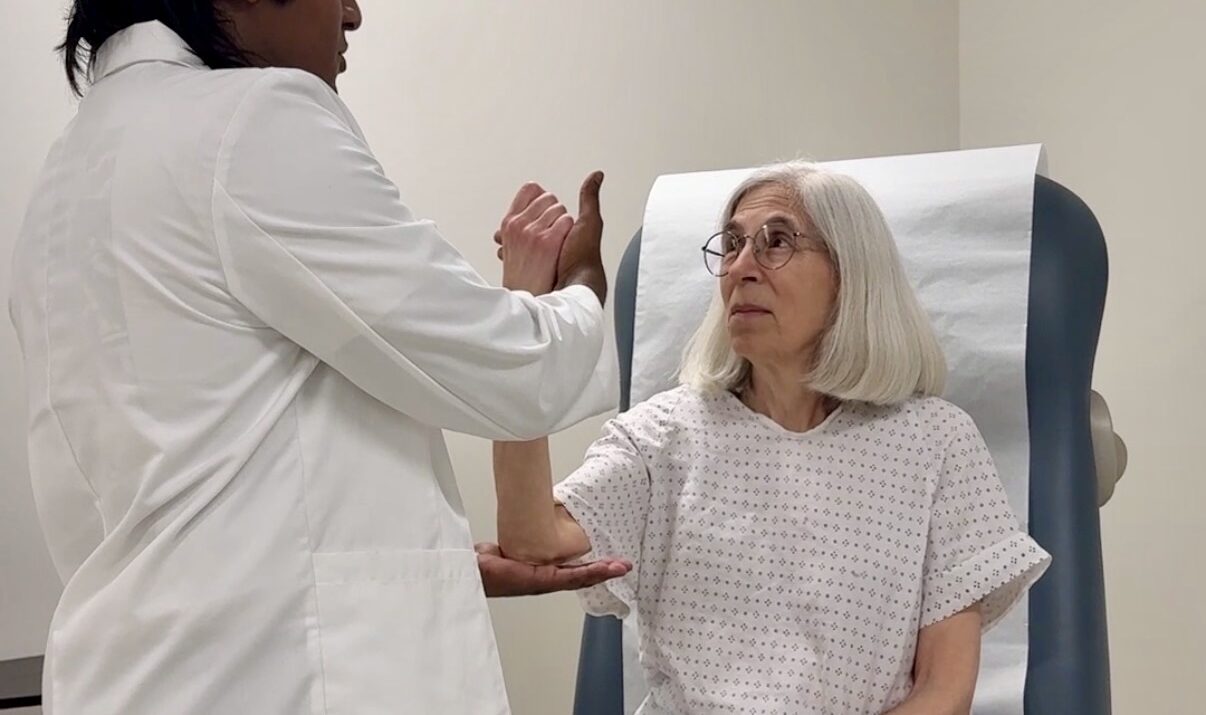

Trained actors play an essential role in medical student education.
By Emilija Sagaityte
This story originally appeared in the Fall 2026 issue (Volume 8, Number 2) of Health Discoveries @ Brown. Republished courtesy of Health Discoveries @ Brown.
“What brings you in today?” the medical student asks the actor, who climbs a stair up to the examination table in the clinical skills suite at The Warren Alpert Medical School of Brown University—rooms designed to resemble doctors’ offices and equipped with otoscopes, ophthalmoscopes, and other props—or, more accurately, medical tools.
In this specialized setting, the actor is known as a standardized patient, commonly referred to as an “SP.” An actor memorizes their script. An actor rehearses, not just words but also their movements. An actor adopts new dialects—and new personas. An actor becomes one with the character they portray, embodying someone different but also bringing themselves to the stage. An actor must have the proper costume wardrobe. Today, a flimsy, cotton hospital gown will do.
What brings this actor to this medical school, to this clinical classroom? Like all standardized patients at Brown and at most US medical schools—and many other types of clinical training programs—the actor has been hired by the institution, undergone training, and practiced and prepared to act out the history, symptoms, and exam findings of a real patient while following the instructions of a pre-written, realistic clinical encounter that they have memorized. Their purpose is to help students develop the patient interviewing, physical examination, and interpersonal skills they will use as clinicians.
SPs can choose the types of sessions in which they participate and the extent to which they become involved. Common sessions at Brown include Doctoring classes; Objective Structured Clinical Examinations, where students are evaluated on their ability to independently navigate a surprise case with a patient; and ultrasound sessions, where students practice using ultrasound probes and recognizing structures on imaging. Other roles for SPs include participating in encounters as part of educational summer programming, faculty development, interprofessional education (which includes students from different health professions), and the Internship Preparatory Course, which readies medical students for residency, explains Brown’s director of the Clinical Skills Simulation Center and Standardized Patient Program, K. Scarlett Handley, RN, BSN.
ACT I: Meeting the Standardized Patient
A small group of medical students is greeted by the physician instructor and the SP. A student introduces themselves and asks the standardized patient, “What brings you in today?”
“I have been having some chest pain,” they respond. The simulated visit continues as the student runs through questions and practices the heart and lung exams. The MD in the room offers guidance—and the SP does as well, noting how the interaction could be improved. “We need to give the student actionable feedback,” Paula Goldberg, a Rhode Island native and a standardized patient at Brown since 2011, says.
While rarely a doctor, the SP teaches through the lived experience and vulnerability of being on the exam table, conveying guidance that directly impacts these student doctors’ future patients. “I think it’s been really nice to learn beyond the textbook curriculum with the SPs,” medical student Kate Salguero Lizarraga says. “I learn something new with each SP interaction.”
Even with the unstated, mutual awareness of the simulated nature of the encounters, the interactions are taken seriously. Medical student Celinie Nguyen sees value in treating “every case like it is real and is actually impacting the” standardized patient.
“The student doctor and the standardized patient they’re speaking to—we’re doing our part in that little 30-minute segment to create a sense of healing for someone else down the line,” William Oakes, a standardized patient at Brown since 2004, explains, “so it’s all paying it forward.”
ACT II: Meeting the Medical Student
In many ways, we medical students become actors in this environment, too.
We also have a script with bullet points we must hit but with enough room for improvisation to make the character our own. Assistant Dean of Medical Education and Director of the Clinical Curriculum Steven Rougas, MD, says that one purpose of coursework with the SPs is to help students develop their professional identities. Indeed, we begin to forge our own characters as doctors—decide who we want to become when we arrive on the wards, choose the words that work, and the ones that simply don’t.
But the “acting” in this case does not equate to being disingenuous or even unrealistic. The anxiety outside the clinical suite doors is as palpable as a pulse after students have spent the hours before their exams reviewing and rustling through notes, not to mention the camera that watches us from the corner like we are the ones under questioning. Yet, as soon as the door opens, we are calm, we are smiling, we are collected, professional, and welcoming.
Once I transitioned from these simulated spaces with their soundproof walls to hospital beds with pull-through curtains, embracing the role of this unfazed physician became all too relevant as I learned by observing my mentors. When seeing anxious, unsettled, even scared patients in the minutes past midnight, the doctors’ overflowing pager messages and the other difficult cases they’re juggling—all of these are brushed off outside of the new patient’s door. Two knocks, and then it’s a friendly hello, a seat on a chair by the bedside, and an outstretched hand. This assumption of the brief role of the welcoming acquaintance who just happens to have read a lot of medical books, unperturbed, is, in a way, an “act.” But it’s perhaps the most realistic portrayal of who we are outside the walls of a hospital and the demands of a call schedule.
There are no faces behind a camera here, but we are still being watched by the most important evaluator: the patient. They may not be able to judge how precisely we measured their vitals, but they remember quite well how we made them feel. Some will be brave enough to tell us; others may be dissuaded by the power dynamic or choose not to, especially when the feedback is not positive. But it is the SPs who help prepare us for this crucial, daily test of our abilities in patient care.
“We help to teach and help to instill bedside manner,” Oakes says. While SPs have a concrete rubric with which to evaluate students, their written comments address, “Did I feel cared for? Did I feel encouraged? Did I feel comforted? … Was that advice given to me in a nonjudgmental, nonstigmatizing fashion?”
ACT III: Partnership between the Standardized Patients and the Medical Students
Many aspects of medicine involve a dichotomy between the medically detached and the emotionally connected. I recall my days as a first-year medical student in anatomy, studying the structures of a donor body. I would find myself swinging from being engrossed in finely dissecting out every vessel in a body cavity to taking a step back and remembering that this all lay inside a person, like myself, who had lived a full life I would never fully know. Transitioning into a hospital setting, the moments of being enthralled by the steps of a surgery or questions in a medical interview to uncover the diagnosis have always been balanced by the reminder of the person at the heart of the interaction—not just a case, not just a diagnosis.
Nguyen says SPs are “standardized, simulated with specific quotes that they have to say or specific presentations, but … they’re still also people with their own personalities. You can’t treat the experience as if you were in the anatomy cadaver lab … [it] is not the same at all.”
In the partnership between medical students and standardized patients, this duality exists as well. The SPs offer their words, bodies, and minds for the education of the next generation of doctors. As students, many of us probably know very little about them outside of the roles they are assigned to play, only as much as they choose to disclose—much like real patients. Likewise, they are much more than components of medical education.
“At the beginning, I was worried about seeing SPs as part of the assessment and grading process, or as a challenge that had to be solved,” Paige Liebel says. She soon came to realize, however, that SPs “are really partners in the room” and are “helping us learn.”
For students like Liebel, the SPs help establish a “safe space” where students can break the fourth wall and directly ask if they’re performing an exam maneuver appropriately. “I don’t know how else I would learn [the clinical skills] other than possibly hurting a patient or not doing a good job,” she says.
Similar to how skilled actors outshine and outlive their characters and the props on a stage, the SPs’ parts as educators transcend their roles in exam rooms as they become acquainted with their medical student audience.
“Sometimes you will have special interactions with SPs, where you’ll remember them and they’ll remember you [or] something about your [medical] interview, and it kind of just gets carried through throughout the years like an inside joke,” Nguyen says.
ACT IV: Setting the Stage for Brown’s Standardized Patient Program
In Brown’s Doctoring program, which started in 2005, students work with faculty and standardized patients to learn clinical skills and how to apply medical knowledge to directly care for patients as physicians through a patient-centered approach, according to Rougas and Director of the Doctoring Program Dana Chofay, MD. Prior to this, students would work with their clinical mentors to identify real patients at the hospital for students to interview. While this is still a component of students’ training, many of their initial interactions now transpire in the Doctoring course.
“The first time taking [vital signs], the first time putting a stethoscope on somebody’s back, taking a pulse … the first time I touched someone in a medical sense” happened with the SPs, Liebel says.
The program offers professional, clinical experience where student doctors can err and navigate difficult situations before they become real, Rougas says. Skills practiced include interviewing, counseling on topics like interpersonal violence, nutrition, and depression, relaying clinical diagnoses, and examining patients.
As an early medical student, “it’s the only time where you actually have the chance to direct how the conversation is going to go,” Liebel adds.
Salguero Lizarraga built up her confidence by working with standardized patients before transitioning to her clinical rotations at the hospitals. “SPs were so great at helping me really feel comfortable and find my workflow, so that way I can be present for my current patients now,” she says.
The standardized patient program has evolved throughout the years, alongside changes in how medical communication is taught to students. Handley highlights efforts to diversify those who are hired as SPs and the types of patients represented in clinical cases to reflect the patient community, including patients of various genders and patients with disabilities. She also worked to double the cohort size from 30 to 60 SPs since 2018.
Oakes has also noticed a larger emphasis on trauma-informed care over the years, referring to the phrasing that students use when giving instructions during the physical exam or when asking patients questions about their medical history.
“The fact that respect for others is instilled and is an important part of the curriculum makes me happy to go to work every day and really just warms my heart, knowing that I’m working in a place where empathy matters, where other people’s lives matter … and the spectrum of human life is respected,” Oakes says.
ACT V: A Look Behind the Standardized Patient Characters
When I join my interview calls with Oakes and Goldberg for this article, I greet familiar faces. Both have been key figures in my medical education at Brown. As in our prior encounters, I have come prepared with a checklist of questions. This time, however, I am not asking about how their characters developed a dry cough or injured their knee. Today, I am interested in finding out what brought Goldberg and Oakes into the job of becoming standardized patients.
Oakes discovered Brown’s SP program through a colleague he met during his years as an actor in the local theater community, where he has performed in about 75 productions. He has also worked as an SP for the Rhode Island College nursing program’s simulation center and for the physician assistant program at Johnson & Wales University.
Goldberg was introduced to the program through a physician. Like Oakes, Goldberg has participated in similar programs at the University of Rhode Island’s College of Pharmacy and Johnson & Wales, as well as Brown University Health’s Medical Simulation Center. Her credits include a patient, a worried, inquisitive family member of a patient, and an ultrasound subject for Rhode Island Hospital’s anesthesiology department.
Oakes says that expressing not only physical illness but also the psychological and emotional aspects of disease is “a lot of fun and also a challenge.” These cases help him practice his range for very intricate stage characters—and are valuable for the students. “I certainly enjoy the cases that have a greater psychological component simply because it affords the medical students a greater opportunity to provide counsel, and that is just one of the joys of doing this job.”
His acting career has enabled him to add a creative spin to his SP roles. “Although we are standardized patients, and we want the learning experience to be standardized … being on stage does help you think on your feet, and it does help you to maneuver and dance around a little bit within the very strict parameters,” he says.
Oakes dedicated his knowledge of acting to writing reviews as a theater critic, acquiring skills that have molded his approach to providing feedback on medical students’ clinical performances. In addition to giving the necessary critical feedback, he identifies their strengths as well through a holistic evaluation.
“Observation is a skill that good actors and doctors share,” Oakes explains. “To give proper feedback … you’ve got to be watching, and you’ve got to be listening. … You could be the most eloquent speaker in the world, but you’re not a good actor if you’re not listening to the other person on stage with you.”
Chofay says, “Many of our [SPs] have been with the program for years and have really fine-tuned where students either have apprehensions or have difficulty with the more challenging parts of the exam, and are able to actually coach them … in a very unique way that’s different than the faculty.”
Sometimes the lines between acting and reality blur. Goldberg recalls one particularly resonant case about end-of-life conversations for a diagnosis that a loved one experienced. In such circumstances, the tears come more naturally.
Oakes, too, has been on the receiving side of end-of-life discussions with families. “The doctors and the health care practitioners that I had real-life discussions with were so sensitive and so tactful,” he says. “If I can help instill that in the next generation of health care practitioners, that’s honoring one’s loved ones.”
ACT VI: Becoming a Standardized Patient
To land the part, SPs must undergo a rigorous application, interview, audition and review process. Then, as for any performance, the standardized patients have to be directed, study their lines, watch sample performances on video, and rehearse well in advance. Handley organizes and leads intense SP training centering on communication, “reinforcing that how something is said is just as critical as what is said,” she says. The SPs start preparing their cases from several weeks to a month prior to their assigned sessions. They also take on roles of extras, or understudies, for other SPs.
Their cases, which can range from one to five at a time, span subspecialties and medical class years. SPs review slideshow presentations about their cases and read about the materials, anticipated questions, and the answers they are able to provide to the students. “It’s a lot of memorizing, and keeping [the cases] straight is a challenge,” Goldberg says, not to mention the medical jargon that she has absorbed throughout her time in the role.
“We have the proper, correct, and uniform answers to provide to each student so that the students’ learning experience is as standardized as humanly possible,” Oakes says.
Oakes acknowledges the heavy memorization involved on the students’ part, who must learn their physical exam maneuvers like stage directions and their checklist of interview questions like response lines in a play. He occasionally catches their gaze veering off to the side as they try to remember their next question—a behavior he has also observed among fellow actors trying to remember lines—or hears them exclaim happily not due to what he says as an SP but rather out of jubilation over their own progress in an encounter.
Goldberg and Oakes consider the role an opportunity to learn as well as to teach. They believe it carries into their experiences as real patients who are able to expect specific parts of exams or request that various medical providers change how they perform an exam, like not listening for heart sounds over clothing—a mistake that typically costs students points in their clinical tests. Oakes has even had medical students point out a new, real diagnosis through their examination skills. “I have often wished that my health care practitioner [were] a fourth-year Brown medical student” due to students’ thoroughness, he says.
ACT VII: The Epilogue
While working through a series of SP encounters as part of the Internship Preparatory Course during my final year of medical school, I could not help but enter the feedback session afterward wondering if I had asked all the right questions or prescribed the correct medications. But the SPs commented minimally on these aspects. Instead, they appreciated the moments when they felt consideration and empathy in the words exchanged.
Now that I am familiar with the hospital workload and patient volume that naturally enforces time limitations on every patient encounter, my SP’s comments served as an important reminder that those thoughtful exchanges are not wasteful. They are not embellishments that can be easily forsaken in the absence of endless time. To the patient, those words matter.
As physicians, we will not always have the correct answer; sometimes, we won’t even have an answer. Sometimes, knowledge and skill will not be enough to save our patients. The quality of our conversation becomes the extent of our medication.
When we find those physicians whom we feel comfortable and safe around, the ones who seem to know what to ask, what not to say, when to listen, and how to place their tools, including the clinical trainees who we suspect are seeing their first patients, those soft skills may have been shaped in part by the standardized patients who were part of their education. All of us—performers, teachers, learners, and their future patients—are key players on the medical stage.
Emilija Sagaityte graduated from The Warren Alpert Medical School in May and is now a pediatrics resident in Washington, DC.