‘Float hunting’ also enhances mindfulness
NEW SHOREHAM – Every June through October, 550 handmade glass floats are scattered across Block Island by Eben Horton, the creator of the Glass Float Project, and volunteers. Horton started leaving his glass pieces on the island in 2011 to practice mindfulness, encourage environmental awareness, and bring a little bit of magic to the island.
Horton first blew glass when he was around 10 years old in an ornament-making class.
“It didn’t, like, change my life or anything,” Horton said. “But then, when I was in high school, my freshman year in high school, I heard that the shop that I took the class at was looking for an apprentice. I thought, well, you know, I’ve done that before. I liked it, it was fun, I think I’ll go and ask. So I did, and they hired me.”
Horton worked there after school all through high school, then studied at Rochester Institute of Technology, completing the glass program there.
He worked at a couple of different studios before opening his own studio and small exhibition space in 2000. This original space used to be an old gas station, so Horton used the space’s roots to come up with the name, The Glass Station Studio and Gallery.
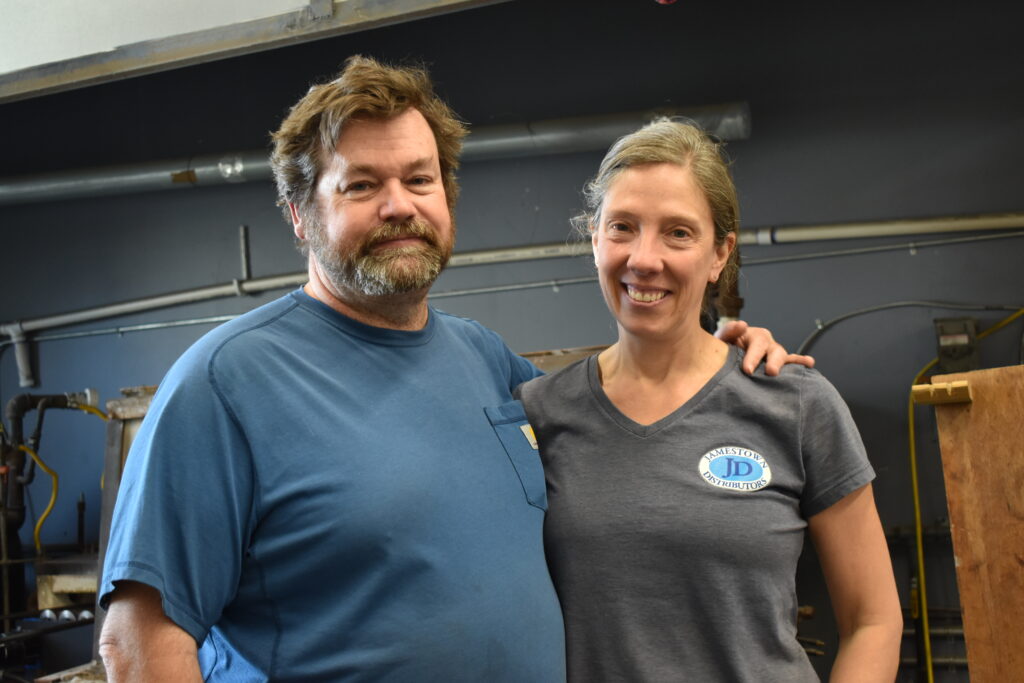
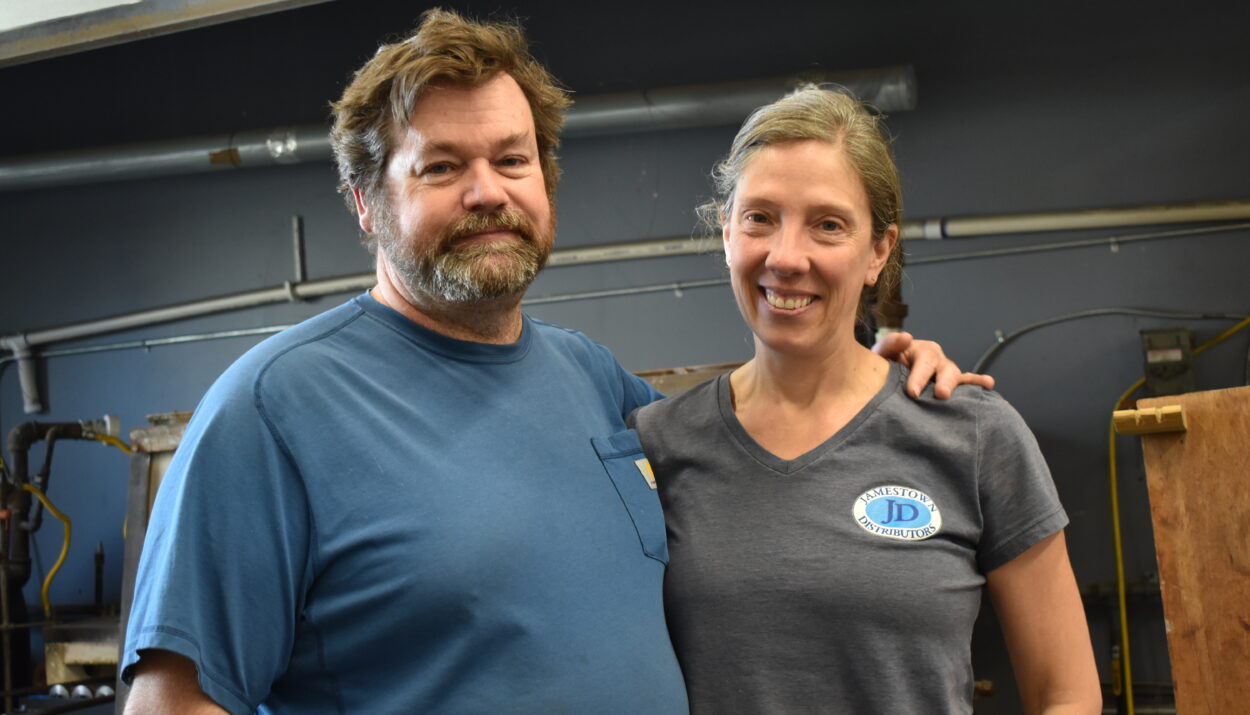
Today, Horton runs The Glass Station with his wife, fellow glassblower Jennifer Nauck, in a newer location just down the road from the first store. They’ve grown the business into a production studio and gallery space featuring over 40 glass artists from North America.
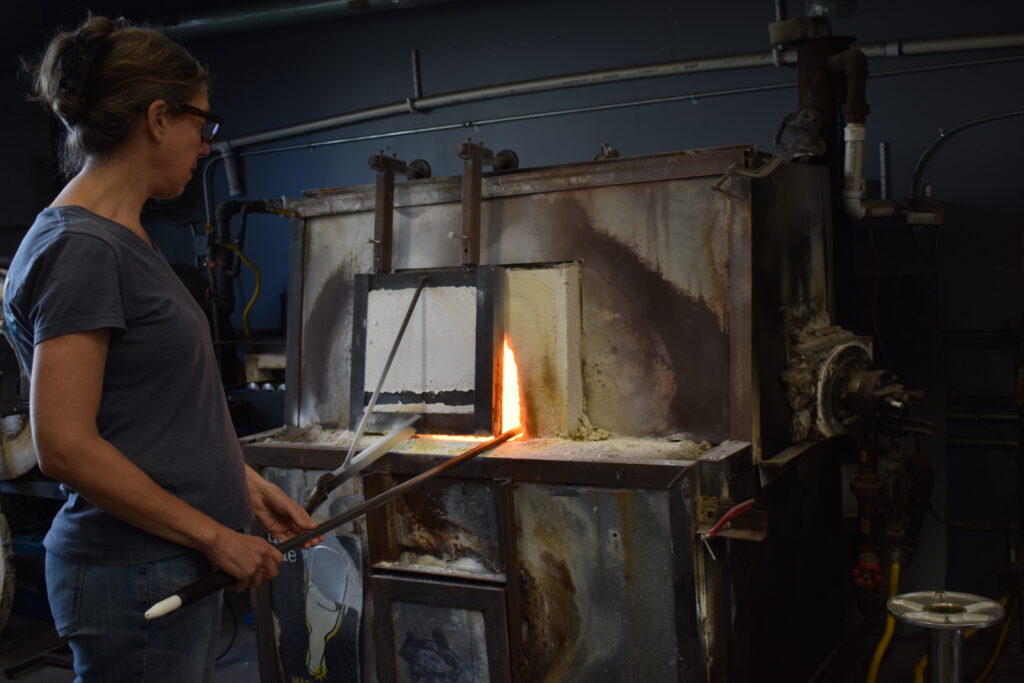
Nauck, also a trained glass blower and artist, learned to blow glass in Colorado and started working in, then later managing a gallery.
“I was managing the gallery and just couldn’t be in there like eight hours a day and see what was going on in the studio and not want to be a part of it,” Nauck said.
From there, she worked in the gallery during the day and hopped in the studio to work on projects at night.
Horton and Nauck met at a trade show in Philadelphia in February of 2011. They were both exhibiting glass and met on the loading dock. They kept in touch after the show, then in October that same year, Nauck came out to Rhode Island for a vacation, and they’ve been together ever since. Horton already had his studio out here, so it made sense for Nauck to move to him. She did so in 2014.
“It’s a really good mix of private life and work life that just seems to work for us,” Nauck said. “It’s a little bit shocking that we’re together like 24/7 basically.”
While Horton and Nauck are working on the Glass Float Project in partnership today, the idea actually came to Horton before they knew each other.
At 19, Horton worked in a glass studio in Providence, RI, a summer job between finishing high school and starting college. Artists in the studio were making paperweights, and the color inside had small cracks. Horton said everyone was bummed out about a whole day’s work being wasted, so he asked if he could take the ruined paperweights and do something fun with them instead of throwing them out. His boss said yes, so he took a backpack full of some imperfect pieces and hid them all over the beaches in Middletown and Little Compton.
“I just thought, wouldn’t someone be so amazed and happy to find something like this and wonder how it got there?” Horton said. “It turned a disaster into some fun thing.”
Horton did this once, then went off to college and continued his career in glass blowing. It wasn’t until around 2010, after the recession had hurt his business, that he thought he needed to come up with a unique public art project to bring attention to his work. He remembered that day of hiding the imperfect paperweights and thought he should do something similar again.
“In that period of time in between, I was so busy making vessels,” Horton said. “It was always in the back of my mind, but I never really had the opportunity.”
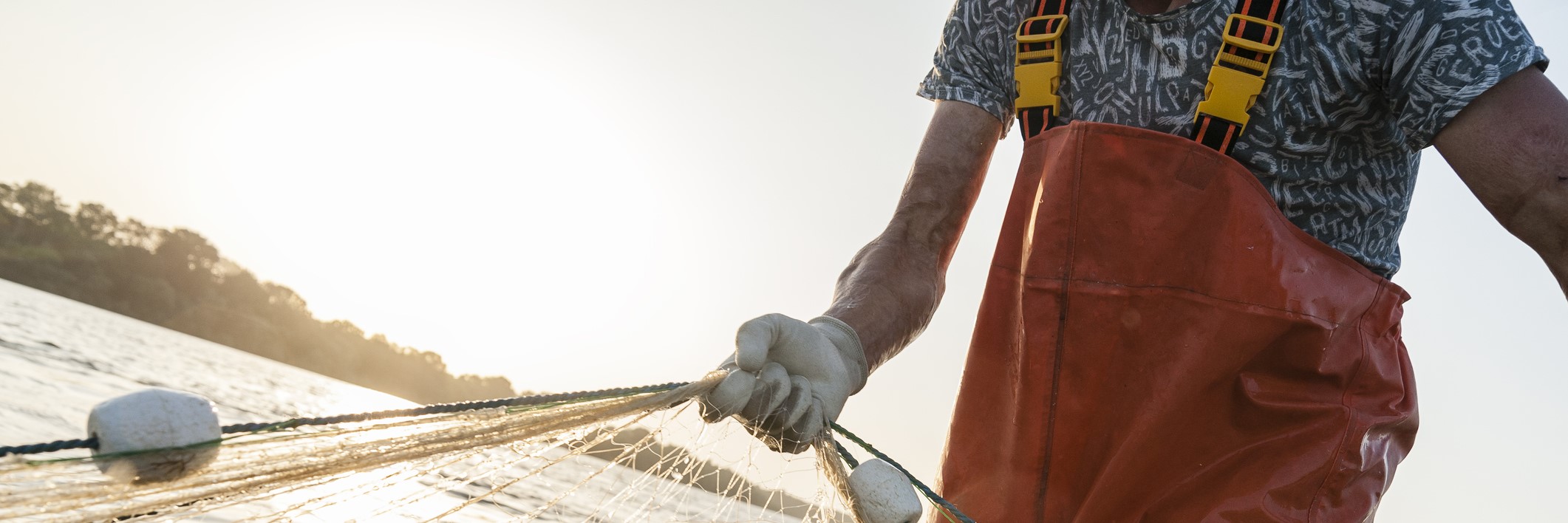
Along with the memory of hiding the glass in his youth, Horton also drew inspiration from communities on the West Coast who actively go hunting for original Japanese glass fishing floats from the 20th century that kept fishing nets afloat. The floats sometimes detached from the nets and ended up on beaches, where lucky ongoers can sometimes find washed-up floats.
When Horton realized he wanted to go through with making his own project on such a large scale, he reached out to various organizations.
“I just felt like, if I got permission, got the blessing of the island community, it would be embraced,” Horton said. “Which it was.”
He applied for a grant from the Rhode Island State Council of the Arts, which helped partially fund the project, and ran the idea by the Block Island Tourism Council as well for funding and support.
Jessica Willi, executive director of the Block Island Tourism Council, has been working on the council for almost 20 years. In her role, she handles marketing and promotion of Block Island, including destination development, so people have things to do once they get there.
Willi has been involved in the project since its inception and thought it was a great idea then and now.
Along with assisting with sponsoring and partially funding the project, Willi aids in how the floats are registered on the Block Island tourism website. While optional, float finders are encouraged to share when, where, and how they found certain floats through the site.
Willi also helps with the nuts and bolts of getting the word out and guidelines for float hunting.
Some important guidelines include leaving no trace behind, one float per seeker per year, staying on established trails, and not deconstructing wildlife to look for floats.
“We talk about not hitting the bushes and whacking them, and don’t take apart stone walls,” Willi said. “Carry in and carry out. Don’t leave your trash, and all that sort of stuff. So we find a lot of people do come in and they actually pick up trash and leave it better than they found it.”
Horton said he was only going to do the project for a year or two, but it became incredibly popular, so he never stopped.
“Its 100% impacted tourism,” Willi said. “Block Island is so wonderful as it is without anything, that people don’t really need a reason to go, but even then, there’s people that come just to hunt for floats. A lot of people plan their trips around it.”
For the first couple of years, Horton made around 150 floats, but increased the numbers when he realized how many people were searching for them.
“I realized, this isn’t a flash in the pan,” Horton said. “This is important, and there are so many people looking for these things. I felt bad. You know, in my perfect world, everyone would find one, but that’s not the way this world works. And I thought, well, how many could I do without going crazy?”
Horton said the first night he ever went out to hide floats for the project, he slept in his van and called Jen. There was a big squall that night, and the van was blowing around.
“The next morning,” Horton said, “I drove down the road, I drove by a few beaches, and I’m like, ‘what are all these people doing out here in the rain? They’re crazy.’ And then I realized that, ‘oh my god, they’re actually out looking for glass floats.’”
Before he hid the floats, he said he considered pulling a “Banksy.”
“I thought it’d be neat to do this anonymously, and then no one would know where these things are coming from,” Horton said.
But before he even hid the first one, Channel 12 News interviewed him. A consequence of getting permission was also getting people talking about the project, Horton joked.
Today, floats are hidden during the first full weekend of June and hidden in batches until around October.
“What I realized was, no matter how well I hid them, they were found fairly quickly,” Horton said. “So I recruited a bunch of friends out there.”
They’ll hide a couple every day, so it’s a slow trickle. Horton said this makes it fair, so if someone plans their vacation, there won’t be a dry spell, and they won’t all be found in one day.
“In fact, the first year I did hide a lot of them earlier in the season, and then I thought ‘they must be all found,’ and I felt bad, so, learning curve,” Horton said.
Horton often gets recognized, but that doesn’t deter them from still hiding some.
“We’re always like ‘I hear people, go down this way, maybe they’ll go down that way,’ and then we’ll stop and listen,” Nauck said.
They enjoy hiding floats on trails not highly traveled to encourage people to go to places they don’t normally go to.
“So if we’ve hidden them on the less-used trails, then maybe people will be inspired to go down some of the paths less traveled,” Nauck said.
One of the most well-known and most favorite spots by both hiders and seekers is the cannon, a historic installation at Legion Park. The inside of the cannon is deeper than an arm, so getting it out is the “ultimate IQ test,” according to Horton.
Some of these seekers are so dedicated that they have their own group name: orbivores. They even have a Facebook group, the Block Island Glass Float Project Forum, which is the official group of The Glass Float Project, run by Horton. Orbivers in the group can share floats they’ve discovered and find tips, discussion, and photography by Horton.
The group has over 21,000 members, including Debra Frost-DeCaro, who works in international and US domestic corporate relocation in Connecticut, but in her spare time, enjoys looking for glass floats.
She read about the project in the Block Island Times many years ago and became obsessed. She said she started going for a weekend every year, then upped it to a couple of weekends a year, and now ends up going over a dozen times annually.
A couple of years after reading the article, she was on the island with some friends and was distraught that she hadn’t found one. A few hours before their 8:00 a.m. ferry ride back home, she snuck out of her hotel and found her very first float on a trail.
“I was just in shock, of course,” Frost-DeCaro said, “and then you wonder, are you ever going to find one again?”
Frost-DeCaro said she found her next float three years later and puts a lot of planning into the process annually. She goes to the island with the intention of searching for and finding a float.
“When I’m going to go for a week, I get a big piece of paper, and I list out where all of the ones have been found this year,” Frost-DeCaro said.
She then maps out the floats found on trails and, if a lot have been found on a trail, she’ll avoid those and go to other trails that haven’t had a lot of float-finding action yet. The plan isn’t a guarantee, but it has resulted in quite a few finds.
“I love it when you find old ones, you know, the ones that have been hidden for a couple years that nobody’s found,” Frost-DeCaro said. “Those are special to me. I found one in 2022 that was extremely well hidden. I think there was some divine intervention on finding that one because there was just no way you would’ve seen it.”
With the float in 2022, Frost-DeCaro said it was the weekend of her late father’s memorial service. Her husband, Chris DeCaro, told her they should go on a quick trip to the island to help with her grief.
“So it’s literally 11:00 a.m., and we’re supposed to be on the ferry at noon, ” Frost-DeCaro said. “We have to check out of the hotel, we have to return the rental car, and I’m on a trail, and I’m like, I don’t want to leave. And I lay down on top of a stone wall like a two-year-old saying ‘I don’t want to leave,’ and literally something pushed my head down the back side of the stone wall, and buried in prickers there, there it was, and it had to have been my dad.”
Frost-DeCaro has found a few over the years and keeps them on a piece of driftwood she dragged off the beach. She labels them with the day and year she found them, what number she found, and where she found it.
“I don’t clean them,” Frost-DeCaro said, “I want them to look like the day I plucked it out of the stone wall.”
Frost-DeCaro finds joy in both the physical and digital aspects of the project. In the Facebook group, she said she’s always curious about how other people find floats.
“I love seeing the excitement,” Frost-DeCaro said. “I love seeing the kids find them. I love seeing the dogs find them. You truly share in other people’s joy, especially the first timers, because they’re so excited.”
The project is for people of all ages. While kids and even dogs find it special, the project is special because everyone can be involved.
“As an adult, there are very few things that are like magic,” Frost-DeCaro said, “and to me, the Glass Float Project is a little bit of magic.”
While magical, the floats are also quick to make, according to Horton.
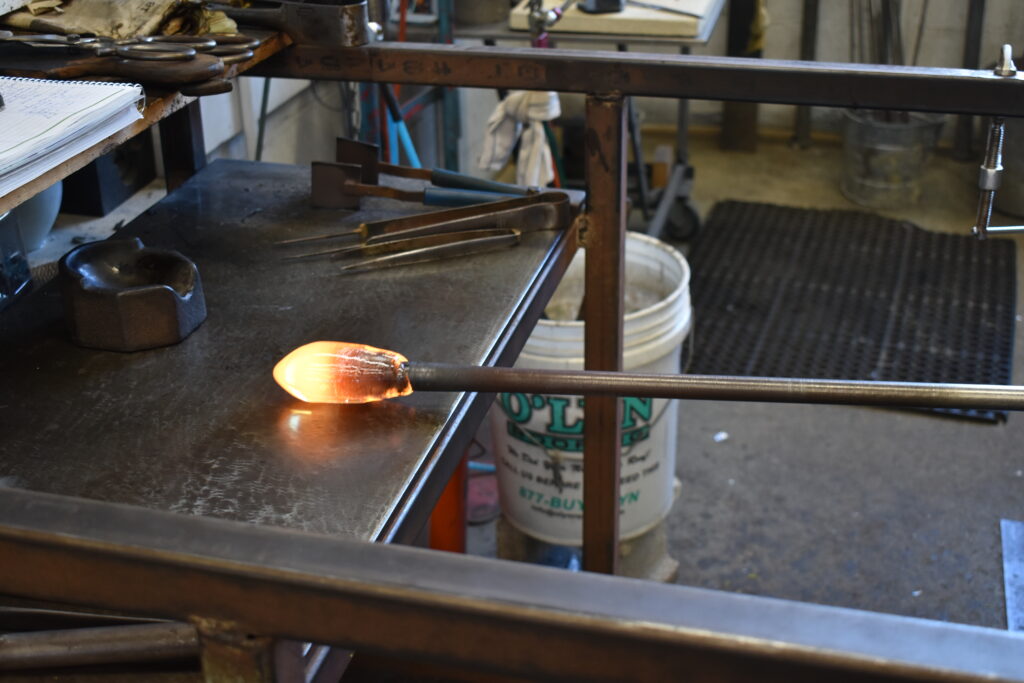
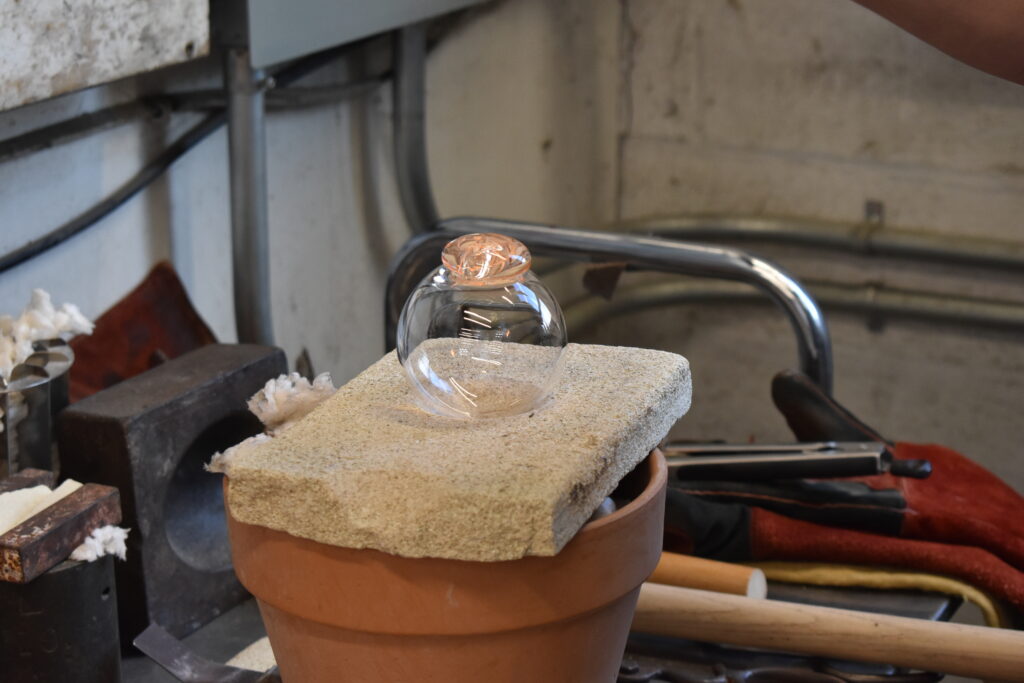
“The sphere is the most simple thing to make, because it’s hollow,” Horton said. “It doesn’t take as much material as a paperweight. They also cool down quicker. So you can make one, bonk it off the pipe, put the stamp on it, put it in the oven, and not have to sit there and turn this thing for five minutes, so it doesn’t deform.”
Some years, they make the floats throughout the year; other, more organized years, they have them ready before the start of the season. This year, Nauck said they’re hopeful that they’ll create them all ahead of time and have them boxed up and ready to go by the first of June.
While the glass pieces often look like treasure, Horton doesn’t agree with using “treasure hunt” as a descriptor for this project.
“Is it a treasure hunt?” Horton questioned. “I never really looked at it like that. I looked at it as a form of meditation.”
Horton said that the nature and outdoor areas all along the island are great places to reflect.
“If you got to work on something, what better way to go out and walk on the trails and figure out whatever’s going on in your head,” Horton said. “Jen taught me that.”
It’s something someone as old as a grandparent or as young as a grandchild can participate in, Nauck said.
“One of the greatest things that somebody has ever said about this project was, talking to Eben, ‘you turned a place that was known for drinking and partying into a family-friendly destination,’” Nauck said. “There’s, unfortunately, horrible accidents out there, and that’s not the only thing that this island should be known for, because it’s just an extraordinary, natural place too.”
Horton shared that in the early 2000s, he was on the island for a friend’s wedding. Another wedding was happening, and the hired band was staying in the same bed and breakfast as Horton.
“That band got really drunk after the wedding, and one of the members was walking back, another one was driving, and hit and killed the guy,” Horton said. “And I’m lying in bed… and I heard a knock on a door, and it was the chief of police looking for the wife of the guy who was killed. And I got to hear through thin walls, her being told her husband was just killed… that’s what really got me thinking, ‘this island needs some healthy activity out there.’”
Nauck said one of the best parts of the project is seeing multigenerational family photos with everyone holding floats they’ve found. The pair hope to be able to see many pictures like this as time goes on by protecting the island.
“The project already has done good things for the island, I think you ask anyone on the tourism council, and they’ll tell you that,” Nauck said. “But as far as the environmental side, I feel like it’s a responsibility that everybody who goes out there has. Wouldn’t it be amazing if Block Island ended up having the cleanest beaches in New England because of this, because people loved this island so much that they took the time and took the energy to make sure that it had the cleanest beaches it possibly could.”
In the past, the project was part of their business, but now it’s a nonprofit. It’s always been an interactive art installation, but Nauck said they also want to have an environmental aspect to it.
“We’ve always said things like, when you’re out there on the beaches, why not pick something up as well?” Nauck said. “The project has the real potential to do a lot of good for the island itself, environmentally.”
Nauck said how it will entirely work is still in the works, but they’re determined to help people think about environmental stewardship along with the art.
Horton said their glass comes from the Czech Republic, and their color comes from Germany. No one in the United States makes the materials they use, according to Horton, but one day they’d like to utilize recycled glass from the island.
“My fantasy, and I’ve never figured out how to make it work, is to build a little glass furnace, go out to Block Island, and make floats out there with like, Corona bottles or something,” Horton said, “and take these things that are going to end up in a landfill and turn them into floats.”
In terms of present-day environmental practices, the Glass Station Studio and Gallery roof is completely solar, and they use natural gas when firing.
“With the floats, I try to keep it green,” Horton said. “So on days where I know we’re gonna make a lot of floats, I save our clear glass, and I’ll throw that clear in the day before so [many of] the floats are recycled scrap from our process.”
Horton and Nauck make most of the floats themselves, but they’re a wonderful object for teaching, according to Horton. Everything in glass blowing starts from a ball, so perfecting them makes for good practice.
“It’s a really good training tool for how much glass you’re taking out of the furnace, how hot it needs to be to work it, and then as it’s blowing up, you learn to train your eye to see how big something is,” Nauck said.
They make a lot of glass projects as a team, but it’s especially efficient when making the floats.
“Jen will throw the gather on my bench, I shape it, blow it up, squeeze it down, and by the time I’ve squeezed it down and it’s almost solid, Jen’s coming back and she puts a gather on my bench,” Horton said. “She takes that one away, and then she’ll knock it off the pipe, put the seal on it, and then put it in the oven. And then she goes and takes a gather, puts it on my bench, and I’ve just finished that one, and it goes twice as fast.”
Once they’re finished with a float, they’ll carve the identifying information in each. All floats are dated with the year and numbered between 1 and 550, so seekers know exactly which float they’re finding. The first float is always something special, and the next floats corresponding to the year (this year’s floats 2 through 26) are brightly colored. Nauck said this year, for the 15th anniversary, the first floats are going to be extra special.
“We’re going to just take a little bit of extra time, and each one is going to be really unique,” Nauck said. “So, different color application techniques, different ways of blowing them out. So I think they’re going to be a little bit more interesting and very unique.”
They keep the first float a secret every year, but some of their favorites have been a coronavirus-looking float during the pandemic, a lobster pot buoy, and a skate egg case, an animal egg casing for skate fish, which are closely related to sharks and rays.
“Unbelievably to me, the person who found that had a tattoo of a skate egg,” Horton said. “When people ask me for hints, I say, ‘It’ll find you.’”
Horton said they’ve been approached by businesses to make floats with paid advertisements, but they’ve never considered saying yes.
“No, that’s not what this is about,” Horton said. “Yeah, so no commercialization, but turning it into a nonprofit was a way to grow it in a correct way, a responsible way, and a way that just gives back and isn’t just for our gain.”
Horton and Nauck only make one exception on customized floats.
“Every year, we always end up taking special orders for some floats that have marriage proposals written out,” Nauck said, “which is so sweet, so incredible.”
The Glass Float Project is a one-of-a-kind experience, largely because of the island itself.
Horton said he has always loved Block Island and has always known he wanted the project to be solely on this island.
“It’s hard to put it in words,” Horton said, “but when you go out to Block Island, you’re not in Rhode Island. It’s like its own thing, and there’s like a level of magic with that.”