
By Andrea Gutierrez
Originally published by The Providence Eye, a publication partner of Ocean State Stories.
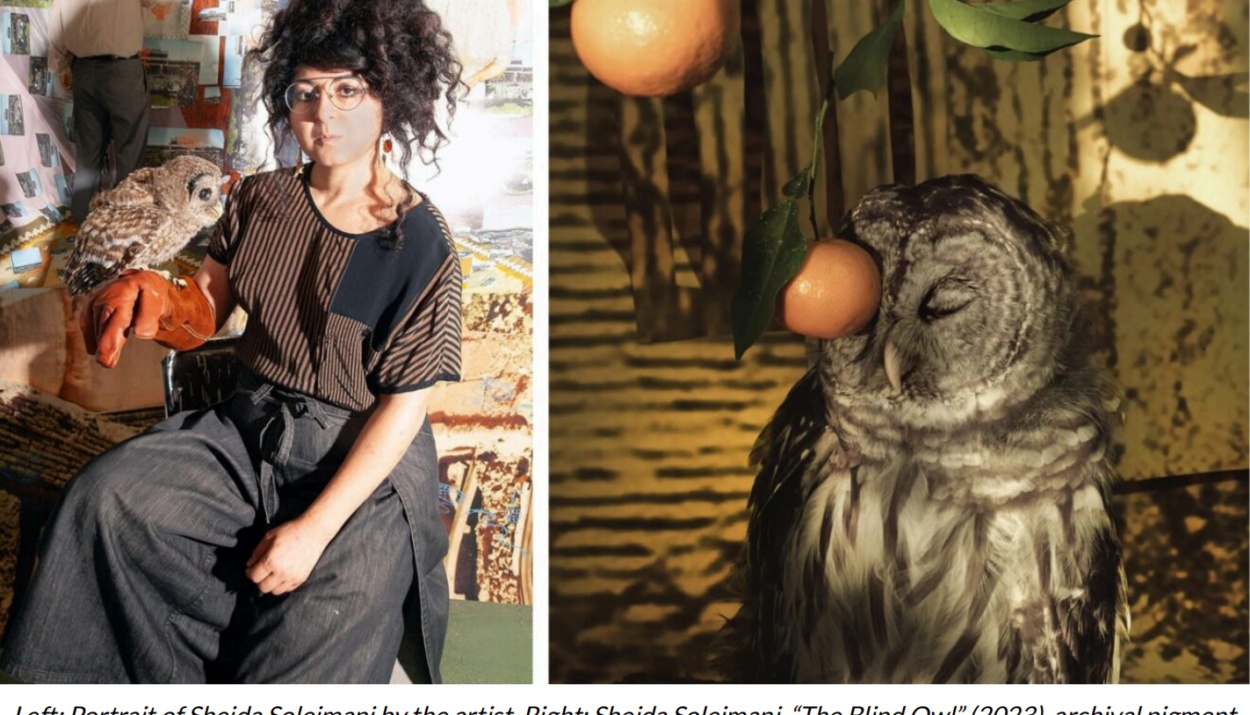
PROVIDENCE — The John Simon Guggenheim Memorial Foundation announced its latest cohort of fellows last month, awarding the prestigious distinction to 223 artists, scholars, and scientists. Providence-based artist Sheida Soleimani was recognized for her contribution to the field of photography.
Soleimani is no stranger to prestigious recognition. Her art has been featured in Artforum, The New York Times, The Huffington Post, Interview, and Vice. Her curriculum vitae is impressively long for a 36 year old artist, and it does not even include her work as an activist and educator. In addition to her career as a professor at Brandeis University, she is also the founder and executive director for Congress of the Birds, a New England-based avian rehabilitation center.
Despite her individual accolades, Soleimani seems to measure her success by the depth of her ties to the collective.
“It’s an honor to be recognized among the other great thinkers and artists who have been awarded this fellowship,” Soleimani said. “Historically, recognition in the art world has been predominantly white and male, and this cohort of fellows is a shift toward more diverse representation, and I’m honored to be a part of that.”
Soleimani’s art and ethos were shaped in part by her parents, political refugees who fled Iran in the 1980s and settled in a suburb of Cincinnati, Ohio, where she was born.
“I saw my parents build their whole lives around caring for other people while I was simultaneously attending school in the U.S. where individualism was prioritized over community care.”
This cultural dichotomy fundamentally shaped her as an artist. As a teenager, she began snapping close-ups of flowers with a camera her mother brought from Iran, eventually dreaming of a career in photojournalism. That dream shifted during a family trip to Puerto Rico. She recalls riding in the back seat of a vehicle, camera in hand, when she saw a man waiting at a bus stop in the pouring rain. She raised her camera to snap what initially struck her as a beautiful photo, when her subject made eye contact with her.
“I suddenly realized how invasive it felt for me to be sitting safe and dry in a car, while taking a photo of someone outside being rained on.”
After that experience in Puerto Rico, she rejected the idea of photojournalism, finding it inherently exploitative. Her photography practice developed through pictures that she took of dioramas she crafted.
“I started to question whether we needed to see the horrors of the world in order to connect to the suffering,” she said. “It turns out that we don’t. Which we have realized through witnessing what has happened in Gaza and Iran—it doesn’t affect us anymore. We’ve become numb to it.”
However, Soleimani’s belief in the power of art to create social change remains intact, which is part of what qualifies her for this latest honor. Established in 1925, the mission behind the Guggenheim Foundation was to add to the artistic power of the United States with the purpose of a better international understanding, and Soleimani wants her art to reflect the history and wisdom that comes from lived experience.
“I keep coming back to this concept of history being connected to the present moment, and our elders being witnesses to that. The things that are happening now, they didn’t happen in a vacuum.”
Perhaps that is best represented by her latest solo exhibition, What a Revolutionary Must Know (2025), at the Contemporary Arts Center in her hometown, Cincinnati. The exhibition featured photographs from constructed sets, a callback to her childhood dioramas, that serve as metaphorical representations of her parents’ escape from Iran as political refugees. She credits her parents as a big part of her creative process—not only as models and subjects in her photographs, but from the moment she gets an idea and calls them to begin to brainstorm together about how to bring it to life. It’s evidently a very meaningful part of her artistic process, and she warmly reflects on how happy they are to be included.
Soleimani’s work with wildlife is a part of her artistic process, too. She has always been aware of the parallel between her family’s survival story and the migratory nature of birds, but she says that she tries to avoid that representation in her art because it feels a little too “on the nose.” However, the birds do make it into her photographs, but like her parents, they are a bigger part of the process.
“My life is chaos, but the birds need a schedule,” she noted. “So, my time in the studio is structured around their needs.”
Even in conservation, Soleimani confronts the frustrations of bureaucracy. Rhode Island law restricts facilities from rehabilitating birds from out of state—a hurdle for those in nearby Seekonk, Massachusetts, who are 15 minutes from Soleimani but over an hour from the nearest Massachusetts facility.
”It just feels so arbitrary. Just like with people,” Soleimani said of the mandate.
In all of her endeavors, Soleimani prioritizes inclusivity. She believes that we have everything to gain from making art more community-based and accessible.
“Art is bougie. You have to be privileged to look at art. Even if you have the money to buy a ticket to the museum, you may not have the time because you are responsible for caring for other people.”
Which is part of the reason she is proud to call Providence home. People often assume that she lives in New York City to be immersed in the vibrant art seen there. While she visits New York City often for work, she finds it uninspiring because she sees all of the same people at the shows there. For Soleimani, the appeal of Providence lies in its grassroots energy, citing local mainstays like Dirt Palace and Riffraff as essential venues.
“The art scene in Providence is still very DIY, which keeps it community-based. I’m glad we are not trying to be in the bourgeois art world.”
Andrea Gutierrez is originally from California and she traversed much of the country before finding home in Providence. She worked in hospitality for 20 years, and finds joy in dining al fresco on a perfect summer evening. She is interested in places where food, art, history, and the natural world intersect to create an aesthetically rich environment, which makes the Creative Capital a perfect fit. She’s eager to shine a light on the city’s greatness, and to be a community builder that contributes to what makes the city great.