
URI professor combines traditional with digital
By MATTHEW LAWRENCE, Beacon Media Contributing Writer
Sep 23, 2026
This story was originally published in the Warwick Beacon, a publication partner of Ocean State Stories.
Read this story in its original form and all other Beacon stories by clicking here.
SOUTH KINGSTOWN — There’s a new Fine Arts Center at the University of Rhode Island, and no one seems happier about it than Travess Smalley, an assistant professor of print media who just moved his office and studio on the building’s third floor.
“It was raining in my office. I could look up and see through the ceiling,” he says about the office he was initially given when he took the job at URI four years ago.
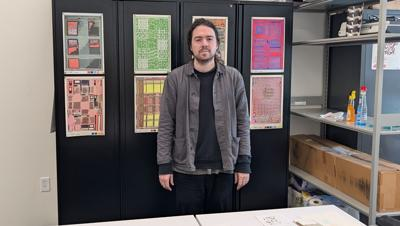
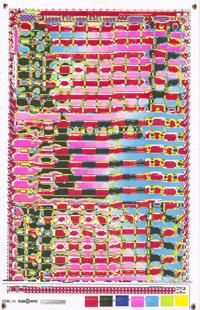
Travess Smalley spent his summer producing his Pixel Rugs as risograph prints.
“They said don’t worry about it. You’ll be moving soon.”
Until last month, the art department was working out of temporary space in a chemistry building while the new Fine Arts Center was constructed.
According to a press release from URI, the new $99 million center was funded through state capital and University funds as well as a 2021 voter-approved bond issue. The project included renovation of the Fine Arts Center and a new 71,000-square-foot, three-story academic building that features a theater lobby and art gallery on the first floor, as well as areas for digital art and media, recording studios, and classrooms.
The center houses the university’s art, music, theatre and dance programs. The art professors’ offices are large enough that they can double as creative studios. Some, like Smalley, are still getting set up.
Contemporary Art
The Fine Arts Center also includes two gallery spaces. One features Experimental Fields: Sixty Years of Contemporary Art at URI. Curated by Smalley, the archival exhibition-within-an-exhibition features about a dozen posters promoting exhibits at URI by important New York artists of the 1960s and 70s, ranging from composer Steve Reich, sculptor Lynda Benglis, painter Pat Steir, multidisciplinary artist Edgar Heap of Birds, and conceptual artist Lawrence Weiner.
The posters are surrounded by a larger exhibition of work by current URI faculty.
The long-term plan for the posters is to promote URI’s place as an important site for contemporary art and to encourage student inquiry about the artists who have exhibited there.
Print Media
Smalley teaches Print Media, a field that he says fuses the traditional art of printmaking with the digital advancements of today. He sees the two as intertwined.
“You can program a laser engraver to print wood blocks and then use those wood blocks to make a relief print.” He shows an example of one student’s wood block that was drawn digitally, engraved, and now can be inked and pressed on paper to produce physical prints.
“It’s all about the translation between the processes,” Smalley says.
The building’s Integrated Print Studio features all the necessary tools in the same open room, a layout that may present some practical challenges. “Hopefully the computers don’t all end up covered in ink,” he says.
Digital and manual
In his own art practice, Smalley has been combining the digital with the manual for years. In 2019 he started his Pixel Rugs series, a brightly colored collection of designs that now live both on- and offline.
“A game designer that I follow shared a tutorial about how in indie video games, the designers got pixel art wrong,” he explains. “The thing that stayed with me about this tutorial was how in such a limited grid of space, so much can be accomplished. Even in the early Nintendo era, there was a tremendous range of what you could do with that space and how creative the game developers of the time were.”
“The other thing I learned: I thought there was a specialized pixel art software that developers had, but I learned they were all using Photoshop, which is a tool I’ve been using my whole life.”
“If you take one simple pattern and overlay it with another, the way those colors mix will change it. You can very quickly have an uncountable number of possibilities.” Not content with the grids as they were, he began warping and manipulating them.
This led to Pixel Rugs, which Smalley initially shared daily on Twitter. He still shares occasionally, though Twitter is now X.
History informs art
Throughout history, he says, artists have worked with grids.
“I started from the technical side, but then I learned about the history of the matrix in relationship to weaving on a loom, or with punch cards. I remember coming across a German book from the 1600s or 1700s and it was all looking at a matrix. Ancient mosaics, too. You can keep going back. Grids and pixel art ideas are embedded through history.”
From West Virginia
“I’m from West Virginia,” Smalley adds, “from the mountains, and I grew up with bluegrass music and quilting. Some of my earliest visual experiences are around these gridded quilts that were in my family going back to the 1800s.”
“And then I learned about Frances Louisa Goodrich and her archival work. She was from the northeast, but she did her research on Appalachian textiles, going down and recording the different quilt patterns that women had made.”
“Her recordings will be numbers like ‘1-2, 1-2-3. 1-2, 1-2-3.’ It reads like a computer script.”
“Meanwhile, I’m in the present writing scripts to make these rugs on a computer.”
The bright, almost garish colors used in the rugs are hard to miss, but Smalley’s inspiration is perhaps unexpected.
“My interest in color and texture goes back to my favorite t-shirt from when I was a child. It was one of those Ocean Pacific or Body Glove shirts from the early nineties, those surf shirts with deep purples and neon greens. Somehow that palette imprinted itself on me in a way that still gives me goosebumps.”
“Of course, It’s not just about one color,” he adds. “It’s about when the neon green, the black and purple come together.”
Recognition
Smalley was one of 43 individual artists to receive a Make Art Grant this year from the Rhode Island State Council on the Arts (RISCA), the state office that supports artists and art organizations. Artists apply in late winter and are notified whether they were accepted in June. Smalley received $3,500 for his project.
Smalley has been producing risographs, a popular print process where images are printed one or two colors at a time through a machine that looks like a photocopier. The upside is that the colors can be very vibrant. The downside is that the machines aren’t very big.
“I asked for money to experiment at a small scale with these and then work with a screen printing studio in Providence to make larger screenprints. That’s the goal. It feels like a natural next step for the project.”
German publisher Vetro Editions recently published Pixel Rugs, a monograph of Smalley’s work. Produced in a very limited edition, the book is printed with an ink that reacts under ultraviolet light.
Rugs on exhibit
There are also now pixel rugs that can function as regular household rugs. He was approached by Samira Gagné Ludwin, who owns the specialty rug atelier Maman and produced the rugs as six foot and eight foot squares.
One of his rugs is currently in an exhibition at the Paris gallery ArtVerse. The group exhibition is called Ghost in the Thread and it’s specifically about glitch and textiles. Another rug was featured last year in a design feature in Architectural Digest.
Smalley is particularly interested in how colors translate. White wool is a very different color than the white on a computer screen, he says.
“It’s nice to have something in wool,” he says. “You can just spill coffee on it and clean it up. You can’t spill coffee on your computer. This rug will last longer than my hard drive.”
“Potentially I’ll be making more rugs in the coming year,” Smalley says. “I have an idea in my mind that it’s doable, but diesel is at record highs and I can’t imagine the impact that’s going to have on things. I’ll hopefully be making a few more, assuming everything doesn’t double in cost in the next six months.”