Legendary Light Keeper of Lime Rock
By MATTHEW LAWRENCE, Beacon Media Contributing Writer
Oct 14, 2026
This story was originally published in the Warwick Beacon, a publication partner of Ocean State Stories.
Read this story in its original form and all other Beacon stories by clicking here.
NEWPORT — If you haven’t spent much time in Newport, then the name Ida Lewis may not ring a bell. As a young woman in the late 1860s, though, this lifesaving heroine was a national celebrity.
Brian Wallin is a citizen historian who became something of an expert on Lewis, a lighthouse keeper who rescued at least 18 people during her decades of time as keeper of Lime Rock Light, a small outcrop of rocks in Newport Harbor. On October 24, the anniversary of her death, he will give a talk about Lewis at the Steamship Historical Society of America’s Ship History Center.
Wallin studied history in college, became a television news reporter, then moved on to health care administration, retiring as a Vice President from Kent Hospital in 2009. Now he is a Trustee of the Varnum Continentals historic militia in East Greenwich, teaches at URI’s Osher Lifelong Learning Institute, volunteers as a docent at the Naval War College Museum in Newport, and gives talks around the state about Rhode Island history, his first love.
“I narrate the Rhode Island Fast Ferry Bay and Lighthouse Cruises,” Wallin says. That’s how he first became interested in Ida Lewis Lighthouse in Newport.
“Rhode Island has over 400 miles of coastline and about 160 days a year of reduced visibility,” he says. “It’s subject to frequent storms, freezing, and all sorts of hazards to navigation.”
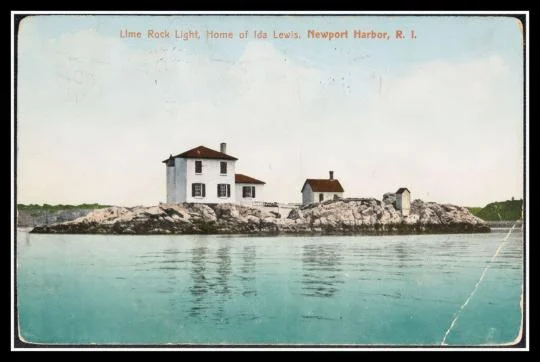
“Now you wouldn’t think it, but Newport Harbor really is a dangerous area of water,” he adds. “The north end is shallow and rocky, and the south end was subject to a lot of accidents caused by a hazard to navigation called Lime Rock, which is roughly opposite the southern end of Goat Island.”
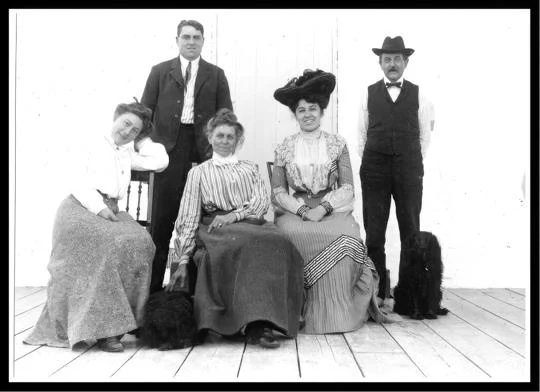
Ida, center petting her dog, her brother Rudolph behind her, and brother Tom with two unidentified women. Submitted photo courtesy of the Providence Public Library
According to Wallin, in 1852 the federal government erected “a little wooden lighthouse that was only 20 feet tall.” Lighthouses at the time were lit with smoky oil lamps, light from which was amplified by glass prism lenses invented in the 1820s by August Fresnel.
The first keeper of Lime Rock Light was Hosea Lewis, who lived in Newport with his wife and four children.
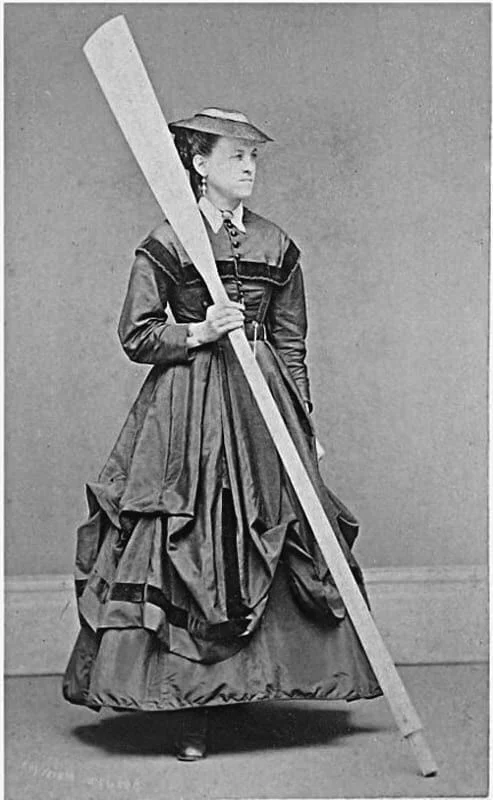
“Hosea would row out from the shore to the light with his daughter Ida, and young Ida became an accomplished oarswoman and swimmer,” Wallin says. He explains these were very unusual activities for girls at the time.
In 1856, the federal government built a six-room light station on the rock for Lewis and his family to live in.
“Shortly thereafter,” Wallin says, “he had a stroke that made him an invalid for the rest of his life.”
Hosea’s wife, also named Ida, took over, but it was hard for her with a family to raise and a disabled husband to care for.
“At 14, Ida [the daughter] rows her brothers to school in the morning, comes back, takes care of her father, and takes over operating the light.”
Tasks included preparing the lanterns to work all night, polishing lenses, and cleaning the soot that constantly accumulated from the smoky oil lamps.
“The light would rotate on a bed of mercury that turned by a clockwork mechanism that had to be wound every so many hours,” Wallin explains.
It was tedious and frequently very isolating work.
Wallin says that Lewis slept in the room closest to the light.
“I do that so I can hear the light calling to me,” Lewis is reported to have said, according to Wallin.
The harbor is foggy, rainy, and stormy, particularly in the winter. One snowy March night in 1869, Lewis rescued Sergeant James Adams and Private John McLaughlin from the cold water.
“They were stationed at Fort Adams and went into town to do what soldiers do. This happened regularly, and every so often they’d try to sneak back by walking over the ice or rowing in a boat.”
“Ida was very quiet—shy, retiring, barely five feet tall and only a hundred pounds—and it became a sensation that she lifted these two men into her boat.”
Wallin says the story exposed Lewis to a great deal of press scrutiny, making national headlines and even drawing the attention of President Ulysses S. Grant and Vice President Schuyler Colfax.
The year of the rescue, Lewis’s father documented over 9.000 people visiting the lighthouse, rowing out to Lime Rock or being rowed out by Lewis herself.
“I’d get wet up to my armpits to meet Ida Lewis,” Grant reportedly said upon realizing that Lewis didn’t live on the mainland.
After the rescue, she married a sailor and spent two unhappy years in Black Rock, a suburb of Bridgeport, CT. The two never divorced, nor did the marriage produce any children.
“The light is my child,” Lewis is reported to have said.
Lewis went on to save more people over the years. Officially, she rescued eighteen, but people believe she saved more. She was just too shy to talk about it.
Despite the publicity, light keepers were paid very poor salaries for work that was very isolating and often very tedious. When Lewis was finally officially named to her father’s former position, she was the highest paid light keeper in the country at the time. She made $750 a year.
“Being a lady light keeper was not an uncommon role,” Wallin says, noting that widows frequently took over the position when their husbands died. “There are at least 200 women of record that served as light keepers,” he adds.
Later in life, Lewis worried about the future of the light. “Washington started closing in on her with all kinds of red tape and paperwork,” Wallin says. “She started getting more and more upset.”
One October day in 1911, she extinguished the light, went downstairs, and had a cerebral hemorrhage. She died two days later at the age of 69.
After her death, the state changed the name of the land from Lime Rock to Ida Lewis Rock. The Lighthouse Service, the federal agency that oversaw lighthouses at the time, initially opted not to rename the light after Lewis because it had never named one after a person before. In 1924, they relented, but shortly afterwards Lewis’s worst nightmare came true, Wallin says, and the light was decommissioned.
The house was put up for auction and bought by a group of Newporters led by Arthur Curtiss James, who became First Commodore of the Ida Lewis Yacht Club, Wallin says. The club still exists today.
Wallin says that Rhode Island’s lighthouses represent a great example of our state’s unique history.
“We are awash in history and Ida is a perfect example of that,” he says.
The Steamship Historical Society of America was founded in 1935 by amateur and professional historians, according to its website. Today the society holds more than 100 collections as well as a maritime reference library. The society’s collections include model ships, photographs, artifacts, ephemera, and memorabilia.
“They have an outstanding collection of memorabilia,” Wallin says. “It’s the premiere national – almost international – authority on the history of steam powered vessels,” he adds. “And it’s in Warwick.”
The Society’s Ship History Center is located at 2500 Post Road in Warwick, just south of the airport. It is normally open by appointment to the public.
Two more Speaker Series events follow Wallin’s discussion of Ida Lewis, both happening virtually on Zoom. On November 7, Marvin Barrash will discuss the loss of the USS Cyclops in the Bermuda Triangle in 1918, and on November 21, Laurie Gwen Shapiro will discuss her book The Stowaway, which follows one young man’s “journey from scrappy teen stowaway in the jazz age to a seasoned captain aboard a liberty ship in the Merchant Marines,” according to the SHHSA website.